

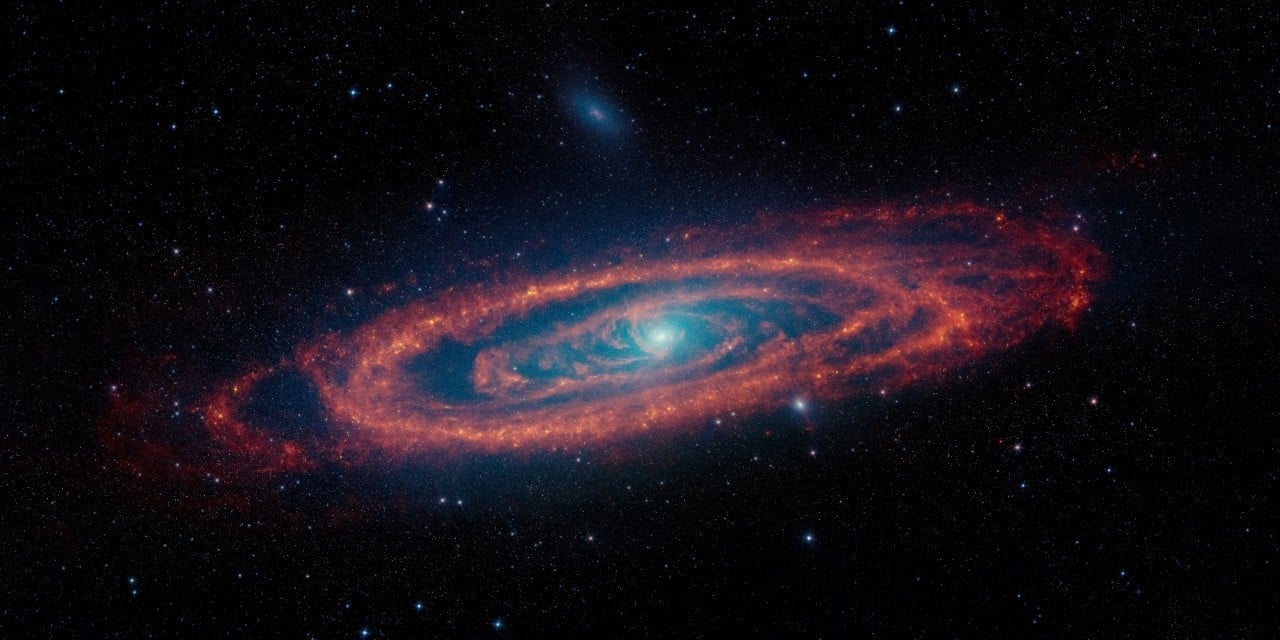
Astronomers have just uncovered a crucial mechanism that explains the existence of complex cosmic structures much earlier than traditional theoretical models predicted. Deep Observações performed with Telescópio Espacial James Webb revealed massive elliptical galaxies that already showed signs of chemical and structural maturity just 500 million years after Big Bang. The discovery changes perceptions about the chronology of the young universe, suggesting that the local environment plays a much more determining role in galactic evolution than the simple passage of time.
Analysis indicates that these galaxies did not form in isolation, but rather within protoclusters, regions of extreme density that function as high-pressure stellar incubators. Diferente of the rarest areas of the cosmos, where star formation occurs slowly and gradually, these primitive clusters concentrate immense amounts of gas and dark matter. Essa configuration creates an intense gravitational field that drastically accelerates the collapse of gas clouds, precipitating star birth at a frantic pace.

The observed phenomenon solves one of the great mysteries brought about by the first images of James Webb, which showed apparently “old” celestial bodies in a newborn universe. The key to this apparent contradiction lies in the efficiency of processes within these dense environments. The constant interaction between galactic components in these locations allows evolutionary steps, which would normally take billions of years in isolated environments, to be compressed into a few hundred million years.
Influence of density on stellar chemistry
The chemical composition of these ancient galaxies surprised scientists due to their abundance of heavy elements, or metals, which theoretically require multiple generations of stars to be synthesized. Nos protoclusters, the rate of star formation is so high that the life cycle of massive stars occurs at breakneck speed. Essas stars burn their fuel quickly and explode as supernovae, dispersing metals throughout the interstellar medium and enriching the gas that will form the next generation of stars.
This accelerated chemical recycling process gives galaxies a spectral signature of maturity very early in their history. Enquanto galaxies in less dense environments would still be forming their first populations of metal-poor stars, those located in the “urban centers” of the early universe had already reached a stage of chemical complexity comparable to that of much older galaxies. Isso demonstrates that cosmic location is a determining factor in the development of stellar systems.
Gravitational dynamics and morphological stability
In addition to chemistry, the morphology of these galaxies also defies previous expectations. The presence of organized elliptical shapes and structures like star bars suggests that the physical dynamics in these environments are intense. Dark matter acts as a gravitational anchor, holding the cluster together and facilitating frequent mergers between smaller galaxies. Essas collisions, far from destroying structures, end up quickly stabilizing them, transforming chaotic spirals into robust ellipticals.
Advanced computational simulations, used to corroborate observational data, show that dark matter halos are essential in this process. Eles funnel cold gas into galactic centers, fueling supermassive black holes and sustaining accelerated growth. The existence of stellar bars so early in the history of the universe indicates that the internal regulatory processes of galaxies were already fully active, shaping the distribution of stars and gas from the inside out.
Technological synergy and data validation
Confirming these findings required a multi-instrument approach, combining the infrared sensitivity of James Webb with the radio detection capability of the ALMA observatory. Enquanto the space telescope can penetrate layers of dust to observe the light of ancient stars, radio telescopes map the available reservoirs of cold gas. Essa complementary vision allowed researchers to reconstruct evolutionary history with unprecedented precision, validating the hypothesis that the early universe was heterogeneous and filled with pockets of intense activity.
The main factors identified for this rapid evolution include:
– Environmental Aceleração: High local density forces interactions that accelerate the galactic life cycle.
– Enriquecimento early: Explosões frequent supernovae saturate the environment with heavy metals quickly.
– Constructive Fusões: Colisões constants in protoclusters lead to the formation of stable elliptical structures.
– Papel of dark matter: massive Halos guarantee the cohesion necessary to keep the cosmic “cauldron” active.
This evidence does not contradict the Big Bang theory, but it significantly refines the models of hierarchical formation. Understanding that galaxies can mature at different rates depending on their cosmic neighborhood opens up new perspectives for studying the architecture of the universe. Continued observations should reveal more of these clusters, helping to map how today’s large structures began their journey amid primordial chaos.



