
Passage by the Sun activates the nucleus of comet 3I/ATLAS and releases a cloud of complex organic gases

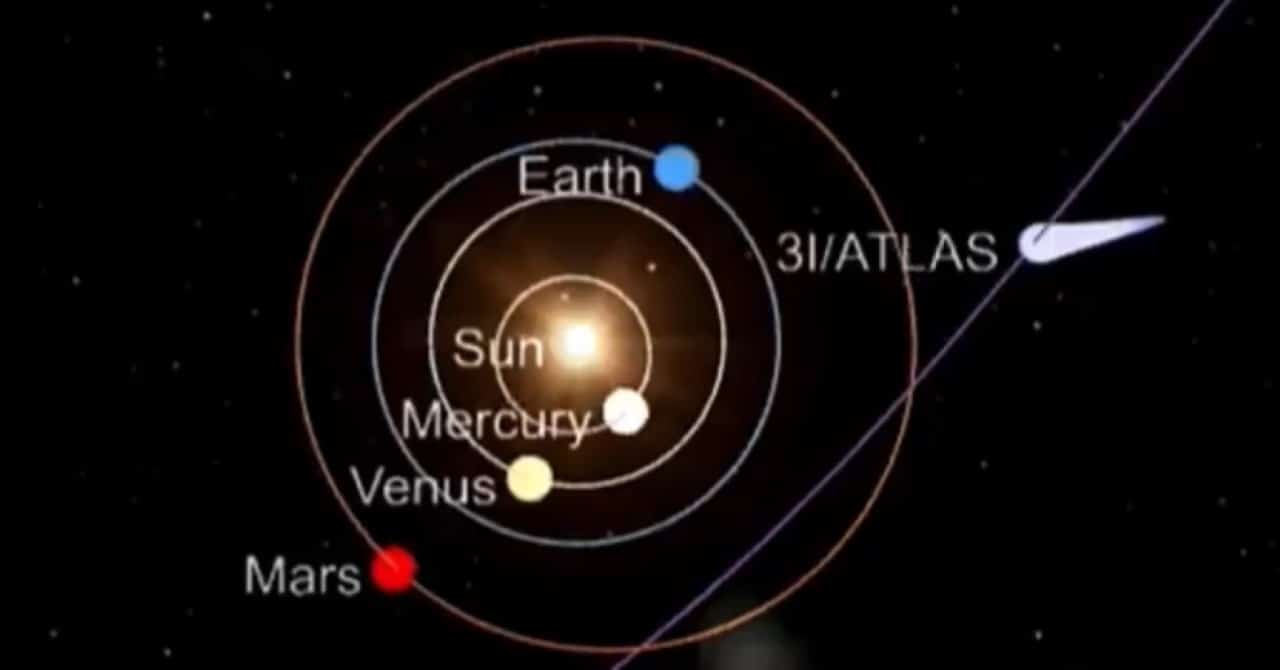
Recent data from the SPHEREx space mission reveals a dramatic transformation in the third interstellar object confirmed by science. Após reaches its closest approach to Sol at the end of October 2025, the celestial body known as 3I/ATLAS presented an abrupt intensification in its activity. Continuous monitoring indicated that, starting in November, the release of volatile materials and dust increased dramatically, suggesting that solar heat penetrated the surface layers and reached deep ice reservoirs.
The detailed analysis of emissions points to a twenty-fold increase in the amount of water vapor expelled in relation to the levels observed in August of the previous year. Esse behavior marks a significant transition in the object’s dynamics, which went from a state of relative dormancy to a phase of vigorous sublimation. The flow of carbon monoxide accompanied this exponential growth, highlighting the chemical complexity hidden in the core of the interstellar visitor.

Images captured by Telescópio Óptico Nórdico in mid-November documented visible physical changes in the structure of the coma. Enquanto gaseous emissions maintained a symmetrical distribution, the dust cloud around the nucleus assumed an asymmetrical shape, similar to a pear, indicating the direct influence of solar radiation pressure on the released particles.
Orbital tracking and characteristics
The ATLAS warning system first detected the object in July 2025, immediately classifying it as a body of origin external to our planetary system due to its extreme speed. Viajando at more than 57 km/s, the comet follows a hyperbolic trajectory that guarantees its single passage and subsequent definitive exit into deep space. The absence of a gravitational link with Sol allowed astronomers from several observatories to prepare observation campaigns focused on perihelion.
The gradual approach to the inner Sistema Solar generated a progressive thermal wave on the comet’s surface. Esse heating was the necessary trigger to activate physical processes that remained stagnant during the long journey through the interstellar medium. The phenomenon observed in October 2025 served as a natural laboratory for understanding the thermal resistance of objects formed in other stellar systems.
Chemical composition and organic elements
Spectrometers attached to the observation instruments identified a rich variety of compounds being ejected into space. Além of water and carbon monoxide, the spectral signature revealed the presence of complex organic molecules, which were released as soon as the surface ice barrier was disrupted by heat.
- Cyanide:Detectado in strong emissions shortly after perihelion, indicating high volatility.
- Methanol:Encontrado in proportions that defy previous models of formation in cold environments.
- Formaldehyde:Liberado together with other gases, suggesting thermal processing in the nucleus.
- Methane and Etano:Indicadores of sublimation of internal layers preserved since the formation of the object.
The detection of these elements provides crucial clues about the primordial conditions of the stellar system where 3I/ATLAS originated. The mixing of ices and organics suggests universal chemical processes in the formation of smaller bodies, regardless of the host star.
Evolution of dust structure
The change in dust cloud morphology reflects the dynamic interaction between the ejecta and the solar environment. The orientation of the dust tail, facing Sol at its narrowest part, demonstrates how particles of different sizes react to sunlight. Análises of reflectance shows that the exposed material is dark and has a low albedo, characteristic of surfaces rich in amorphous carbon and olivine.
The scattering of bluish light observed in the particles indicates that the comet has lost its original coating, exposing a geologically diverse interior. Essa thermal “flaking” allowed scientists to observe, for the first time in this object, the transition from an ice-dominated domain to a dust-dominated one, permanently altering the appearance of the celestial body.
Parallels with previous visitors
The behavior of 3I/ATLAS offers an interesting contrast to its interstellar predecessors. Diferente from 1I/’Oumuamua, which passed through Sistema Solar with minimal cometary activity and generated debate about its nature, and from 2I/Borisov, which behaved like a typical comet from the beginning, the new visitor showed a late and explosive activation.
The chemical ratios between carbon dioxide, carbon monoxide and water, observed in January 2026, surprisingly aligned with local comet patterns in our own system. Essa unexpected similarity raises questions about the homogeneity of planet formation processes in the galaxy, suggesting that the building blocks of life and planets may be more common than previously imagined.
Luís Henrique Costa é jornalista formado pela FMU, editor-chefe e fundador do Mix Vale, portal de notícias em atividade desde 2013. Responde pela direção editorial do veículo, que cobre Brasil e mundo em economia, benefícios sociais, esportes, tecnologia, ciência e entretenimento. Atua na área há mais de 15 anos e lidera uma equipe de cerca de 15 colaboradores.



