


The North American space agency released, this Tuesday, a detailed analysis of the dynamic behavior of the celestial body identified as 3I/ATLAS. The official report points to discoveries that challenge conventional astrophysics models, specifically regarding the object’s non-gravitational acceleration. Diferente than expected for common comets and asteroids, this interstellar visitor presents a movement that cannot be explained solely by the attraction of Sol or the planets of the solar system.
Observations made by Laboratório from Propulsão to Jato (JPL) from Nasa indicate that the object is being pushed in a sideways direction with surprising intensity. Scientists have identified that the transverse acceleration component is five times greater than the radial acceleration, which normally pushes bodies away from the Sol due to the sublimation of gases. Essa anomaly suggests complex internal physical processes that differ from standard outgassing behavior observed on other celestial bodies.
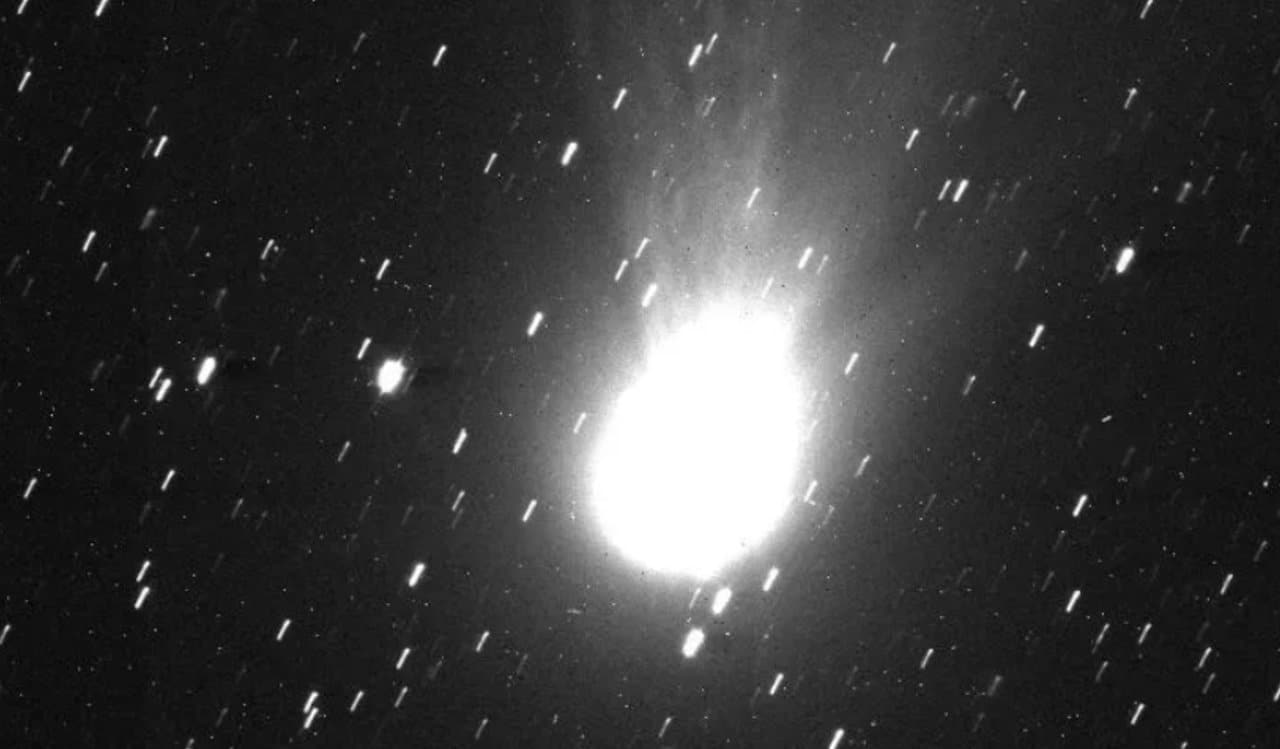
To refine the orbital data, the team used high-resolution images captured by Telescópio Espacial Hubble. The combination of these new visualizations with existing mathematical models made it possible to isolate the forces acting on 3I/ATLAS. The study confirms that the object is not only following a ballistic trajectory influenced by gravity, but has its own natural propulsion system that alters its route as it crosses the solar system.
The phenomenon of non-gravitational acceleration is generally attributed to the release of jets of gas and dust when an icy body approaches a star. However, the magnitude and direction of the forces observed in this specific case forced researchers to reconsider the physical structure and composition of the object’s core. The analysis suggests that the mass distribution and gas emission sites on the surface are highly irregular or exotically organized.
Orbital dynamics and recent observations
During the closest pass of Sol, which occurred in August 2026, the behavior of 3I/ATLAS was intensively monitored. The measurements indicate that the object’s surface activity generated a significant deviation from its predicted orbit. Unlike most comets, where the reaction force of the jets points directly against the Sol, in this case the resulting force acts perpendicular to the solar line of sight.
The precision of the data obtained allowed astronomers to calculate the exact deviation caused by these non-gravitational forces. Estima It is assumed that the position of the nucleus has been displaced by around 2.6 kilometers in relation to the purely gravitational trajectory. Embora may seem like a small distance on astronomical scales, this deviation is fundamental to understanding the flight mechanics of objects that originated outside our planetary system.
Calculations indicate that the orientation of the object’s rotation axis plays a crucial role in these dynamics. Observations suggest that:
- The celestial body’s rotation period is approximately 7.1 hours, maintaining regular stability during the observation period.
- The axis of rotation is inclined by less than 20 degrees in relation to the direction of Sol, which exposes one of the poles to solar radiation continuously.
- The configuration of the gas jets is not random, presenting a geometric pattern that favors lateral movement to the detriment of radial movement.
Symmetrical structure of the jets
One of the most intriguing aspects revealed by the study is the arrangement of emission sources on the object’s surface. Computational modeling, based on removing the diffuse glow of the coma (the gas cloud around the nucleus), made it possible to identify the existence of three distinct “mini-jets.” Essas structures are not randomly distributed, but rather spaced symmetrically by 120 degrees around the body of the object.
This particular three-pronged configuration is highly unusual in the chaotic nature of comets. The symmetry suggests that the thermal properties and volatile composition of the surface are uniform in specific regions, allowing sublimation to occur in a coordinated manner. The combined force of these jets creates a torque and lateral thrust that result in the anomalous transverse acceleration detected by the Nasa’s sensors.
The existence of these symmetrical jets raises questions about the object’s formation in its home star system. The preservation of such a structure after an interstellar journey indicates that the material that makes up 3I/ATLAS has a particular cohesion and thermal resistance. Continued analysis of these jets could provide clues about the processes of space erosion and the longevity of smaller bodies traveling between stars.
Physical interpretation of forces
The scientific community divides the forces that act on the object into three main components to facilitate analysis: radial (A1), transverse (A2) and normal (A3). In the case of 3I/ATLAS, the radial and normal components behave within the limits expected for an object of this class. The consistency of these data validates the standard thermal sublimation models currently used in astrophysics.
However, the transversal component (A2) presents values that deviate from the rule. The correlation between the selection of specific data and the orbital parameters demonstrated that this lateral force is the dominant force responsible for the changes in the trajectory. Isso implies that the object functions, in a way, like a ship with side thrusters activated, altering its course autonomously in response to solar heating.
The magnitude of this acceleration, although decisive for the orbit, is physically subtle. The effect accumulated over months results in a change in position that is equivalent to a tiny fraction of the distance between Terra and Sol. Ainda Thus, the detection and precise quantification of this force demonstrates the sensitivity of current instruments and the ability to model complex physical interactions over vast distances.
Perspectives for modern astronomy
The 3I/ATLAS study opens a new phase in the understanding of interstellar objects. Confirming that such bodies can have their own acceleration dynamics, independent of gravity, adds a layer of complexity to the prediction of their orbits. Isso is vital for planetary defense and planning future interception missions.
The research reinforces the need for continuous, high-precision monitoring. As new telescopes and tracking technologies come into operation, it is expected that more objects with similar characteristics will be discovered. Cada new interstellar visitor offers a direct sample of the matter and physical conditions of other star systems, functioning as natural probes that traverse the galaxy.
The data collected on the rotation, inclination and gas emission of 3I/ATLAS will serve as a basis for refining theoretical models on the formation and evolution of comets and asteroids. The symmetric jet anomaly, in particular, will remain a focus of study for physicists and astronomers, seeking to understand how nature can produce such precise configurations in such hostile environments.



