

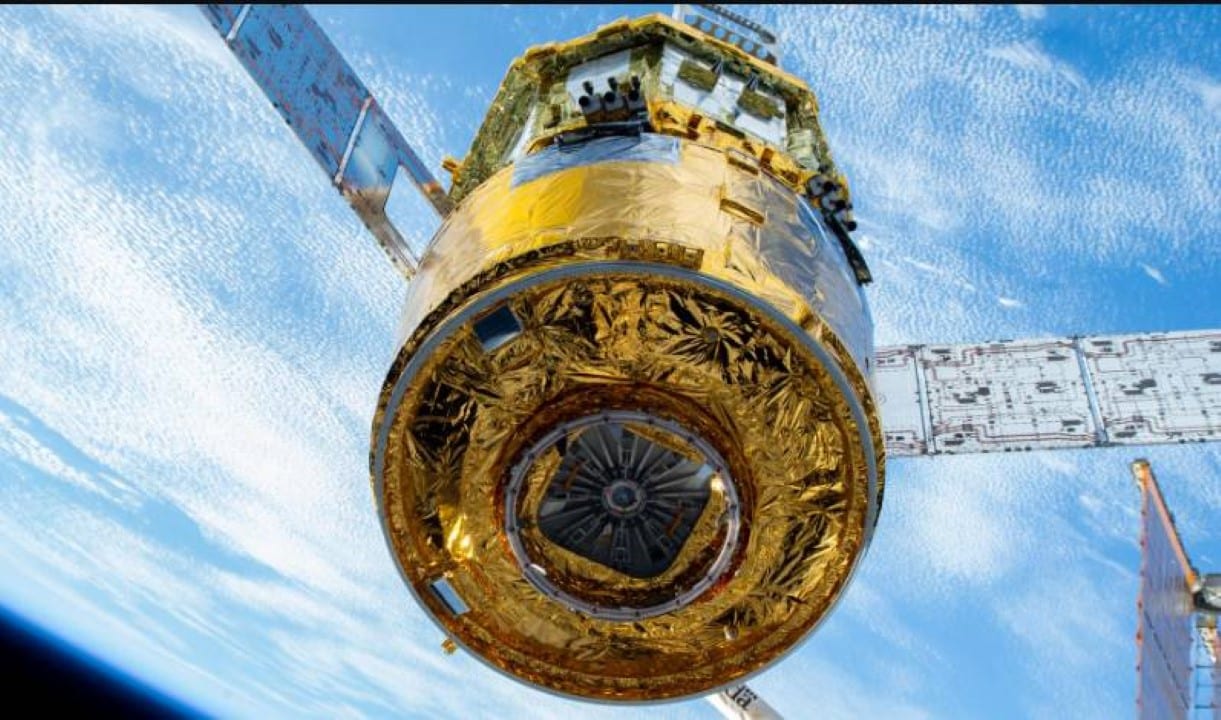
This Friday (6), Estação Espacial Internacional carried out the release of the HTV-X1 cargo spacecraft, from the Japanese agency JAXA (Japan Aerospace Exploration Agency). Canadarm2, the station’s Canadian robotic arm, released the spacecraft at 12 pm (Estados Unidos Eastern Time), at which time the ISS was flying over the Pacífico ocean at about 260 miles altitude. The operation concludes HTV-X1’s stay in the orbital structure, which lasted more than four months since its arrival.
The spacecraft arrived at the ISS on October 29, 2025, after launching on October 25 from Centro Espacial of Tanegashima, on Japão, with an H3 rocket. Canadarm2 captured and installed HTV-X1 in the Terra-facing port of the Harmony module. During its stay, the spacecraft delivered essential supplies, including more than 9,000 pounds (about 4,080 kg) of cargo such as food, scientific investigations, commercial products, hardware and other items to NASA and international partners.
The release occurred in a controlled manner by operators on the ground, who commanded Canadarm2 to uninstall the ship from the Harmony module the day before and position it for final release. NASA astronaut Chris Williams monitored HTV-X1’s systems during the departure process.
Uninstallation operation and pretests
Flight controllers commanded Canadarm2 on Thursday (5) to remove HTV-X1 from the Harmony module port. The craft was moved to a temporary parking position for the night.
Japanese controllers performed a laser range sensor test demonstration while the spacecraft remained secured on the robotic arm. Esses procedures ensured complete preparation for safe release.
The operation avoided any risk to the station and the crew of Expedição 74.
HTV-X1 Mission Details and Capabilities
The HTV-X1 represents the first mission of the new generation of Japanese freighters, with improvements over previous versions of the HTV series. The spacecraft carried pressurized and unpressurized cargo essential to maintaining scientific and life support operations on the ISS.
After the initial delivery, the crew transferred expendable items to the HTV-X1, preparing it for the final phase of the mission. The spacecraft remains capable of autonomous maneuvers after release.
Post-release phase and on-orbit experiments
After release by Canadarm2, HTV-X1 remains in orbit at a safe distance from the station for about three months. Durante this period, the spacecraft serves as a platform for experiments remotely controlled by JAXA.
Tests include demonstrations of technologies such as advanced antennas, solar cells and the possibility of releasing CubeSats for independent missions. Esses experiments contribute to advances in future space exploration missions.
The spacecraft will conduct scientific activities without interfering with ISS operations.
Live coverage and crew participation
NASA broadcast the release live starting at 11:45 a.m. (Estados Unidos Eastern Time) through official channels, allowing real-time monitoring of the maneuver. Coverage captured images of the spacecraft moving away with Terra in the background.
Astronauts on board monitored HTV-X1’s systems to ensure there were no anomalies during departure. Expedição 74 continues with preparations for other activities, including spacewalks and biological research.
Importance of international collaboration on the ISS
The HTV-X1 mission highlights the partnership between JAXA, NASA and Agência Espacial Canadense (CSA), responsible for Canadarm2. The robotic arm, essential for docking and release operations, demonstrates precision in complex tasks in the orbital environment.
These collaborations ensure the station’s continued supply and progress in research that benefits science on Terra and future explorations. HTV-X1 fulfilled its role in supporting the maintenance of a continuous human presence in space.
The spacecraft successfully completed its contribution to orbital logistics before proceeding to the extended experiment phase.



