

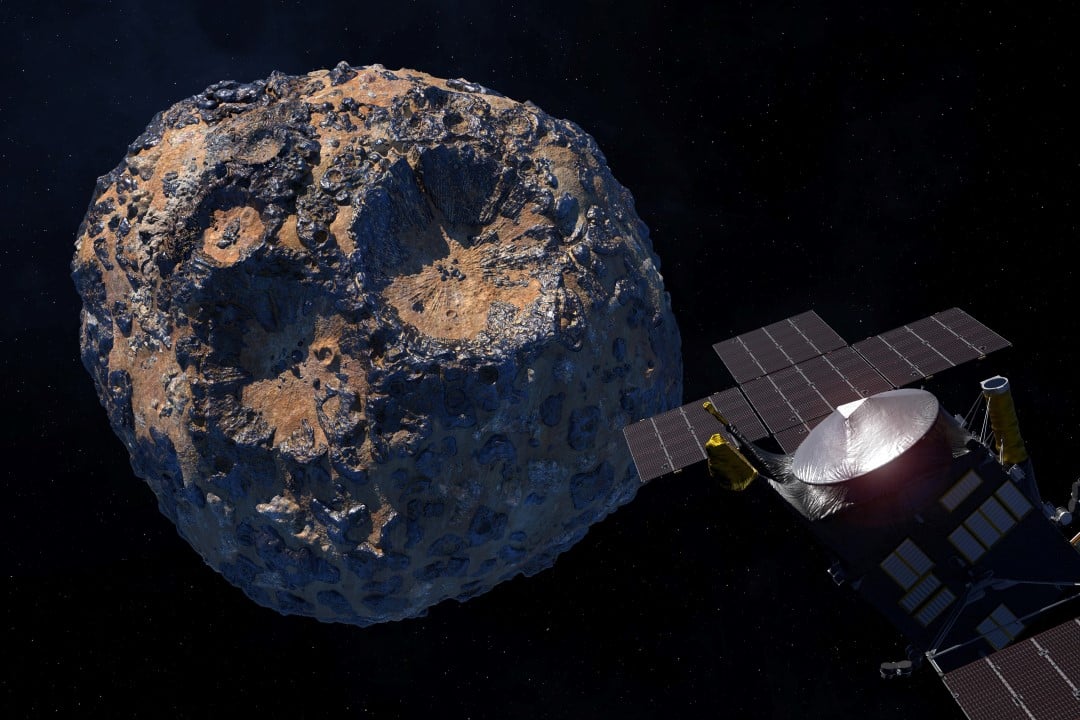
NASA’s DART probe intentionally collided with asteroid Dimorphos in September 2022, as part of the Double Asteroid Redirection Test mission. The impact altered Dimorphos’s orbit around the larger asteroid Didymos in about 32 minutes. Novos data confirms that the collision also modified the trajectory of the entire binary system around Sol, marking the first time that human intervention has measurably altered the path of a solar-orbiting celestial body.
The change in the heliocentric orbit was small, with a 0.15 second reduction in the pair’s 770-day orbital period. The binary system now travels about 720 meters less distance each time it turns around Sol. Observações of ground-based telescopes and planetary radars between October 2022 and March 2025 made it possible to measure this variation precisely.
The kinetic impact technique demonstrated efficacy beyond expectations. The massive ejection of debris from Dimorphos contributed to the deflection, doubling the effect of the probe’s direct impact. Essa cloud of rocky material propelled the system in the opposite direction of the impact.
Details of impact and material ejection
The collision occurred at approximately 22,500 km/h. Dimorphos, about 170 meters in diameter, has lost enough material to change its shape and mass. The larger asteroid Didymos, measuring 805 meters, suffered indirect gravitational influence due to the retreat of the smaller satellite.
Previous studies had already confirmed the shortening of the mutual orbit by 33 minutes. The new analysis focuses on the solar orbital effect, obtained through occultation and radar measurements.
The orbital speed of the system around Sol increased by about 11.7 micrometers per second, equivalent to 1.7 inches per hour. Essa subtle change can accumulate over time and make a difference in risk scenarios.
Observations that confirmed the change
Astronomers used data from observatories like Goldstone and other planetary radars to track the pair’s movement. Medições Precise timing of occultations revealed a 150-millisecond shift in the solar orbital period.
The global network of telescopes contributed continuous observations after the impact. Essas information allowed the adjusted trajectory to be reconstructed with high reliability.
The study, based on 22 measurements carried out over years, reinforces the understanding of the dynamics of the binary system. Pequenas orbital variations have been detected and validated by multiple independent sources.
Implications for planetary defense
The DART mission tested a defense strategy against potentially dangerous asteroids. The Didymos-Dimorphos system poses no threat to Terra, but served as an ideal laboratory to validate the kinetic impact method.
Changing the orbit around Sol is essential to divert objects on a collision course with the planet. The success demonstrates that interventions can adjust heliocentric trajectories in a controlled manner.
The ejection of debris amplified the propulsive effect, showing that “rubble pile” asteroids respond more intensely to the impact. Essa characteristic increases the efficiency of the technique.
Next steps with mission Hera
The Hera spacecraft, from
Hera will map the surface and measure mass with greater precision. Esses data will refine deflection models for future applications to real-hazard asteroids.
The combination of DART results and Hera observations will strengthen planetary monitoring and intervention strategies. Cientistas will continue to analyze the system to better understand the long-term effects.
Contribution of debris ejection to diversion
The cloud of debris expelled during the collision doubled the momentum transfer factor compared to the probe’s isolated impact. Isso occurred because the ejected material left at high speed in the opposite direction to the spacecraft’s movement.
Dimorphos lost less than 0.5% of its total mass, but the effect was significant due to the speed of the fragments. Modelos numerical data confirm that this ejection was mainly responsible for the observed solar orbital change.
These findings highlight the importance of considering the composition and internal structure of asteroids when planning defense missions. Asteroides pores amplify the kinetic shift.
The DART mission represented the first full-scale test of planetary defense. The accumulated results reinforce the feasibility of non-nuclear methods for protecting Terra against future impacts.



