Changes in Earth’s axis cause shorter summers, worrying global researchers
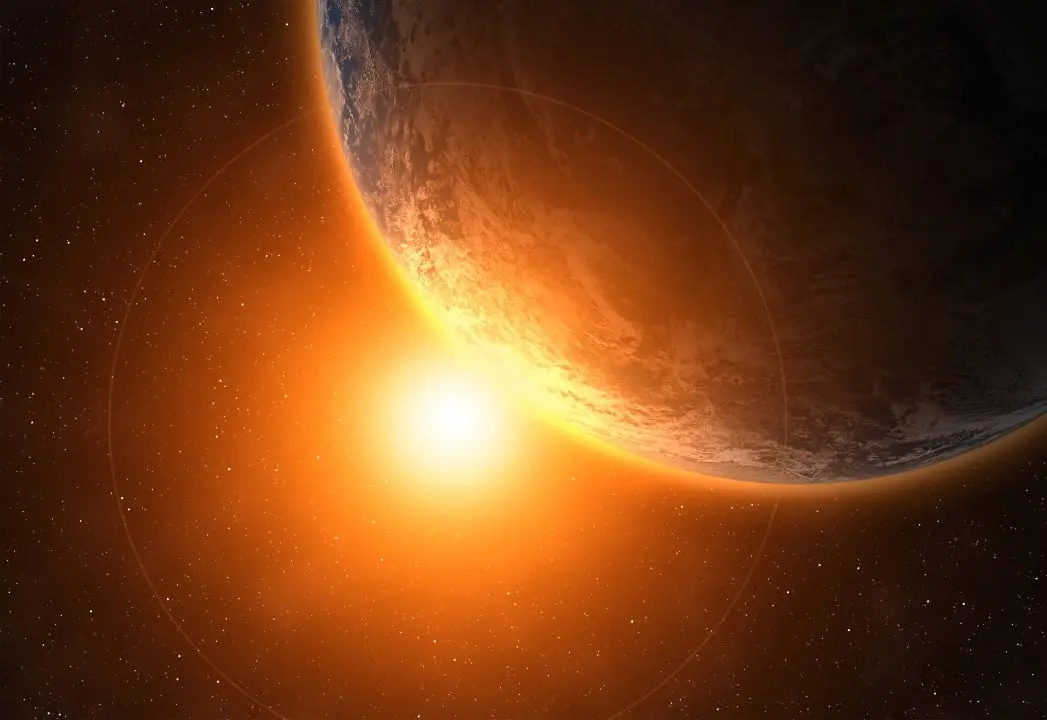
Researchers observe a worrying trend of the summer season shortening each year, a phenomenon attributed mainly to the tilt of the Terra axis and the planet’s orbital dynamics. Essa modification, although subtle and practically imperceptible to daily human perception, has been the subject of analysis by the scientific community, which warns of the cumulative effects over time.
The finding reveals that the summer of 2025, for example, will last approximately 15 minutes less compared to the previous year, lasting 93 days, 15 hours and 37 minutes, compared to the 93 days, 15 hours and 52 minutes of the summer of 2024.
This seasonal variation is not directly linked to climate change or arbitrary seasonal calendars. Pelo on the contrary, it is the result of an intricate combination of astronomical factors, including the tilt of the Earth’s axis of rotation, the elliptical shape of Terra’s orbit around Sol and the gravitational forces that continually influence the planet.
The dynamics of axial tilt and its consequences
The axis of rotation of Terra has an inclination of approximately 23.5 degrees in relation to the plane of its orbit, known as the ecliptic. Essa fundamental tilt is the main driver of the existence of the seasons, as it determines how unevenly sunlight falls on the northern and southern hemispheres throughout the annual cycle.
During the summer period in one of the hemispheres, the corresponding pole tilts towards Sol, resulting in significantly longer days, high temperatures and a greater intensity of sunlight. Contudo, this inclination is not the only element that modulate the exact duration of each season. The speed with which Terra travels its orbit and the geometry of this trajectory play crucial roles.
Elliptical orbit and planetary speed
Terra does not describe a perfect circle around Sol, but rather an elliptical trajectory. Isso means that, at certain points of the year, the planet is closer to Sol — a point known as perihelion — and at other times, further away, at aphelion. Essa variation in distance has direct implications for the orbital speed of Terra.
According to Segunda Lei of Kepler, when a planet is closer to its star (at perihelion), its translation speed increases. Essa acceleration in orbital movement has a direct influence on the duration of the seasons. An increase in the planet’s rotation speed throughout its orbit when it is at perihelion contributes to the seasons becoming slightly shorter, an effect that manifests itself most notably in the summer of each hemisphere.
Implications and scientific monitoring
Despite the seemingly small magnitude of the change – just 15 minutes in a year – the importance lies in its systematic and cumulative nature. Scientists monitor these deviations precisely to better understand complex celestial mechanics and their potential long-term implications. Advanced astronomical observations make it possible to detect and quantify these tiny but significant variations.
The study of these astrophysical phenomena reinforces the understanding that the solar system is a dynamic environment, where gravitational interactions and orbital mechanics are constantly evolving. Cada lost minute of summer, however imperceptible, is a reminder of the delicate cosmic dance that sustains life and weather conditions in Terra.
Continued research into the tilt of the Earth’s axis and the characteristics of the planetary orbit is vital for improving forecast models and for in-depth understanding of the conditions that shape the annual seasons. Isso includes the analysis of how the gravitational attraction of other celestial bodies, such as Lua and other planets, can also exert influences, albeit minimal, on the orbit and axis of Terra.
Leia Também



Understanding the Accuracy of Astronomical Measurements
Technological advances in astronomy allow increasingly precise measurements of orbital parameters and the inclination of the Terra axis. Telescópios Modern space probes and global positioning systems (GPS) contribute to the collection of data that feeds complex computational models. Esses models are capable of simulating planetary movement with surprising accuracy, revealing trends that would go unnoticed by the naked eye.
The ability to detect variations of just a few minutes in the duration of a season demonstrates the sophistication of contemporary science and the dedication of researchers to unraveling the mysteries of the universe. Essa meticulous observation ensures that even the smallest changes in celestial behavior are cataloged and analyzed, providing a more complete picture of Earth’s dynamics.
The role of the precession of the equinoxes
In addition to axial tilt and orbital eccentricity, another astronomical factor that contributes to the complexity of the length of the seasons is the precession of the equinoxes. Este phenomenon is a slow and continuous displacement of the orientation of the rotation axis of Terra in relation to the fixed stars, similar to the wobble of a top. A complete precession cycle takes about 26 thousand years.
Precession influences the point in Earth’s orbit where the equinoxes and solstices occur, changing the date the seasons begin throughout geologic time. Embora its effects are more noticeable on time scales much longer than the duration of a year, it is an intrinsic component of orbital mechanics that, together with other factors, contributes to the small variations observed annually.
This slow but steady process adds an extra layer of complexity to the precise calculation of seasonal durations, requiring scientists to constantly adjust their models to reflect astronomical reality. The interconnection of these diverse celestial phenomena demonstrates the intricate machine that is the solar system and the planet Terra within it.
The long-term implications and human perception
Although the 15-minute decrease in the length of summer is barely noticeable to most people, the implications on geological timescales could be significant. Fenômenos astronomical features such as axis tilt and orbital eccentricity have historically been related to long-term climate cycles such as ice ages.
Human perception of the seasons is often influenced by climatic and cultural factors, which can mask these subtle astronomical changes. However, for scientists, every minute counts in building a comprehensive understanding of the planet’s climate and geological future. Continuous monitoring of these variables is essential for planetary science.
Understanding these celestial cycles goes beyond academic curiosity, as it impacts areas such as agriculture, navigation and even the calibration of weather systems and satellites. Estar Being aware of these small but consistent changes in the length of the seasons is crucial for maintaining scientific accuracy in many practical applications and for the continued exploration of knowledge about our place in the cosmos.