
Leon Kennedy actor suggests production of Capcom’s long-awaited Resident Evil Code Veronica remake
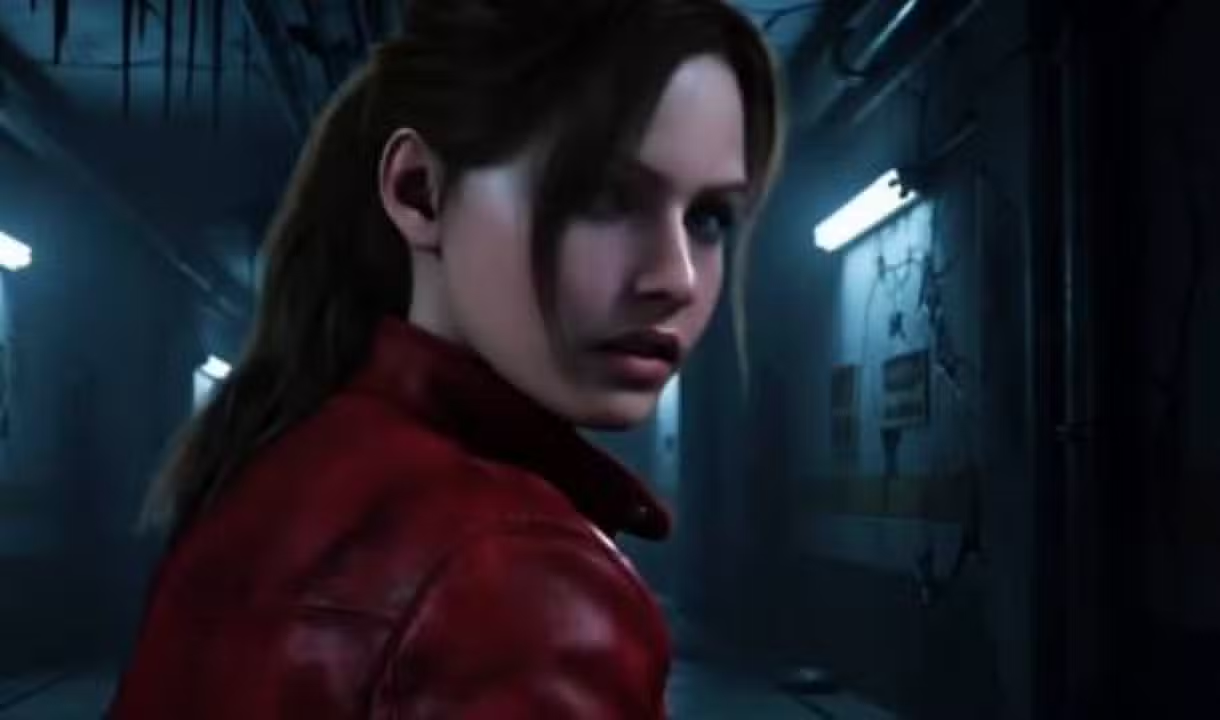
Actor Nick Apostolides, recognized for giving voice and movements to the character Leon S. Kennedy in the most recent versions of the popular survival franchise, published an image wearing a motion capture suit. The post generated immediate movement in the gaming communities, who interpreted the action as a strong indication of the development of a new version of one of the most requested titles by the public. The developer responsible for intellectual property maintains confidentiality regarding projects that have not been officially announced.
The mobilization of fans occurs at a time of high expectations for revitalizations of classic chapters of the series. The title in question, originally released in 2000, occupies a prominent position in the chronology of the narrative, but ended up being left out of the initial sequence of recreations promoted by the company in recent years. The absence of a modern version for this specific work has become a point of constant debate in specialized forums and social networks focused on digital entertainment.
Corporate silence contrasts with the volume of unofficial information circulating behind the scenes in the electronic games industry. Profissionais who follow the sector point out that the strategy of alternating new releases with recreations of past successes has guaranteed financial stability and continuous engagement of the consumer base. The actor’s publication acts as a catalyst for these discussions, reigniting the demand for technological updates to narratives established more than two decades ago.
Evidence points to a new project in the survival franchise
The image shared by the artist shows high-precision equipment used to transfer real facial expressions and body movements to virtual three-dimensional models. Esse type of technology is the current standard for big-budget productions in the gaming market, requiring months of studio work before the programming and level design phase. The enigmatic caption that accompanied the photograph avoided direct mention of character names or trademarks, but the actor’s professional history directed suspicion towards the universe of survival horror.
The engagement generated by the post demonstrates the strength of intellectual property and the effectiveness of indirect, even if unintentional, marketing campaigns. Grupos discussion dedicated to the series began detailed analysis of the image, looking for clues on monitors in the background or in the shape of the suit’s markers. Esse behavior reflects today’s consumer culture, where anticipation and theorizing make up a significant part of the user experience even before the formal announcement of a commercial product.
History and relevance of Claire Redfield’s journey
The original work initially hit the market for the Dreamcast console, presenting a significant visual leap compared to previous games from the first PlayStation era. The transition from pre-rendered scenes to fully polygonal environments allowed the use of dynamic camera movements, changing the way suspense was built during exploration. Essa technical change set new standards for the series’ art direction.
The narrative follows the protagonist Claire Redfield in her continued search for her brother, Chris, after the destructive events that occurred in the city of Raccoon City. Her journey takes her to an isolated prison facility in Ilha Rockfort, controlled by the pharmaceutical corporation responsible for creating biological weapons. The geographic isolation of the location serves as a fundamental element in increasing psychological tension.
During progression, the story introduces new characters, such as the prisoner Steve Burnside, and deepens the mythology of the Ashford family, one of the founders of the antagonist corporation. The development of the plot also marks the return of central figures from the first game, expanding the global conspiracies that drive the franchise’s universe. The T-Veronica virus is presented as the new biological threat, having different characteristics from the previously seen pathogens.
Despite not carrying a number in its official title, the game is classified by the creators and the community as a main and indispensable chapter in the chronology. The events depicted fill crucial narrative gaps between the destruction of the original city and the government missions seen in the series’ fourth and fifth episodes. The absence of a modern recreation leaves a void in understanding the story for new players who have recently joined the franchise.
Technological updates with modern graphics engine
The adoption of the developer’s proprietary graphics engine, used since the seventh numbered chapter of the series, transformed the visual and mechanical identity of recent productions. The tool allows the application of advanced photogrammetry, scanning real objects and textures to create environments with a high degree of photorealism. Volumetric lighting and particle systems are key to establishing the dark atmosphere required by the genre.



An eventual recreation would abandon the original fixed camera system and tank controls, adopting an over-the-shoulder third-person perspective. Essa mechanical modernization brings the gameplay closer to contemporary standards of action and exploration, requiring a complete redesign of the scenario architecture. The prison corridors and facilities in Antártica would need to be rescaled to accommodate the player’s newfound freedom of movement and aiming.
The enemies’ artificial intelligence would also undergo a complete overhaul to maintain the level of challenge. The original opponents, programmed to react to specific camera angles, would be replaced by entities capable of organically chasing the player through the environments. Spatial sound design would complement the experience by providing auditory cues about the location of threats in low-visibility locations.
Industry release schedule and leaks
Information circulating on technology forums and patent registration databases suggests long-term planning for intellectual property. Unofficial Relatórios indicates that the recreation focused on Ilha Rockfort would be positioned to hit the market in the coming years, filling the company’s launch calendar. The development would be taking place in parallel with the production of the new ninth chapter of the main series.
The commercial strategy involves maintaining public interest through annual or biannual releases. The interspersion between new stories and updated versions of classics maximizes financial return and dilutes the risks associated with creating fully experimental mechanics. The sales success of previous recreations validates this business model before the company’s investors.
Expansion of the universe and connection between narratives
The revitalization of this specific chapter offers the opportunity to correct narrative inconsistencies and strengthen connections with the already remade games. The presence of the antagonist Albert Wesker, who gains superhuman abilities at this stage of the story, can be explored in greater depth, setting the stage for his appearances in chronologically later titles. The relationship between Claire and Steve Burnside also has room for a more mature dramatic development, in line with the serious tone adopted by recent productions. Além In addition, the developer has the chance to insert never-before-seen documents, text files and scenarios that explain the transition of the pharmaceutical corporation from a commercial entity to a clandestine bioterrorist organization. Há also the possibility of including direct references to Leon S. Essa narrative cohesion is one of the main attractions for the consumer base dedicated to the series’ mythology.
Other classic titles in line for revitalization
Recreation planning is not just limited to Claire Redfield’s journey. Dados extracted from server logs point to the pre-production of an updated version of the game that chronicles the events prior to the incident at the original mansion. Este title, focused on the Bravo team and the use of two simultaneous protagonists, presents unique design challenges for adapting to modern graphics engines.
The modernization of the entire classic catalog ensures that the franchise remains accessible on current generation hardware. Digital preservation through complete recreations replaces simple emulation, offering products that meet the quality standards required by the current interactive entertainment market.
Commercial expectations and reception of the target audience
The sales history of the modernized versions establishes a high level of financial expectations for any new announcement. Combining nostalgia with cutting-edge technology has proven to be a highly profitable formula, capable of attracting both veterans and a new generation of consumers. Official confirmation of the project will dictate the direction of the survival horror game market for the industry’s next fiscal cycles.
Veja Tambem em News (EN)

Research reveals that parents are unaware of how their children use artificial intelligence

Samsung releases new system update with new features for Galaxy Watch 4 users

Digital retail reduces the value of the Galaxy S25 5G smartphone with bank bonuses and device exchange

Amazon’s wireless CarPlay adapter has a 50% discount and high approval ratings from drivers

Zach Cregger’s new Resident Evil ignores games and focuses on an unprecedented story with new characters

Rumor suggests that Nintendo is preparing a special edition of the Switch 2 with a remake of Ocarina of Time

Apple accelerates production of the iPhone 17e and develops new Air model with dual camera system

Epic Games platform releases twelve high-budget games at no permanent cost for PC users

PlayStation 5 Pro price drop accelerates digital retail sales and eliminates global stocks

New Galaxy Watch 9 firmware appears on server and confirms progress in software development

Apple’s commemorative project tests cell phone with 1.1 millimeter edge and curved screen for 2027
