Space agency simulation projects 440-meter interstellar comet collision in Madrid
The North American space agency maintains rigorous protocols for the classification and continuous monitoring of objects close to our planet. Para To enter the official astronomical monitoring list, a celestial body must have a calculated orbit that brings it less than 7.5 million kilometers from Earth’s orbit and have a physical diameter greater than 150 meters, dimensions that require attention from planetary defense systems.
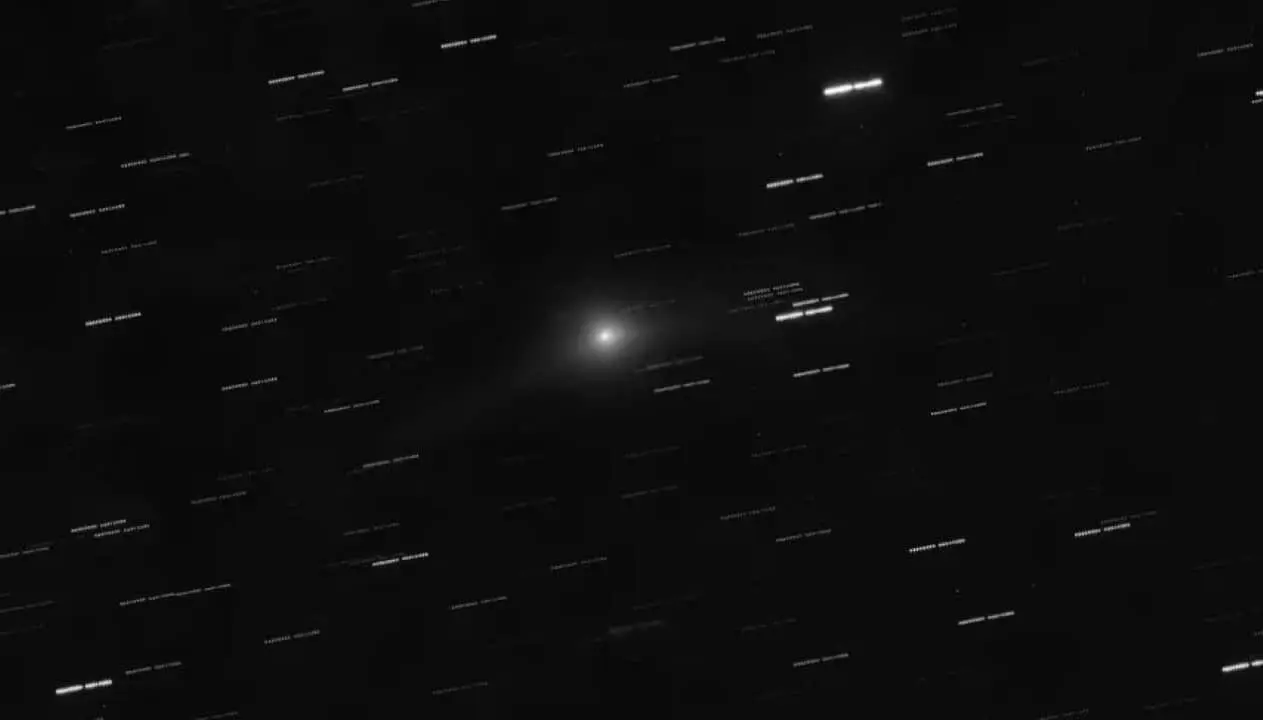
The celestial body cataloged as 3I/ATLAS meets specific criteria that place it in an extremely rare category of space visitors. Trata is the third object of demonstrably interstellar origin already detected by the astronomical observation instruments of Terra, following the widely documented passages of the object Oumuamua and comet 2I/Borisov in previous years.
An advanced digital modeling tool, developed by software engineering experts, allows you to calculate the physical variables of a hypothetical collision of this specific celestial body. The interactive system uses real physical data from the comet, such as mass, speed and entry angle, to project the kinetic, thermal and seismic effects of a direct hit on the Spanish capital.
On the same topic: Interstellar body 3I/ATLAS begins to break apart after reaching 210 million kilometers from the Sun
Discovery at the Chilean observatory and space route
The initial identification of the celestial body occurred on the first day of July, using the scanning telescopes of the asteroid final warning system located in the mountainous region of Río Hurtado, in Chile. Automated equipment recorded the light anomaly, and astronomers immediately noticed a standard deviation in the object’s trajectory in relation to local asteroids.
The orbit calculated by the observatory’s computers did not present the closed elliptical curvature, characteristic of bodies that orbit our main star. Essa open hyperbolic trajectory confirmed that the comet formed in a distinct planetary system and is just crossing our cosmic neighborhood at high speed.
Due to its extreme acceleration and angle of approach, the object will eventually surpass the limits of our star’s gravitational pull. Após this passage through perihelion, the celestial body will continue its journey in a straight line through deep space and will permanently disappear from the reach of the largest terrestrial and space telescopes.
Analysis of physical structure and gravitational acceleration
Photometric measurements carried out by orbiting space telescopes indicate that the object’s solid core has an estimated minimum diameter of 440 meters. Durante its initial passage through the orbit of the system’s largest planet, long-distance radars recorded a constant speed of 221,000 kilometers per hour.
The acceleration of the celestial body increased significantly as it approached the gravitational well at the center of the system, reaching the mark of 246,000 kilometers per hour. The extreme speed of entry into the system suggests that the origin of the comet dates back to a considerably old star system, with orbital dynamics different from those observed locally.
Period of astronomical alignment and data collection
Between January 19th and 26th, orbital mechanics will provide a rare geometric alignment between the planet, the comet and the central star, creating ideal conditions for collecting high-resolution spectrometric data. Diferente of conventional observations of local comets, which last only a few hours due to Earth’s rotation and solar brightness, this event will maintain a phase angle of less than two degrees for an entire week, during which time the object will be positioned at a distance equivalent to 3.33 times the radius of Earth’s orbit. Especialistas in astrophysics point out that this spatial configuration offers a unique opportunity in recent decades to accurately determine the surface albedo, the structural density of the core and the exact mineralogical composition of an artifact originating outside our heliospheric bubble, allowing us to map chemical elements that formed even before the condensation of our primordial cloud of gas and dust.
More on this story: Interstellar visitor 3I/ATLAS is at risk of disintegration as it approaches the Sun in 2026
Collision projection in the center of the urban network
The physical data entered into the impact simulator establishes the ground zero of the hypothetical fall exactly in square Puerta del Sol, the central and densest point of the urban network of Madri. The kinetic energy accumulated by the comet’s mass traveling at hypersonic speeds would result in an immediate release of mechanical force and extreme thermal radiation.
See Also



Direct contact with the Earth’s crust would instantly excavate a main crater 3.8 kilometers in diameter. The depth of the hole generated by the energy transfer would reach 439 meters, permanently altering the topography, the water table and the geology of the central region of the European metropolis.
Vaporization of soil, foundations and surface structures would occur in fractions of a millisecond, engulfing entire neighborhoods located within the immediate perimeter of the impact. The residential and commercial areas of Centro, Salamanca, Chamberí, Arganzuela and Retiro would cease to exist even before the propagation of the primary atmospheric shock wave.
Learn more: Extreme speed of 57 km/s confirms that comet 3I/Atlas came from another star system
Demographic calculations applied to the computer simulation indicate the loss of two thousand lives in the direct vaporization zone inside the crater alone. Neste initial radius of impact, material destruction is classified as absolute and irrecoverable by all parameters of modern civil engineering.
Propagation of thermal energy and atmospheric shock waves
The total conversion of kinetic energy at the moment of impact would generate a thermal explosion equivalent to 826 megatons of TNT, a destructive force that vastly surpasses the combined capacity of all nuclear arsenals currently cataloged on the planet. The resulting atmospheric shock wave would produce a peak acoustic pressure of 242 decibels, causing immediate rupture of internal organs, severe hemorrhages and lung collapse in hundreds of thousands of individuals located within a radius of 18 kilometers from the epicenter, directly affecting neighboring and densely populated municipalities such as Getafe, Leganés and Alcobendas.
The violent expansion of the superheated gases would create surface winds with extreme speeds of up to four kilometers per second, sweeping the topography with enough mechanical force to disintegrate reinforced concrete buildings and uproot vegetation within a 41-kilometer radius. The scientific simulation projects that the displacement of air at hypersonic speed would be the factor responsible for the largest number of victims, estimating 1.7 million direct fatalities due to the action of the winds alone, while the massive transfer of energy to the bedrock would trigger a secondary seismic shock of magnitude 6.4 on the Richter scale, collapsing structures that resisted the initial shock wave.
Learn more: Interstellar visitor 3I/ATLAS surprises scientists with lack of ammonia in its structure
Anomalous chemical composition and emission of rare gases
Spectroscopy performed by space instruments revealed an atypical ratio of carbon dioxide to water in the comet’s debris tail, a pattern of sublimation that differs substantially from chemical signatures found on local celestial bodies. Essa discrepancy confirms the formation of the object in a cold molecular cloud with temperature gradients different from those of our system.
The optical sensors also detected the continuous emission of nickel-rich gases, replacing the iron vapor commonly observed in the coma of comets approaching our star. Essa metallurgical peculiarity gives researchers direct clues about the distribution of heavy elements in the distant protoplanetary disk that gave rise to the object.
Statistical frequency of kinetic phenomenon
Mathematical models applied to planetary defense programs indicate that the probability of a celestial body with the exact dimensions and speed of 3I/ATLAS hitting a densely populated metropolitan area is extremely low. Geological crater records and long-term astronomical projections establish that kinetic events of this specific magnitude occur on the Earth’s surface at average intervals of 30,000 years.