

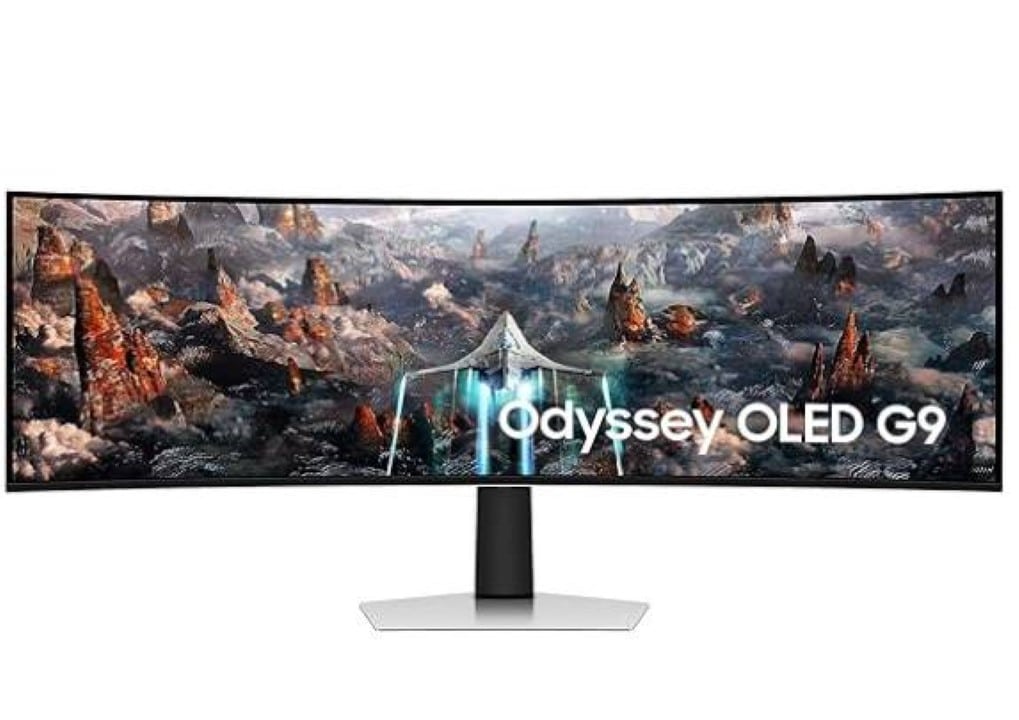
The South Korean manufacturer Samsung officially launched the Odyssey OLED G9 monitor on the national market, expanding its portfolio of high-performance equipment. The device, which has a 49-inch curved screen, is aimed at audiences looking for rigorous technical specifications for games and productivity. The model is now available on the brand’s official shelves and sales channels in the country, sold at a suggested price of R$9,499.00.
The equipment stands out for the integration of a panel with OLED technology, which eliminates the need for traditional backlighting. Essa feature allows each pixel to be illuminated individually, resulting in extremely accurate contrast levels and the reproduction of absolute dark tones, without unwanted light leakage around the edges of the screen. Color fidelity is maintained even in highly graphically complex scenes.
In terms of dimensions and format, the monitor adopts an ultra-wide aspect ratio of 32:9, which is physically equivalent to placing two standard aspect ratio monitors side by side, but without the dividing edges in the center. Essa visual breadth is combined with Dual QHD resolution, which delivers 5120 x 1440 pixels, ensuring a vast and detailed work area for running multiple programs or rendering large virtual scenes.
To sustain image quality in motion, the internal hardware is designed to process frames at very high speed. The refresh rate tops out at 240Hz, while the gray-to-gray response time, known technically as GtG, is just 0.03 milliseconds. Esses numbers place the device at a demanding level aimed at scenarios where fluidity is a determining factor for the precision of commands.
Visual architecture and panoramic immersion
The screen structure was designed with a curvature of 1800R, an index that follows the natural field of vision of the human eye. Esse curved design has the practical function of maintaining uniform focal distance between the center and edges of the panel, reducing eye strain during prolonged periods of observation. In racing or flight simulators, curvature expands the user’s peripheral perception, creating a more immersive visual environment.
The pixel density of the equipment is set at 110 PPI, a metric that ensures the sharpness of small textual and graphic elements. Essa density prevents the effect of aliasing at the edges of images, maintaining visual clarity even when the user is positioned close to the screen. The Dual QHD resolution works in conjunction with this density to balance graphics card performance and the final quality of the rendered image.
The panel’s static contrast reaches a ratio of 1,000,000:1, a specification that highlights the monitor’s ability to differentiate between lighter and darker tones with extreme precision. The internal image processor analyzes content in real time to optimize the display, adjusting color and brightness parameters according to the rendered scene, whether in low-light virtual environments or highly lit landscapes.
Technical performance for electronic competitions
Fluid frame transition is one of the pillars of the Odyssey OLED G9, supported by the 240Hz refresh rate, which can be achieved through HDMI 2.1 or DisplayPort connections. In fast-action games and esports, where latency can define the outcome of a match, the ability to display 240 images per second provides a tangible mechanical advantage. The ultra-fast response time of 0.03 ms acts directly to eliminate the ghosting effect, also known as ghosting, ensuring that fast-moving objects remain sharp and without blurred traces on the screen.
To avoid synchronization failures between the video card’s frame generation rate and the monitor’s refresh rate, the equipment has official support for AMD FreeSync Premium Pro and G-Sync Compatible technologies. Esses variable refresh rate protocols dynamically adjust the screen frequency, eliminating visual problems such as tearing, which causes horizontal cuts in the image, and stuttering, responsible for choking when moving the camera. The integration of these technologies ensures a seamless visual experience regardless of fluctuations in computer performance.
Thermal protection system and anti-glare technology
The panel surface is equipped with OLED Glare Free technology, which has international UL certification. Esse special coating was developed to absorb and disperse ambient light, reducing external reflections by up to 54% when compared to conventional protective films used in the monitor market.
The effectiveness of this anti-reflective treatment allows the monitor to be used in rooms with strong natural or artificial lighting without the image losing legibility. The user can maintain full focus on the content displayed, without the need to excessively increase the screen brightness to compensate for interference from external light, which also contributes to the device’s energy efficiency.
Preserving the integrity of the OLED panel is managed by advanced thermal modulation algorithms. The system continuously monitors the internal temperature of components and intelligently adjusts brightness to prevent overheating, especially during uninterrupted use sessions that require high light processing.
Preventive measures against the burn-in effect, which is permanent image retention, operate autonomously in the background. The software identifies prolonged static elements, such as operating system taskbars or game interface logos, and subtly reduces light intensity in those specific areas. Adicionalmente, an intelligent screen saver activates after 10 minutes of inactivity, dimming the screen to extend the life of the display.
Advanced connectivity and multitasking capabilities
The monitor’s vast display area is made the most of using the Picture-in-Picture and Picture-by-Picture functions. Essas tools allow the user to connect multiple video sources simultaneously, dividing the screen to display the signal from a desktop computer and a video game console at the same time, maintaining the native resolutions of each device without loss of quality or aspect ratio distortion.
The rear connection panel was structured to offer versatility in mounting workstations and entertainment. The device features HDMI 2.1, Micro HDMI, DisplayPort and USB-C connectivity ports, facilitating integration with a wide range of modern peripherals and hardware. The presence of these high-bandwidth interfaces is critical to supporting the data traffic required for maximum resolution and high refresh rate.
Physical structure and synchronized lighting
The design of the equipment prioritizes ergonomics and premium aesthetics, featuring a silver metallic finish that gives the structure robustness. The support stand is ultra-thin, measuring just 4.5 millimeters at its narrowest point, which optimizes the space occupied on the table without compromising the stability of a 49-inch screen. The metal base offers mechanical height and tilt adjustments, allowing the user to position the monitor according to their body posture, an essential factor in mitigating muscle fatigue during long hours of operation. On the back, the built-in lighting system, powered by CoreSync and Core Lighting+ technologies, projects a halo of light into the environment that reacts in real time to the predominant colors displayed on the screen. Esse feature expands the visual atmosphere beyond the edges of the monitor, creating a luminous extension that follows the dynamics of the rendered scenes, consolidating the model’s positioning as a reference in high-end hardware for demanding consumers and professionals in the technology sector.



