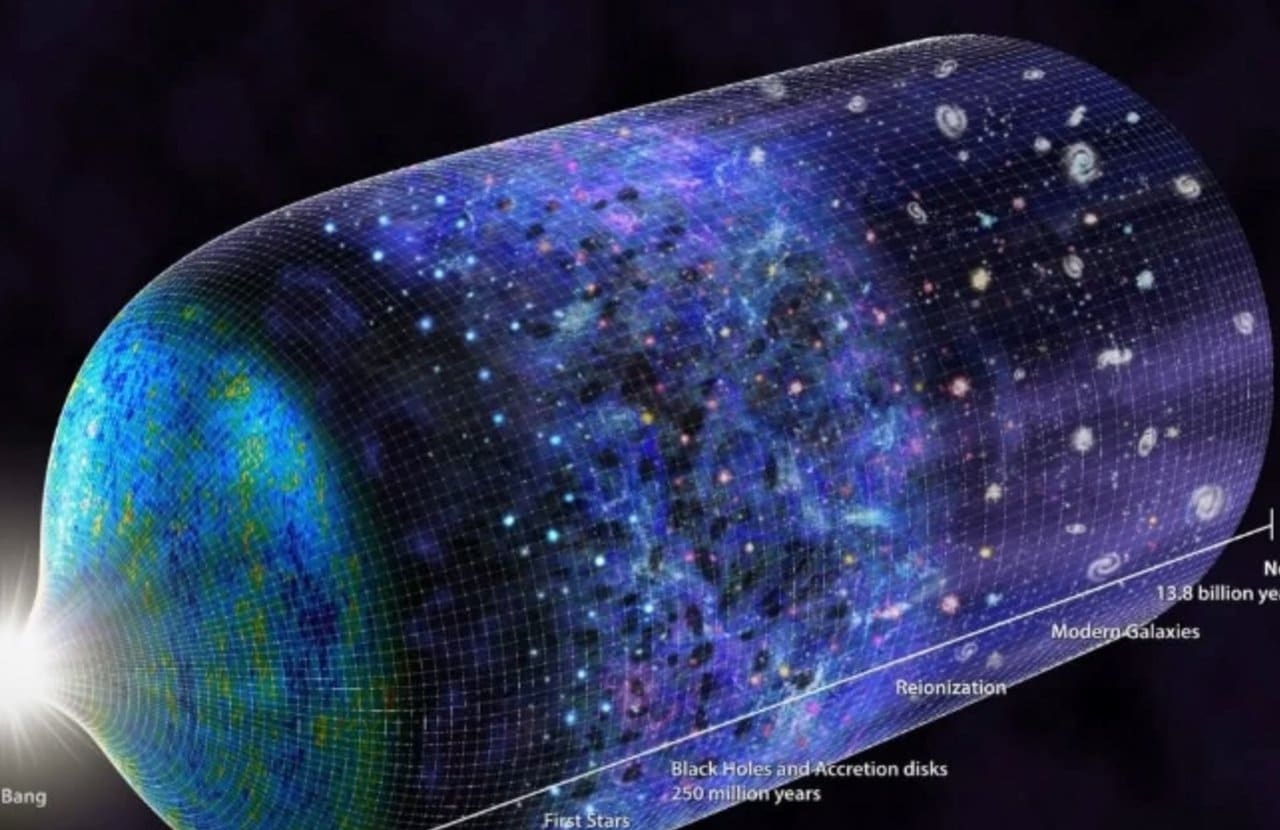
New data collected by Telescópio Espacial James Webb (JWST) has revealed a worrying confirmation for modern cosmology. The information indicates a significant and undeniable discrepancy in the expansion rate of the universe, a phenomenon known as “Hubble tension”, which suggests a fundamental flaw in the current understanding of physics. Esta validation launches a direct challenge to the standard cosmological model, pushing the scientific community to reevaluate its most consolidated theories.
For many years, astronomers at various institutions have intensely debated the nature of this divergence. On the one hand, measurements of the early universe, based on cosmic microwave background radiation, point to a specific speed of expansion. Do another, observations of stars in closer galaxies indicate a distinct rhythm, creating a dilemma that scientists had hoped to resolve more precisely.
The general expectation was that this difference could be attributed to simple measurement errors or inaccuracies in the instruments. Contudo, JWST’s new high-precision observations have eliminated this possibility, utilizing its unparalleled ability to scrutinize distant celestial objects. The robust confirmation of Webb solidifies the existence of a serious problem, which cannot be dismissed as a mere instrumental artifact.
The voltage of Hubble detailed
The Hubble tension is, in essence, a conflict between two ways of measuring the Hubble constant, which describes the expansion rate of the universe. One method is based on observations of the early universe, just after Big Bang, using data from the Planck probe that mapped the cosmic microwave background radiation. Este method suggests a value for the constant of Hubble around 67 km/s/Mpc (kilometers per second per megaparsec).
The second method involves measuring distances to nearby galaxies using “standard candles” such as Cefeidas stars and Tipo Ia supernovae. Essas measurements, which have been refined by missions like Telescópio Espacial Hubble and now James Webb, consistently point to a higher value, around 73 km/s/Mpc. The approximately 10% difference between these two values is statistically significant and can no longer be ignored.
James Webb, with its infrared vision and unprecedented resolution, analyzed more than 1,000 pulsating stars in galaxies located millions of light years from Terra. In doing so, the telescope was able to validate previous findings and, crucially, rule out any possibility that the problem was caused by technical glitches or light distortions that could affect Cefeidas’s brightness measurements.
Implications for the standard cosmological model
JWST’s confirmation of the Hubble strain places modern cosmology at a crossroads. If the mathematics describing the universe is correct, but the numbers obtained by different methods do not line up, this implies that Modelo Cosmológico Padrão, known as Lambda-CDM, is incomplete. Este model is the theoretical framework that describes the composition and evolution of the universe, including:
The need for “new physics” to resolve the tension of Hubble is becoming increasingly evident. Cientistas are already exploring several hypotheses to explain the observed discrepancy.
Paths to a new physics
Several emerging theories seek to fill the gaps left by the tension of Hubble. Algumas of the main lines of investigation include:
These proposals, while speculative, pave the way for exciting and potentially revolutionary research, forcing cosmologists to reconsider the foundations of physics.
The Future of Cosmic Exploration and Rewriting Books
Confirming the voltage of Hubble by Telescópio Espacial James Webb is not just a problem; it is a window to the unknown. Ela reaffirms that, even with the most advanced tools at our disposal, the universe still holds deep secrets that could eventually force us to rewrite the textbooks on the structure of reality itself. Este is a crucial moment for science.
JWST’s unparalleled ability to observe the universe with never-before-seen clarity and sensitivity is fundamental to this discovery. Sua accuracy in analyzing Cefeidas stars and other cosmic distance indicators has allowed robust validation that could not be achieved by previous telescopes. The ongoing mission of Webb, along with other observatories and theoretical projects, will be vital to unraveling the enigma.
The impact of this confirmation is not limited to astronomers and physicists; it resonates throughout the scientific community and the public interested in the cosmos. Entender the expansion rate of the universe is fundamental to predicting its final fate, be it a “Big Crunch”, a “Big Freeze” or a “Big Rip”. The tension of Hubble suggests that this destiny may be more complex and surprising than we imagined. The search for answers will continue to be one of the greatest scientific endeavors today, driven by curiosity and the incessant human search for knowledge about our place in the cosmos.