

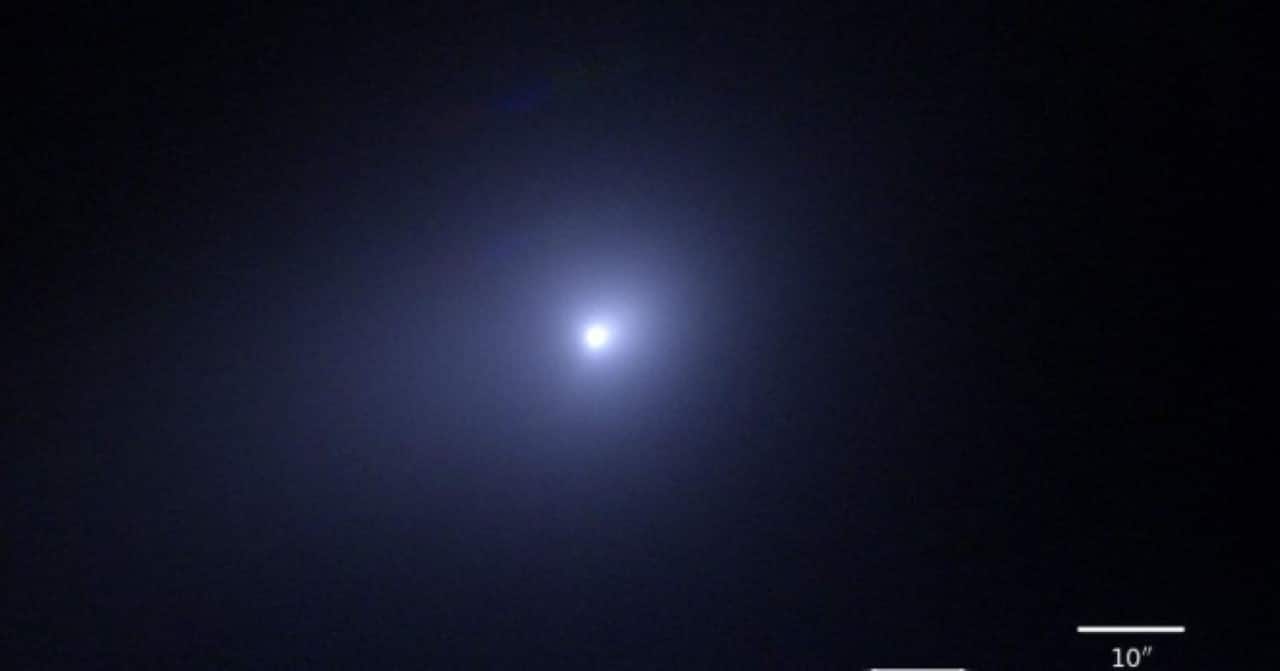
A scientific discovery of great relevance in the field of astronomy was recently released, with researchers identifying methanol in significant quantities in the interstellar comet 3I/ATLAS. Esta revelation, the result of meticulous observations carried out with the advanced set of ALMA radio telescopes, located at Chile, points to distinct chemical characteristics of this celestial body, which originated outside our solar system. The results suggest that the composition of 3I/ATLAS differs considerably from most known comets orbiting Sol, providing crucial clues about formation conditions in other stellar systems.
The team responsible for the study, led by Nathan Roth, from American University, published their findings in the renowned academic journal The Astrophysical Journal Letters. Este work deepens understanding of the chemical diversity of objects roaming interstellar space and the potential differences in planet-forming environments beyond our cosmic neighborhood.
Discovery and innovative methodology
The research conducted by the Nathan Roth team used the power and precision of the Atacama Large Millimeter/submillimeter Array (ALMA) to scrutinize the composition of comet 3I/ATLAS. ALMA is a cutting-edge infrastructure capable of capturing radio waves at millimeter and submillimeter wavelengths, which are ideal for detecting organic molecules in space, such as methanol (CH3OH). The telescope’s resolution capacity allowed a detailed analysis of gaseous emissions from the comet.
When the nucleus of a comet is heated by solar radiation, it releases gases and dust, forming a tenuous, transient atmosphere known as a coma. Spectral analysis of this coma is an effective method for determining the comet’s internal chemical composition. The Roth team focused on identifying methanol and hydrogen cyanide (HCN), two molecules often found in comets and considered important markers of the conditions of their origins.
The 3I/ATLAS enigma in the cosmic scenario
Discovered in July 2025, 3I/ATLAS quickly captured the attention of the scientific community as the third confirmed interstellar object to pass through our solar system. Antes of it, only “1I/’Oumuamua”, sighted in 2017, and “2I/Borisov (Comet Borisov)”, in 2019, had been identified as visitors from other star systems. The rarity of these events makes each observation of an interstellar object a unique opportunity to collect data about the raw material of planets and stars that formed elsewhere in the universe. The trajectory of 3I/ATLAS evidently indicated its extrasolar origin, boosting intensive observation campaigns that involved several terrestrial and space instruments, including the iconic Telescópio Espacial Hubble (HST) and the Telescópio Subaru.
Surprising chemical patterns and comparisons
Between August and October 2025, the research team used ALMA to monitor 3I/ATLAS as it approached Sol, a period in which its gaseous activity intensified. The observations were focused on analyzing the ratio between methanol and hydrogen cyanide, crucial elements for understanding the comet’s chemical signature. The results revealed a significant anomaly in this relationship.
Data analysis demonstrated that 3I/ATLAS had a significantly higher proportion of methanol compared to hydrogen cyanide. Este finding contrasts with the chemical profile of most comets that formed in our own solar system, which exhibit a different composition.
More specifically, the scientific article details that the ratio of methanol to hydrogen cyanide in 3I/ATLAS was approximately 124 times greater in observations on September 12, 2025, and approximately 79 times greater in observations carried out on September 15 of the same year. On average, known comets from the solar system have a proportion of methanol around 26 times higher than that of hydrogen cyanide, which classifies 3I/ATLAS in the category of methanol-rich comets.
The methanol content detected in 3I/ATLAS is remarkable. Embora the comet C/2016 R2 (Pan-STARRS) set the previous record with a proportion of methanol approximately 280 times greater than that of hydrogen cyanide, 3I/ATLAS now occupies the second position in this ranking, highlighting its chemical uniqueness and the richness of its organic content.
Gas Ejection: The Internal Dynamics of the Interstellar Comet
ALMA’s high resolution not only enabled the detection of these molecules, but also offered unprecedented insight into the process of gas ejection from comets. Essa Detailed capability is critical to understanding how a comet’s internal components are released into space.
The research revealed that hydrogen cyanide is ejected directly from the nucleus of 3I/ATLAS, a behavior similar to that observed in comets in our own solar system. However, methanol appears to be released not only from the nucleus but also from small ice particles floating in the coma. As the comet approaches Sol, these particles are heated, sublimating the ice and releasing the contained methanol, a phenomenon described by the team as analogous to a “miniature comet” within the larger coma. Esta is the first time that a gas ejection process with such a level of detail has been documented on an object of interstellar origin, underlining the importance of the 3I/ATLAS observation.
Evidence for the formation of extrasolar celestial bodies
In a press release from Observatório Nacional of Radioastronomia (NRAO), Nathan Roth highlighted the relevance of these findings, stating that “observing 3I/ATLAS is like collecting a fingerprint from another planetary system.” Ele emphasized that the observed abundance of methanol is not common in comets formed within our cosmic neighborhood, suggesting formation in a distinct astrophysical environment.
Previous observations by 3I/ATLAS, carried out by Telescópio Espacial James Webb (JWST), had already indicated that the comet’s coma was rich in carbon dioxide (CO2) when it was still far from Sol. The subsequent detection of methanol in high abundance, now confirmed by ALMA observations, complements these data. The combination of this information strongly points to the idea that the material that makes up 3I/ATLAS may have formed under environmental conditions significantly different from those that prevailed during the formation of comets in our solar system, or that the comet followed a unique evolutionary trajectory in its system of origin.
The future of interstellar object research
Directly studying the materials that make up interstellar objects like 3I/ATLAS offers an unprecedented window into planetary formation processes in other stellar systems. By analyzing these “cosmic visitors” who were born in other planetary nurseries and who, for some reason, were thrown out of their systems, traveling billions of kilometers to reach ours, scientists can drastically deepen our understanding of the diversity and mechanics of formation of celestial bodies on exoplanets. Cada new discovery adds layers of knowledge to an ever-expanding field of research, revealing the secrets of a vast and multifaceted universe.



