

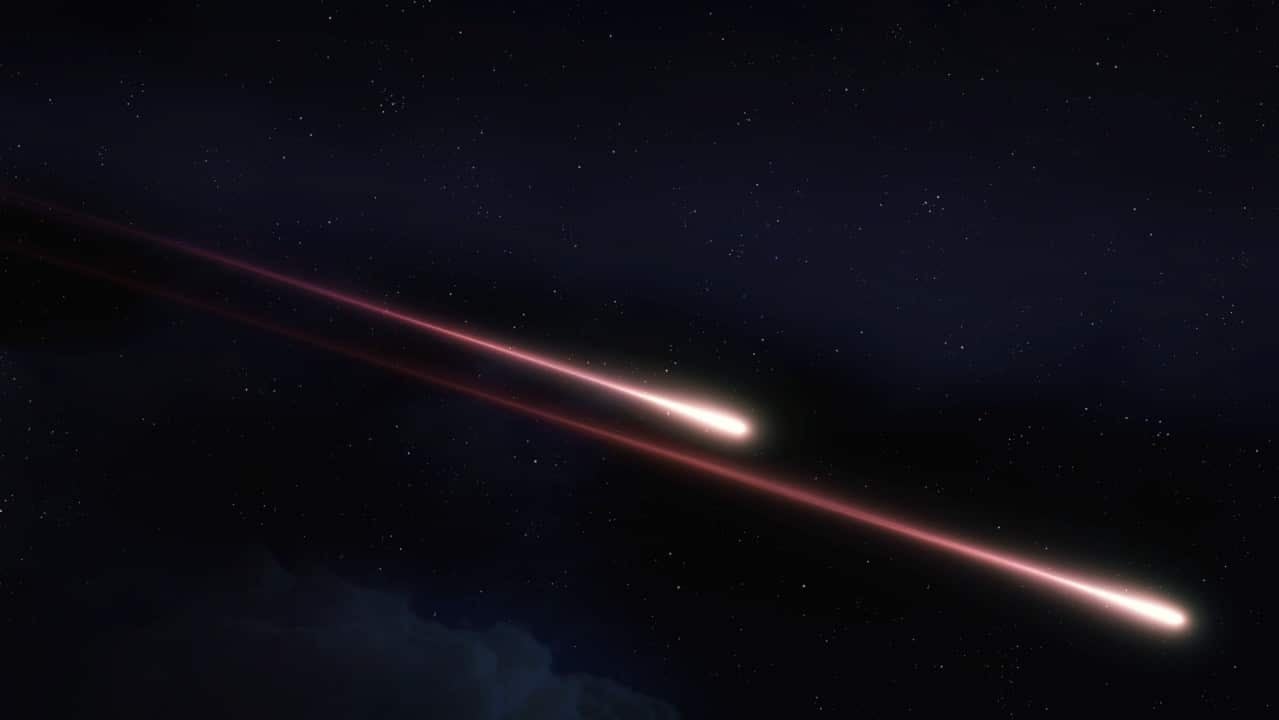
A strong bang hit the region of Cleveland, in the Estados Unidos, generating strong apprehension among local residents and neighboring areas. The unusual sound spread across vast areas of land, causing homes to vibrate and raising immediate questions about the origin of the event. Relatos indicated that the acoustic disturbance was perceived even in distant locations, such as the state of Nova York, highlighting the magnitude of the occurrence.
The lack of initial information led the population to seek answers through communication channels and public security authorities. The main hypothesis raised by residents in the early hours was that of an industrial explosion or a major accident. The physical sensation of shaking in house structures contributed to increased concern in affected communities.
Serviço Nacional of Meteorologia (NWS) intervened to clarify the situation, confirming that the phenomenon was the result of a meteor passing through the Earth’s atmosphere. The government body’s official statement was essential in allaying fears of dangerous land accidents and reestablishing normality in the region.
Visual identification and tracking technology
Confirmation of the spatial origin of the bang was only possible due to the use of advanced atmospheric monitoring instruments. The main equipment responsible for detection was the geostationary lightning mapper (GLM), a technology operated by Administração Nacional Oceânica and Atmosférica (NOAA). The Este device orbits the Terra with the primary function of mapping continuous electrical discharges, but has sufficient sensitivity to capture rapid flashes of light generated by other phenomena.
During the analysis of data collected at the time of the bang, experts identified a green flash over the area of Cleveland. The meteors, when penetrating the gas layer of Terra, produce intense light emissions that resemble lightning, allowing the GLM sensors to record the anomaly. The release of this image captured by the satellite served as material proof to solidify the theory of the celestial body and rule out other possibilities.
Mobilization of residents and search for information
The repercussion of the event in residential areas was immediate, with thousands of people taking to social media to report their experience. Testemunhas described the sound as something unprecedented in their local experiences, highlighting the strength of the shock wave that hit doors and windows.
The lack of visible signs of smoke or fire on the ground added to the initial confusion. Veículos local media outlets received an unusual volume of calls from citizens seeking updates on possible isolation areas or evacuation routes.
Serviço Nacional’s rapid dissemination of data from Meteorologia acted as a blockade against disinformation. Transparency in government communication prevented unfounded theories from gaining traction in digital media.
The episode highlighted the need for agile communication protocols between scientific agencies and the civilian population. The ability to provide responses based on concrete data in short periods of time has proven to be essential for maintaining public order in situations of atypical natural phenomena.
Mechanics of sonic boom in the atmosphere
The explosive sound that reached the Earth’s surface is technically classified as a sonic boom. Esse physical phenomenon occurs whenever an object moves through the air at a speed greater than that of sound itself. In the case of meteors, they enter the Earth’s atmosphere at hypersonic speeds, generating extreme friction with the air molecules. Esse friction not only ignites the rocky or metallic material, but it also compresses the air in front of the object. Continuous compression forms shock waves that accumulate and propagate in a cone shape towards the ground. Quando these shock waves reach the surface, they are perceived by the human ear as a singular and powerful explosion. Especialistas in meteorology explain that the intensity of the bang directly depends on the size of the celestial body and the altitude at which it disintegrates. Corpos larger ones that penetrate deeper into the atmosphere tend to generate more severe shock waves, capable of vibrating solid structures such as windows and masonry walls. The dissipation of this acoustic energy can travel for tens of kilometers, justifying reports of tremors in areas far from the original point of entry. Understanding these mechanics helps to demystify the event and reassure the population about the absence of land-based explosives.
Characteristics of celestial bodies on a collision course
Astronomical science has specific nomenclatures to classify the space fragments that interact with our planet. The differentiation is based on the position and physical state of the object in relation to Terra.
– Meteoroides: these are the fragments of rock or metal that break off from asteroids or comets and travel through the vacuum of space, before any contact with Earth’s gravity.
– Meteoros: represent the luminous phenomenon, popularly known as a shooting star, generated when the meteoroid enters the atmosphere and combusts due to extreme friction.
– Meteoritos: these are rocks that have enough mass to survive atmospheric burning and effectively reach the Earth’s surface, becoming valuable objects of study for planetary science.
Previous records in local airspace
The Ohio region has a recent history of astronomical activity visible to the naked eye. Semanas before the event that generated the sonic boom, residents had already reported the passage of other celestial bodies. In mid-February, home security cameras recorded the fall of a meteor during the night, a fact confirmed by local television network affiliates.
Later, in mid-March, a new fireball was captured by surveillance equipment, attesting to the frequency of these phenomena in the current orbital route of Terra. The crucial difference between these previous sightings and the recent event at
Performance of government monitoring bodies
The Earth’s atmosphere functions as a natural protective shield, disintegrating the vast majority of space debris before it poses any risk to inhabited areas. Instituições like NOAA, the NWS, and Sociedade Americana of Meteoros (AMS) maintain around-the-clock surveillance to catalog these inputs and study the behavior of rock materials under thermal stress.
When fragments manage to resist re-entry and reach the ground, teams of researchers are mobilized to locate and collect the samples. The chemical and structural analysis of meteorites provides essential data on the formation of the solar system and the composition of distant celestial bodies, feeding databases of space agencies around the world.
Importance of continuous weather surveillance
Constant monitoring of airspace and the upper atmosphere ensures that large-scale natural events are quickly identified and explained. Investment in satellites with high-precision sensors allows science to provide accurate answers in real time, preventing the spread of panic and ensuring that society understands the physical dynamics surrounding the planet.



