

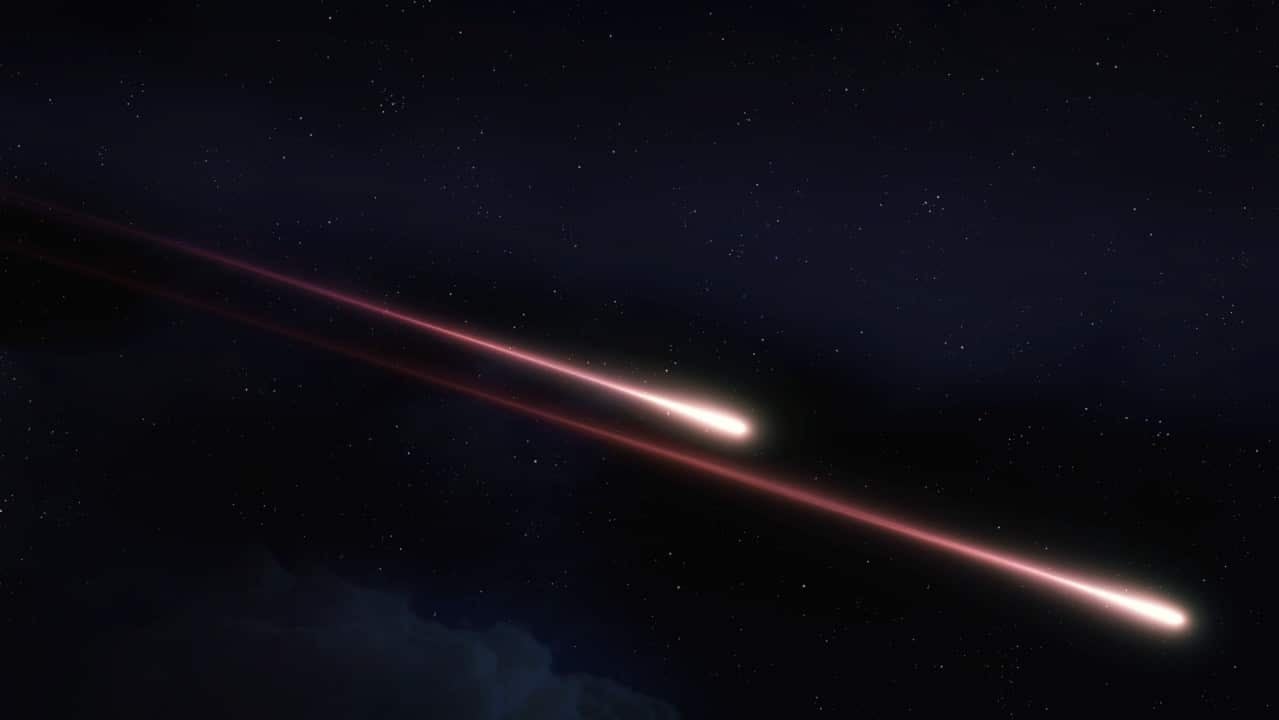
A strong noise of unknown origin reached several urban and rural areas in the Estados Unidos, with the main focus in the state of Ohio. The physical event caused structural tremors in residential and commercial properties, prompting a rapid mobilization of government agencies to identify the source of the atmospheric disturbance.
Technical analysis confirmed that the occurrence was generated by the entry of a celestial body into the Earth’s atmosphere. The dissipation of energy during the free fall resulted in a shock wave that was noticeable kilometers away from the point of visual impact, changing the routine of thousands of citizens who sought immediate explanations for the phenomenon.
Mapping of the event revealed specific details about the area covered and the physical consequences of air displacement:
– The sound epicenter was recorded in the vicinity of Cleveland.
– Ondas secondary propagation has been detected up to the state of Nova York.
– Nenhum serious structural damage or risk to the physical integrity of the population was reported by local authorities.
The rapid identification of the space object prevented the spread of incorrect information about possible industrial accidents or explosions on the ground. The meteorological monitoring network took control of official communication to clarify the dynamics of the event, using satellite data to prove the astronomical nature of the episode.
The dynamics of the sonic boom in the atmosphere
The explosive sound that reached the Earth’s surface is scientifically classified as a sonic boom. Esse physical effect occurs when a solid object exceeds the speed of sound propagation in air, which is approximately 343 meters per second under normal temperature and pressure conditions.
During its downward trajectory, the meteor abruptly displaced air masses. Essa extreme aerodynamic compression generates continuous shock waves that travel in a cone shape until they reach the ground, at which point they are perceived by the human ear as a single and powerful boom, capable of vibrating windows and walls.
Meteorological experts explained that the intensity of the noise is directly related to the size of the rocky fragment and its re-entry speed. Severe friction with the denser layers of the atmosphere also contributes to the fragmentation of material before an eventual collision with the surface, dissipating most of the original mass.
Detection and tracking equipment
Visual and instrumental confirmation of the celestial body depended on cutting-edge technologies operated by climate observation centers. The main equipment used in the identification was the geostationary ray mapper, an orbital instrument designed to record sudden light variations in the troposphere and stratosphere in real time.
Although the satellite’s primary objective is to monitor severe electrical storms, its optical sensors are sensitive enough to capture the incandescence of meteors. Cross-referencing luminescence data with seismic and acoustic records made it possible to trace the exact route of the object over the affected region, validating the researchers’ initial hypothesis.
History of space activities in the region
Midwestern airspace has seen an increase in the documentation of astronomical phenomena due to the proliferation of home security cameras. Nas weeks before the main event, other smaller fragments were filmed crossing the night sky in the same location, indicating a phase of greater meteoric activity.
One of the most notorious records occurred in the middle of February, when private surveillance equipment captured the passage of a luminous bolide at the end of the night. The recording served as a database for astronomers to calculate the trajectory of smaller space debris that often intersects the planet’s orbit.
Later, in mid-March, a new fireball was cataloged by automatic monitoring systems. The frequency of these sightings demonstrates that the entry of small meteoroids into the atmosphere of Terra is a routine and continuous process, closely monitored by planetary defense institutions.
The fundamental difference between the previous events and the recent case lies in the mass of the object and the angle of entry. Apenas celestial bodies with specific dimensions and speeds are able to penetrate deeply into the atmosphere to the point of generating perceptible sound waves at a superficial level, making the Cleveland episode an event of greater scientific relevance.
Security and public communication protocols
The immediate response to incidents involving earthquakes and high-intensity sounds requires efficient coordination between research centers and public security forces. Assim As the first reports of structural vibrations began to jam emergency lines, meteorologists began scanning satellite data to rule out threats of anthropogenic origin. The rapid dissemination of satellite images showing the flash of green light characteristic of the burning of magnesium and other minerals present in the meteor was essential to establish the factual narrative of the event and guide the population objectively.
Transparency in the dissemination of technical information acts as the main tool against disinformation in times of civil unrest. By detailing the physical process that transforms a silent meteoroid in the vacuum of space into an emitter of shock waves in the atmosphere, scientific institutions fulfill their educational and preventive role. Constant monitoring of airspace ensures that anomalies are detected, classified and communicated to society with millimeter precision, reinforcing confidence in alert systems and the response capacity of competent authorities.
The science behind meteoroid fragmentation
The life cycle of a space fragment that reaches Terra involves complex thermodynamic processes that begin long before human perception. Originários from asteroid belts or comet tails, meteoroids travel through the vacuum at speeds that can exceed tens of kilometers per second. When crossing the line of Kármán, the imaginary border between outer space and the Earth’s atmosphere, these bodies encounter air resistance that increases exponentially. The accumulated kinetic energy is quickly converted into extreme heat through impact pressure, and not just through friction, as is often simplified. Esse heat melts the outer layers of the rock, creating a glowing plasma that ionizes the surrounding gases. If the aerodynamic pressure overcomes the structural strength of the material, the meteor undergoes an explosive disintegration in the air, releasing the remaining energy all at once. It is exactly this abrupt release that generates massive air displacement, resulting in the sonic boom that shakes structures and triggers security systems in vast urban areas, transforming a distant astronomical event into a direct physical experience for thousands of people on the ground.
The role of society in data collection
Civil collaboration has become an essential pillar for modern astronomy and the validation of climate models. Relatos details from residents about the exact timing of the boom, the direction of the sound and the intensity of the tremor help researchers triangulate the three-dimensional position of the atmospheric explosion with greater accuracy than relying exclusively on isolated instruments in orbit.
Advances in orbital observation technology
The continued improvement of meteorological satellites promises to increase the predictability of atmospheric reentry events in the coming years. Novos High-resolution infrared and optical sensors are being integrated into planetary defense networks to detect increasingly smaller objects before they cross the stratosphere, ensuring an even shorter response time.
The integration of artificial intelligence in the analysis of raw data allows flashes of light to be classified instantly, differentiating common rays from space bolides in fractions of a second. Essa technological infrastructure ensures that sky monitoring remains a priority for public safety and the continued advancement of scientific knowledge about Terra’s interaction with the space environment.



