

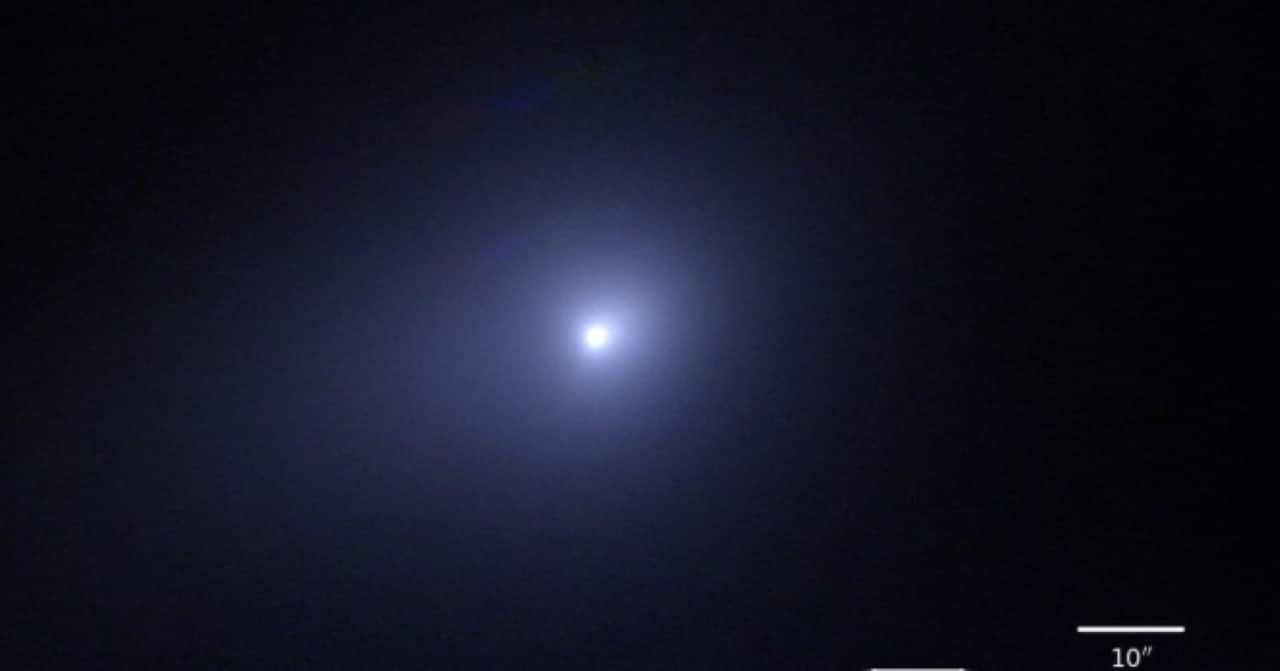
Astronomy has registered a significant advance in the understanding of celestial bodies originating from outside the solar system. Observações recent studies have identified a significant amount of methanol in the composition of the interstellar comet 3I/ATLAS. The survey used the infrastructure of the Atacama Large Millimeter/submillimeter Array, known by the acronym ALMA, an observation complex installed in Chilean territory.
The data collected indicates that the chemical structure of this space visitor presents substantial differences when compared to objects orbiting Sol. The pronounced presence of specific organic compounds provides clues about the environments where distant star systems form. Detailed information about the cloud of gas and dust that surrounds the nucleus of the celestial body reinforces the thesis of an external origin and a particular chemical evolution.
The investigative work was conducted by a team of experts led by researcher Nathan Roth, linked to American University. The results of the spectral analysis were submitted and published in the scientific journal The Astrophysical Journal Letters, expanding the catalog of data on the raw material that makes up planets and stars in other regions of the universe and establishing new parameters for modern astrophysics.
Chemical composition and use of advanced technology
The methodology applied by the team of scientists directly depended on the resolution capacity of the ALMA radio telescope complex. Este equipment has the necessary technology to capture radio waves in millimeter and submillimeter lengths, an ideal spectrum for identifying complex organic molecules in the vacuum of space. The location of the observatory, at a high altitude in the Atacama desert, minimizes interference from the Earth’s atmosphere, allowing very high precision readings. Durante the comet’s approach to Sol, thermal radiation caused the nucleus to heat, resulting in the continuous release of gases and dust particles that form the transient coma.
The main focus of the observation was to map the presence of methanol and hydrogen cyanide, two substances that function as fundamental chemical markers in astrophysics. Detailed analysis of gaseous emissions allowed researchers to quantify the exact proportion between these elements. The precision of the terrestrial instruments guaranteed the separation of the spectral signatures, showing that the dynamics of material release from 3I/ATLAS occur differently, with sublimation processes that reveal the internal structure of the ice accumulated along its extensive cosmic trajectory.
Space visitor trajectory and continuous monitoring
The celestial body 3I/ATLAS was initially identified in July 2025, gaining immediate notoriety in astronomical research centers. Ele became the third object of interstellar origin confirmed to cross the boundary of our planetary system.
Before this passage, official records only accounted for 1I/’Oumuamua, detected in 2017, and 2I/Borisov, observed in 2019. The scarcity of events of this nature quickly mobilizes telescope networks around the world to maximize data collection during the short window of visibility.
The orbit calculated for 3I/ATLAS unequivocally demonstrated its extrasolar origin. Esse factor triggered a series of monitoring campaigns that involved both land bases and equipment in orbit.
Among the instruments used to monitor the comet’s movement, the Telescópio Espacial Hubble and the Telescópio Subaru stood out. The joint effort aimed to record the object’s physical and chemical changes as it received increasing levels of solar radiation at its closest approach.
Comparative analysis of molecular proportions
The period of greatest intensity in observations occurred between the months of August and October 2025. During this phase, the comet’s gaseous activity reached its peak, facilitating the reading of the emission spectra by the ALMA complex.
The reports pointed to a notable discrepancy in the relationship between the compounds analyzed. On September 12, 2025, the proportion of methanol in relation to hydrogen cyanide was 124 times greater. Três days later, on September 15, the measurement indicated a rate 79 times higher.
To establish a comparison parameter, comets formed in the vicinity of Sol have, on average, a proportion of methanol only 26 times greater than that of hydrogen cyanide. The 3I/ATLAS numbers place it in a rare category of celestial bodies extremely rich in organic compounds.
Position in the organic abundance ranking
Despite the high levels, 3I/ATLAS does not hold the absolute record for methanol concentration ever recorded by astronomy. The first position belongs to comet C/2016 R2, also known as Pan-STARRS, which presented unique chemical characteristics during its passage.
The record holder exhibited a proportion of methanol about 280 times greater than that of hydrogen cyanide. Ainda thus, the interstellar visitor takes second place in history, consolidating its importance for the study of pre-biotic chemistry in outer space and the distribution of organic molecules.
Volatile material ejection mechanisms
High-resolution mapping has revealed unprecedented details about the mechanics of outgassing from the cometary nucleus. The data showed that hydrogen cyanide is ejected directly from the central surface, a pattern common to objects in our system.
On the other hand, methanol presents a dual behavior. Além emanating from the nucleus, the substance is also released from small fragments of ice that break off and float in the coma, functioning as secondary sources of gaseous emission when heated by sunlight, resembling miniature comets operating around the main body.
Evidence of formation in remote astrophysical environments
The information consolidated by Observatório Nacional from Radioastronomia indicates that the chemical signature of 3I/ATLAS functions as a fossil record of its planetary system of origin. The Nathan Roth researcher highlighted that the anomalous abundance of methanol suggests a formation process that occurred under temperature and radiation conditions severely different from those found in the primordial solar nebula that gave rise to Terra and the neighboring planets. Observações previews conducted by Telescópio Espacial James Webb had already detected a high concentration of carbon dioxide in the object’s coma when it was still at a considerable distance from Sol. Combining the infrared readings from James Webb with the millimeter data from ALMA strengthens the hypothesis that the comet developed in a region rich in frozen carbon monoxide. Esse specific environment would facilitate the synthesis of complex organic molecules before their expulsion into deep interstellar space, providing a practical model for how organic chemistry is distributed in other corners of the galaxy.
Expansion of the astronomical data catalog
Detailed documentation of 3I/ATLAS properties provides a solid empirical basis for improving theoretical models on exoplanet evolution. Continuously tracking cosmic visitors allows scientists to map the distribution of essential chemical elements across the galaxy, improving remote sensing techniques and overall understanding of celestial mechanics.



