

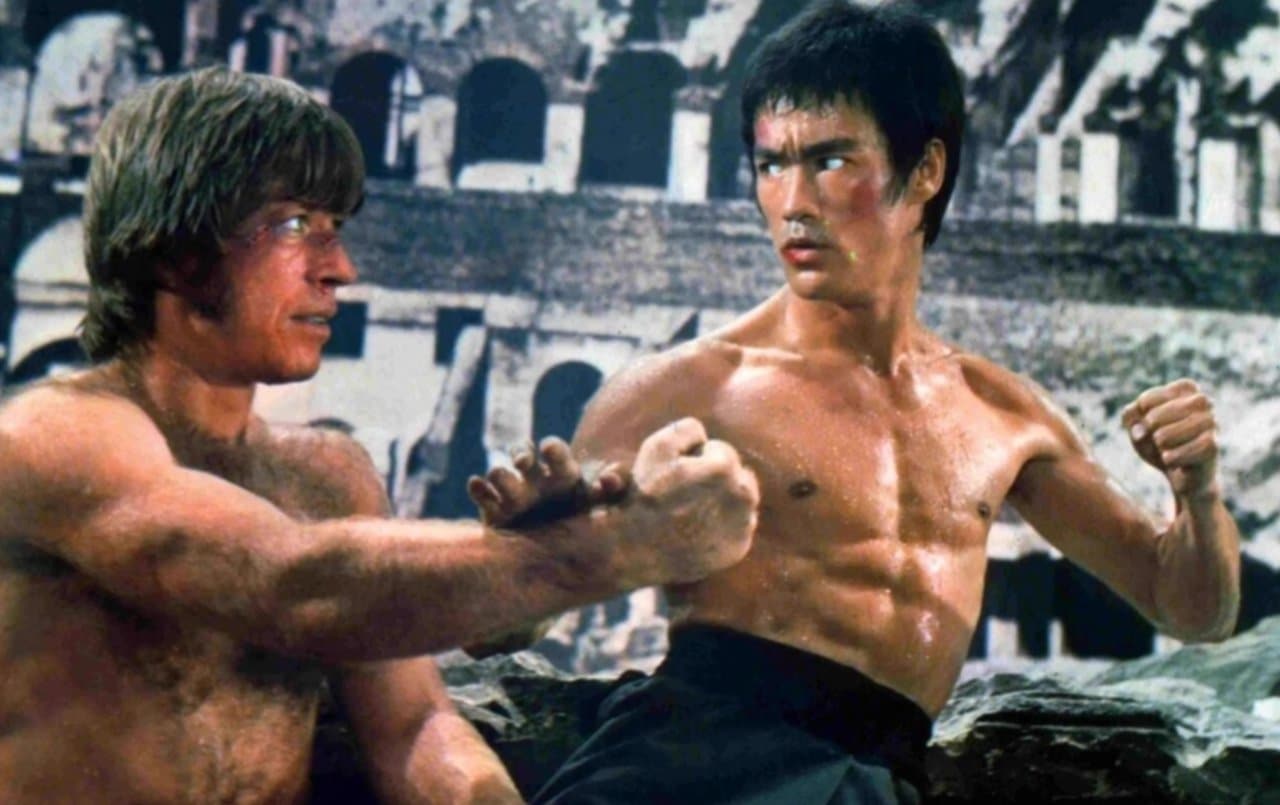
The universe of martial arts cinema has always been the stage for memorable duels, but few clashes have reached the iconic status of the confrontation between Bruce Lee and Este cinematic encounter, directed and starring Bruce Lee himself, continues to be a reference for fight choreography and martial philosophy.
Despite decades passing since its debut, the scene remains a recurring theme in discussions about action cinema. Ela not only consolidated the figure of Bruce Lee as a global icon, but also introduced Chuck Norris to the general public in a role that would come to define his own trajectory. The mastery with which the sequence was executed, focusing on the authenticity and real skill of the fighters, distinguished “O Voo do Dragão” from many productions of the time and assured its place in the history of the seventh art.
The plot leading up to the epic duel
The story of “Voo of Dragão” transports the audience to Itália, where the protagonist Tang Lung, played by Bruce Lee, arrives to help a friend, Cheng Ching Hua. Ela is the owner of a restaurant that is targeted by a local gang, determined to force the sale of the establishment through extortion and violence. Tang Lung, with his unparalleled skill in martial arts, quickly becomes the main obstacle for criminals, who see his henchmen being successively defeated.
The plot deepens when the head of the criminal syndicate, frustrated with Tang Lung’s resistance, decides to seek heavy reinforcements. It is at this moment that Colt enters the scene, in the role of Chuck Norris, a renowned world karate champion from the Estados Unidos. The arrival of Colt raises the threat level, setting the stage for a final confrontation of epic proportions, set in one of the most iconic stages in history: the Roman Coliseu.
Details of the iconic fight at Coliseu
The long-awaited fight between the characters Bruce Lee and Chuck Norris in “O Voo do Dragão” is a true lesson in choreography and martial interpretation. At the beginning of the clash, Bruce Lee’s character, Tang Lung, finds himself at a notable disadvantage. Colt, with his rigid and powerful fighting style, characteristic of Chuck Norris’s karate, dominates the first moments of the confrontation, imposing a strength and precision that seems unshakable. The initial sequence is marked by the brutality and technical skill of Norris, which demonstrates the grandeur of his character.
However, Bruce Lee’s genius manifests itself in the evolution of the fight. Tang Lung gradually adapts its strategy. Ele transforms your movements, making them lighter, faster and, crucially, more unpredictable. Essa change of approach is not just a combat tactic; it reflects Bruce Lee’s own philosophy, based on fluidity, adaptability and non-conformity to fixed styles – central principles of Jeet Kune Do, the martial art he himself developed. Flexibility and the ability to adapt to the opponent become his greatest weapons, allowing him to overcome Colt’s brute strength.
Martial philosophy in action and outcome
Tang Lung’s adaptation during the fight exemplifies the essence of Jeet Kune Do, which preaches freedom of movement and the absorption of all schools of fighting, rejecting limitations imposed by fixed forms. Bruce Lee not only demonstrated this philosophy in his off-screen actions and teachings, but masterfully incorporated it into his films, transforming each confrontation into a declaration of his ideals. The Coliseu scene is a visual testament to this search for efficiency and spontaneity in combat.
At the end of the duel, Bruce Lee emerges victorious, in a conclusion that transcends mere physical victory. It is an affirmation of the superiority of his vision of martial arts, which values adaptability and intelligence over brute strength and rigidity. The scene, which lasts almost ten minutes, was meticulously filmed with wide shots, prioritizing the actors’ real technique. Ambos were experienced fighters, and the film knew how to value this physical performance without excessive cuts or camera tricks, creating a feeling of authenticity that was rare for the time and that still impresses today.
Legacy and recognition of the confrontation
More than a simple clash, the moment culminates in a gesture of respect between the characters, elevating the fight to an almost philosophical level, a hallmark of Bruce Lee productions. Esse humanized aspect of the duel, where the opponent is recognized for their bravery and technique, adds a layer of depth that resonates with the audience far beyond the adrenaline of the combat. The mutual reverence shown by the characters after the grueling battle is an element that solidifies the film’s moral legacy.
Years after the making of “O Voo do Dragão”, Chuck Norris himself recalled the experience of working with Bruce Lee with great appreciation and affection. Ele described participating in the sequence as “very fun” and an invaluable honor, especially as he was aware that that fight would become one of the most celebrated and studied in action cinema. The recognition of the importance of this work by one of those involved demonstrates the magnitude and lasting impact that the film and, in particular, this scene had.
The lasting influence on cinema and martial arts
The fight scene between Bruce Lee and Chuck Norris not only marked a generation, but also set new standards for the way martial arts would be portrayed in cinema. The authenticity of the movements, innovative choreography, and philosophical depth infused into the combat have inspired countless filmmakers and martial artists around the world. Bruce Lee’s ability to communicate complex ideas through his physical performances transformed the mere display of fighting into an art form.
The presence of Chuck Norris, a real-life karate champion, gave the scene unprecedented credibility. The duality between the fighting styles represented by Lee and Norris was not only a visual spectacle, but also a dialogue about different approaches to martial arts. Essa’s combination of talent, vision and execution transformed “The Voo of Dragão” into a cultural landmark that continues to be studied and appreciated by new generations of film and martial arts enthusiasts, solidifying the fame of both stars.
Technical and cultural analysis of the scene
The fight footage in Coliseu is a prime example of how cinematography can enhance the performance of martial artists. The wide shots allowed the audience to appreciate the entirety of Lee and Norris’s movements, without the need for quick cuts or edits that could mask a lack of skill. Essa technical choice highlighted the realism and intensity of the confrontation, making each blow and each defense have a significant visual impact.
Culturally, the fight symbolizes the meeting of Oriente and Ocidente in martial arts, and the way in which Bruce Lee managed to transcend barriers. Jeet Kune Do, his philosophy, proposed overcoming limits and the search for truth in combat, concepts that were skillfully translated to the screen. The Essa scene became an emblem of Bruce Lee’s ability to innovate not just as a fighter, but as a thinker and artist, leaving a legacy that resonates to this day in various artistic and sporting spheres.




