
Gaijin launches Ninth Wave pack for War Thunder with 40 new vehicles and tactical football event By Carolina Costa
6 min read
 |
Developer Gaijin Entertainment has released a massive expansion for its flagship multiplatform military combat simulator. The main update, officially named Nona Onda, introduces a vast arsenal made up of more than forty new and improved military vehicles, spanning several nations and historical eras. The content pack is now accessible to the global user base on Sony computers and desktop consoles.
The focus of this first major intervention in the game system this year is on the modernization of the air, land and naval fleets available to virtual combatants. The inclusion of state-of-the-art weaponry, such as hypersonic missiles and advanced radar systems, substantially changes the dynamics of confrontations at the highest levels of progression. The developers implemented profound changes to the game’s physics to accommodate these new weapons technologies.
In addition to the permanent additions to the war machines catalog, the producer has reactivated alternative game modes to diversify the community’s routine. The combination of rigorous military simulation with temporary recreational events aims to keep the daily engagement of servers high. Structural modifications also encompass a complete review of the technology tree and adjustments to the software’s internal economy.
Expansion of air power with sixth generation fighters
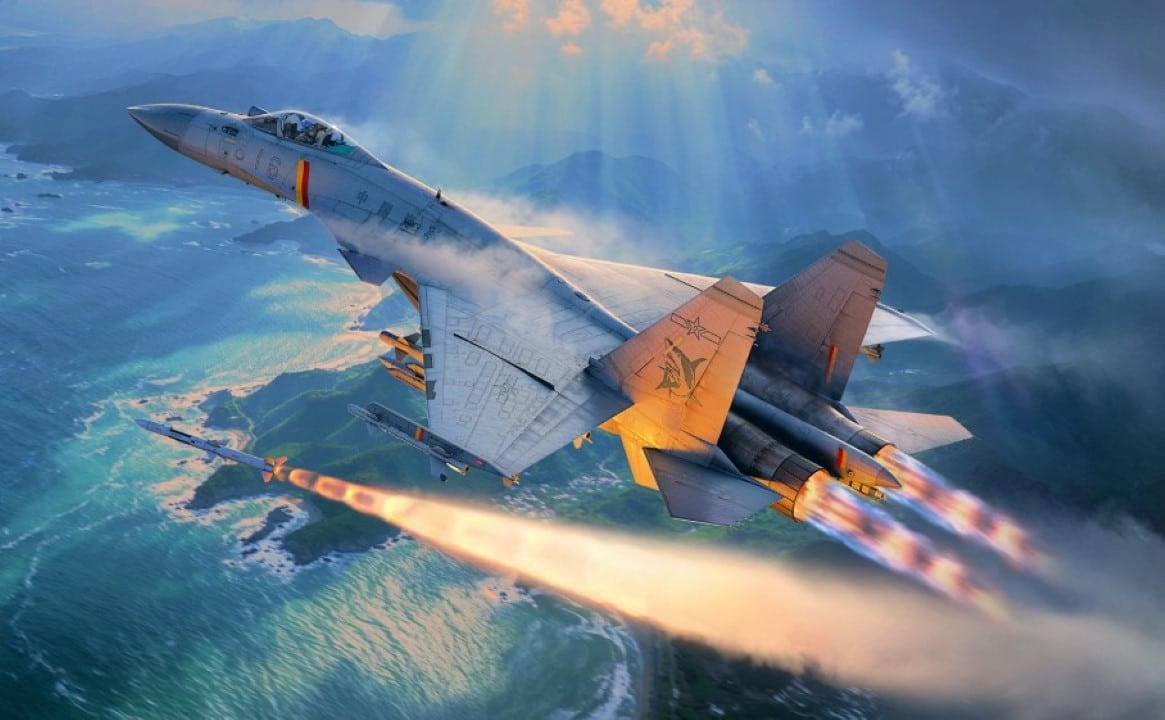
The military aviation segment received special attention with the introduction of aircraft designed for operations on modern aircraft carriers. The main highlight is the Chinese J-15T fighter, a war machine developed with full compatibility for electromagnetic catapult systems. Esta aircraft arrives on the virtual battlefield equipped with PL-12A long-range missiles, weapons that redefine engagement tactics beyond visual range. Flight modeling of this fighter required the rewriting of several aerodynamics algorithms to accurately reflect the airframe’s behavior under extreme stress during evasive maneuvers at high altitudes.
The Estados Unidos armed forces also received a considerable reinforcement for their naval attack operations with the arrival of the F/A-18F Super Hornet in its two-seat variant. The presence of a second virtual crew member on the flight deck optimizes the management of weapons systems and electronic countermeasures during complex bombing missions. The integration of this multirole combat jet expands the range of tactical options for squadrons operating on maps with a predominance of maritime targets and fortified coastal installations. Software engineers meticulously modeled the instrument cluster and multifunction displays to ensure maximum visual and functional fidelity.
Armored reinforcements for intense ground combat
Battles on dry land gained new layers of complexity with the arrival of infantry vehicles and heavy artillery. The American army now has the M1296 Dragoon, a highly modified variant of the traditional Stryker armored vehicle. Este wheeled vehicle offers exceptional mobility in urban terrain and firepower capable of piercing modern reactive armor.
The British technology tree was awarded the AS90 self-propelled howitzer, equipped with a devastating 155 mm cannon. The artillery mechanics of this armored vehicle allow for precise parabolic attacks against entrenched enemy positions kilometers away. Rate of fire and reload time have been balanced to reflect technical specifications from actual military manuals.
For the operators of the Italian nation, the Centauro II (P) appears as a formidable option for reconnaissance and rapid attack. The vehicle sports a 120mm smoothbore cannon, coupled with a modular armor package specifically designed to resist improvised explosives and landmines. Sua weight-to-power ratio guarantees superior acceleration on rough terrain.
The Japão has received an invaluable historical addition with the 10 cm Canhão Autopropulsado Tipo 1 Ho-Ni II. Construído on the reliable chassis of the Tanque Médio Tipo 97 Chi-Ha, this Segunda Guerra Mundial-era armor fills an important gap in the nation’s starting ranks. The damage modeling of this vehicle takes into account the exact thickness of the steel used at the time of its manufacture.
Technological advances in rendering marine environments
The simulator’s graphics engine has undergone a profound redesign with regard to the representation of the surface of oceans and bodies of water. The development team implemented an advanced shading system that calculates in real time the complex interactions between dynamic light sources, player camera positioning, and wave geometry. The Dispersão Subsuperficial technique now processes the refraction of light below the waterline, giving a realistic volumetric appearance to the seas in different weather conditions.
Anisotropic reflections have undergone thorough calibrations to adequately respond to multiple simultaneous viewing angles. Esta technical improvement ensures that the sun’s glare over the water maintains rigorous optical precision, regardless of whether the player is piloting a fighter at ten thousand feet in altitude or commanding a destroyer at sea level. The particle system responsible for simulating splashes, foam and ship wakes has been completely rewritten to interact with the new global illumination.
The mathematical logic that governs the transparency and blending of water textures eliminated visual artifacts and distortions that occurred on coastal margins. Colunas of water generated by torpedo explosions and depth bombs now reacts physically correctly to wind direction and gravity. Estas visual upgrades radically transform the atmosphere of naval engagements, requiring commanders to pay more attention to weather conditions during tactical navigations.
Competitive dynamics of the temporary sporting event
The community’s calendar of activities was updated with the start of the annual edition of the recreational event that transforms the battlefield into a sports arena. Matches take place at pre-determined time windows daily, requiring participants to use modified tanks with jump thrusters and extreme acceleration systems. The core mechanics abandon traditional ballistics in favor of precise physical collisions to drive a giant sphere towards the opponent’s goal, rewarding teamwork and strategic positioning.
This specific mode’s progression system rewards individual and collective performance with limited-run cosmetic items. Competitors who accumulate points through goals, assists and saves can unlock themed stickers and exclusive three-dimensional decorations to customize their armored vehicles in the main game. The server infrastructure has been optimized to support the chaotic physics of matches without compromising frame rate or connection latency.
Progression restructuring and economic adjustments
The insertion of dozens of new war machines required a meticulous reorganization of the technological trees of all factions present in the simulator. Veículos of lower and intermediate levels have had their research requirements and acquisition costs reduced to facilitate new pilots’ access to the latest level VI equipment. The balance of the matchmaking system has been recalibrated to ensure that matches occur between equipment with equivalent technological capabilities.
The internal economy of virtual currencies and research points has undergone a thorough audit to align rewards with time invested in missions. The cost of repairing vehicles destroyed in combat and the price of special ammunition have been adjusted to avoid financial stagnation for users in the highest ranks. Modificações in the user interface now more transparently presents the gain multipliers associated with each action performed on the battlefield.
Cross-platform support and onboarding new users
The simulator’s infrastructure maintains its free distribution architecture, supported by a monetization model focused on premium accounts and collector vehicles that do not tip the competitive balance. The version aimed at personal computers continues to operate stably across dedicated launch platforms, while the eighth and ninth generation Sony consoles receive specific optimization packages to take advantage of available hardware, ensuring performance parity in the cross-play environment. Para To mitigate the steep learning curve characteristic of complex military simulators, the producer has expanded the collection of interactive tutorials and tactical guides available directly on the official portal. Estes teaching materials cover everything from the basic principles of flight and ballistics to advanced engagement tactics with radar-guided missiles and flanking maneuvers with light armor. The stability of global servers has been reinforced with the addition of new data processing centers in strategic regions, aiming to minimize packet loss during peak hours. The technical support team has established new support protocols to quickly resolve account synchronization issues and authentication failures reported by the community after applying the massive data package.
Continuous maintenance of the virtual ecosystem
The development schedule established by the producer reaffirms the commitment to regular injection of content and stability fixes. The immediate application of small fix packages in the days following the major release demonstrates the engineering team’s agility in responding to feedback from the user base. The integrity of the competitive environment remains the absolute priority in global server management.











