
New War Thunder update introduces modern fighter jets and over 40 new military vehicles By Luís Henrique Costa
6 min read
 |
Developer Gaijin Entertainment has officially announced the arrival of a massive content pack for the military combat simulator War Thunder. The update, which is now available to players on a global scale, adds an arsenal of more than four dozen new war machines, covering the air, land and naval fleets of several nations present in the title’s catalog. The launch occurs simultaneously for users of computers and consoles from the PlayStation and Xbox families, ensuring full integration between the platforms.
The main focus of this expansion lies in modernizing the equipment available to higher level players. The introduction of fourth-generation fighters and armored infantry vehicles reflects the community’s demand for more dynamic and technologically advanced engagements. Além of the additions to the arsenal, the development team has implemented significant improvements to the graphics engine, changing the way weather elements and bodies of water interact with the three-dimensional models during matches.
To diversify the user experience, the update also marks the return of alternative game modes that move away from traditional combat. A tactical event focused on a sports modality adapted for armored vehicles has been reactivated, offering exclusive rewards and a break from the routine of historical simulation battles. The company’s strategy aims to maintain the daily engagement of the player base while adjusting the competitive balance of new additions.
Expansion of air power with fourth generation fighters
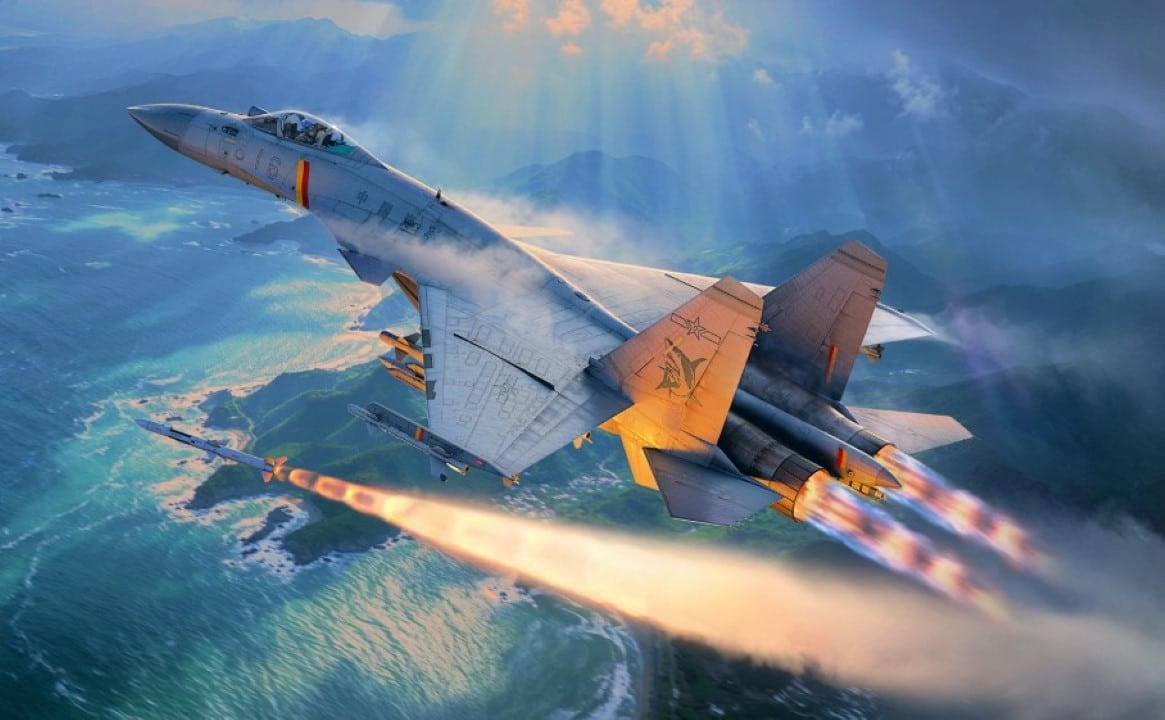
The military aviation segment received special attention with the arrival of aircraft highly requested by modern aviation enthusiasts. The Chinese highlight is the J-15T fighter, an air superiority platform that introduces new combat dynamics beyond visual range. Esta aircraft carries the PL-12A long-range missiles, which use active radar to track targets at extreme distances, fundamentally altering engagement tactics in the simulator’s virtual skies.
The Estados Unidos research tree was strengthened with the introduction of the F/A-18F Super Hornet, a multirole strike fighter operated from aircraft carriers. The presence of a second virtual crew member in the cockpit improves the management of complex weapons systems and onboard radar. The Super Hornet brings with it a wide range of air-to-air and air-to-ground weapons, allowing pilots to adapt the aircraft for interception missions or close air support in land battles.
The implementation of these aircraft required the developer to adjust the flight physics algorithms and the behavior of the radar-guided missiles. Electronic countermeasures systems and missile approach warnings have been refined to provide pilots with the information needed to execute evasive maneuvers in high-speed combat scenarios.
Heavy reinforcements for land fleets
Land battles gained new protagonists with the addition of vehicles focused on mobility and rapid firepower. The Estados Unidos army now has the M1296 Stryker Dragoon, a wheeled armored vehicle equipped with an automatic cannon designed to engage infantry and light vehicles. The agility of this model allows for efficient flanking maneuvers in urban maps, where the speed of repositioning dictates the pace of the confrontation.
The Grã-Brittany received the AS90 self-propelled artillery system, which brings a 155mm howitzer to the battlefield. Este vehicle is capable of firing high explosive projectiles that cause severe damage even without penetrating the main armor of enemy tanks. The game’s overpressure mechanics have been calibrated to reflect the devastating impact of these large-caliber munitions against crews of enclosed vehicles.
The Italian technology tree has been expanded with the Centauro II, a wheeled tank destroyer that combines a 120mm smoothbore cannon with state-of-the-art fire control systems. The ability to fire armor-piercing munitions stabilized by moving fins gives this vehicle a significant tactical advantage in open terrain. Sua light armor is offset by rapid acceleration and stealth profile.
The Japão, in turn, received a historic addition with the Ho-Ni II tank destroyer, strengthening early and mid-tier formations. Este vehicle from Segunda Guerra Mundial offers players a fire support option with a 105mm cannon, ideal for ambushes and defensive tactics on maps with dense vegetation. Detailed modeling of the vehicle’s interior demonstrates the ongoing commitment to historical accuracy.
Advances in rendering marine environments
The simulator’s graphics engine has undergone a profound restructuring with regard to the representation of bodies of water and weather effects. New rendering technology allows waves to react realistically to wind and the displacement of large vessels, creating a dynamic maritime environment that directly affects navigation and the accuracy of naval gunfire. Global illumination has also been improved, with accurate reflections of the sun and moon on the ocean surface, improving visibility during nighttime engagements or in thick fog conditions.
In addition to aesthetics, changes to water physics impact the gameplay of blue water and coastal fleets. Hydrodynamic drag is now calculated with greater precision, meaning evasive maneuvers with destroyers and cruisers require advance planning on the part of captains. The vessels’ structural damage system has been updated to reflect progressive flooding based on the exact impact location of torpedoes and armor-piercing shells, requiring damage control teams to operate at maximum efficiency to prevent sinking.
Return of armored sports competition
Breaking the tension characteristic of simulated military combats, the update reintroduces one of the community’s most popular temporary events: armored tactical football. Nesta modality, players take control of specially modified land vehicles, which have improved acceleration and resistance to physical impacts, to play matches in a closed arena with a giant ball. The objective is to use the game’s physics, including non-lethal shots from the main cannon and direct collisions, to direct the ball towards the opponent’s goal. Este event not only provides a form of casual entertainment, but also rewards participants with exclusive cosmetic items such as decals, profile titles, and three-dimensional decorations for regular tanks. Collision mechanics and ball physics have been rewritten to ensure smoother, fairer matches, eliminating timing issues that plagued previous editions of the tournament. The initiative demonstrates the game engine’s flexibility in adapting rigorous combat mechanics to purely recreational scenarios.
Server optimization and matchmaking
To accommodate the influx of new vehicles and ensure even matchups, the matchmaking system has undergone a thorough overhaul. Research and acquisition costs for mid- and high-tier vehicles have been adjusted, making it easier for players to progress through the more complex tech trees. Adicionalmente, the server infrastructure has been reinforced to mitigate latency issues and data packet loss, ensuring that projectile hit detection occurs accurately even in battles with dozens of simultaneous players.
Interface fixes and technical support
The user interface has received modifications aimed at providing clarity of information during the heat of battle. The damage control panel and radar have been redesigned to take up less screen space while maintaining readability of critical flight data and vehicle health. The reporting and internal moderation system was also updated to deal more quickly with unsportsmanlike behavior in public matches.
The technical support team has implemented a new file verification protocol that reduces the time required to apply minor updates. Isso ensures that emergency bug fixes and specific aircraft flight model fine-tuning are quickly distributed to the user base, maintaining game client stability and the integrity of the competitive environment across all supported platforms.











