
NASA mobilizes ground-based observatories to recover lost signal from the Maven probe on Mars

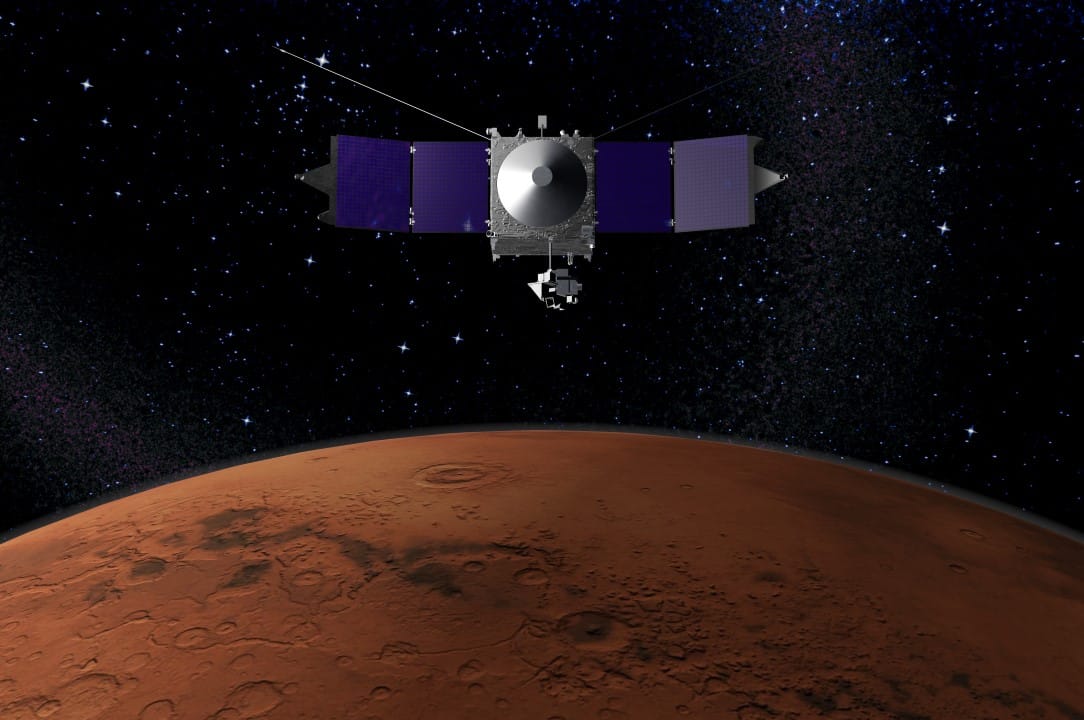
The North American space agency faces a scenario of high technical complexity after the definitive interruption of communications with the orbital equipment that has been monitoring the red planet since the end of last year. The main incident was recorded at the exact moment when the artificial satellite was supposed to reappear from behind the celestial body, failing to send the programmed telemetry packets to the control bases on Terra. Especialistas in ballistics and interplanetary navigation indicate that the artifact may have suffered a severe deviation from its original trajectory, a factor that adds layers of difficulty to remote tracking by global monitoring systems.
Initial mitigation operations and attempts to reestablish data flow had to be temporarily suspended due to the occurrence of the solar conjunction. Esse natural astronomical phenomenon creates a severe interference barrier that makes any safe exchange of commands between our planet and Martian orbit impossible. With this interference dissipating, engineering teams immediately mobilized the Rede of Espaço Profundo and the powerful radio telescopes of the Observatório of Green Bank to perform intensive scans of the space vacuum.
There@NASAconfirmed the loss of contact with the probe#MAVEN, which has orbited#Marsfor more than ten years, providing key information about the atmosphere of the red planet. 🚀pic.twitter.com/vpLzELr6A6
—Jaime Maussan (@jaimemaussan1)December 28, 2025
The flight control center currently operates with highly specific transmission windows, calculated based on the equipment’s last known coordinates. Operators attempt to send data packets containing hard reset commands to the internal computers, hoping that the secondary receivers still have enough power to pick up the signal and reactivate the primary transmitters.
Scientific importance and history of atmospheric monitoring
The space artifact began its scientific journey around the neighboring planet in 2014, carrying instruments designed specifically to unravel the physical and chemical mechanisms that resulted in the almost total loss of the Martian atmosphere. Durante Over a decade of uninterrupted operations, the satellite has provided a massive amount of unprecedented data on the dynamics of the solar wind and its destructive interaction with the local magnetosphere. Essas continuous measurements have allowed the international scientific community to develop highly accurate climate models, essential for understanding how liquid water disappeared from the surface over billions of years.
The abrupt interruption of this flow of meteorological and atmospheric information creates a significant temporal gap in the space agency’s records. Pesquisadores rely on this analytical constancy to map seasonal patterns of dust storms and variations in the density of gases that remain in the Martian environment. Sem the ability to cross current data with accumulated history, decades of studies on planetary evolution and the past habitability of the solar system may suffer considerable delays in their theoretical validation phases.
Technical investigation and formation of the anomaly committee
The gravity of the prolonged silence led the agency’s management to officially establish an anomaly review committee. Este multidisciplinary group brings together the main systems engineers, astrophysicists and propulsion experts from the aerospace sector.
The task force is tasked with auditing every line of code and navigation command transmitted in the weeks leading up to the signal loss. The primary objective is to identify whether a catastrophic software failure occurred during the orbital maneuver or irreparable physical damage.
Working hypotheses include the possibility of a high-speed collision with micrometeorites or uncatalogued space debris. Outra line of investigation focuses on a potential failure in the orientation gyroscopes, which would prevent the high-gain antenna from aligning correctly with terrestrial receivers.
Direct impact on rover data retransmission
In addition to its primary function as an atmospheric laboratory, the satellite plays an absolutely vital logistical role for the surface exploration infrastructure, acting as the main radio relay node for the Curiosity and Perseverance motorized robots. The design of ground missions assumes the existence of a robust orbital network, allowing rovers to use smaller antennas and save precious energy that is redirected to rock drilling and chemical analysis. Aproximadamente twenty percent of all high-resolution images and spectrometry results generated at craters Gale and Jezero rely exclusively on this communication bridge to reach terrestrial servers. With the confirmed absence of equipment, telecommunications engineers are forced to overload considerably older probes, such as the Mars Odyssey, which are already operating well beyond their designed useful life and have significantly less bandwidth for daily data flow.
Operational challenges imposed by the solar conjunction
The astronomical alignment known as solar conjunction represents one of the greatest periodic obstacles to interplanetary navigation. The phenomenon occurs when the central star of the system is positioned exactly in the line of sight between Terra and Marte.
During this period, the solar corona emits a dense curtain of ionized gas and electromagnetic radiation that severely corrupts any radio frequency. Agencies adopt a strict security protocol, suspending the sending of complex data packets.
Sending commands that are fragmented or corrupted by stellar interference can trigger erroneous security protocols in onboard computers, causing permanent damage to sensitive hardware that controls propulsion and internal temperature.
This forced interval of radio silence substantially delayed the initial diagnosis of the fault. Ground teams had to wait weeks until the orbital geometry allowed the safe resumption of transmissions and the effective start of search operations with radio telescopes.
Consequences for planning future missions
The instability in the Martian communications network highlights the fragility of the current digital infrastructure in deep space. The planning of future robotic incursions and the development of modules for manned missions directly depend on environmental predictability.
The lack of real-time monitoring of atmospheric density increases the risks associated with the entry, descent and landing sequences of large spacecraft. The director of Divisão of Ciências Planetárias, Louise Prockter, classified the full recovery of functions as a highly unlikely event in the current scenario.
- The transfer of scientific packets uses high-speed protocols that now need to be reconfigured.
- Software engineers study remote updates to optimize the energy consumption of surface robots.
- The agency is evaluating emergency partnerships with ESA to use the idle capacity of European satellites.
- Projects for new dedicated communications orbiters may have their development schedules accelerated.
Continuous listening protocols and recovery prospects
Despite the pessimistic projections drawn up by the technical committee, passive listening protocols remain active at tracking stations around the globe. The history of space exploration records rare cases in which equipment in deep safe mode managed to restart its systems after solar batteries captured adequate levels of light.
However, confirmation of a severe trajectory deviation remains the greatest risk factor for rescue teams. Essa navigation anomaly indicates that the artifact may have entered an irreversible escape orbit towards deep space, definitively ending its contribution to planetary science.
Technological legacy and accumulated data collection
Regardless of the outcome of electronic rescue operations, the volume of information collected over the last decade guarantees an invaluable legacy. The collection of data stored on terrestrial servers will continue to fuel academic research and doctoral theses on the formation of the solar system for many generations.
Maria Clara é colaboradora da redação do Mix Vale, portal de notícias com cobertura de Brasil e mundo. Produz conteúdo nas editorias de economia e benefícios, com foco em informação de serviço para o leitor brasileiro. Escreve para o portal desde 2016: Formação: Atriz.



