
Suzuki presents new GSX-8TT motorcycle with 82 horsepower engine and retro track-inspired look By Luís Henrique Costa
6 min read
 |
The Japanese manufacturer officially revealed to the global market its latest investment in the two-wheel segment, combining classic design elements with contemporary engineering. The new model arrives to expand the brand’s medium-weight family, using the same platform already known for its versatility on urban roads and winding roads. The vehicle’s main purpose is to offer an agile riding experience, supported by a robust mechanical package and a comprehensive electronics package that meets current mobility and leisure demands.
The development of the new machine focused on rescuing the visual heritage of competitions from past decades, integrating an aerodynamic front fairing that protects the pilot without compromising the minimalist aesthetic. The structure was designed to guarantee daily comfort and quick responses when required at higher speeds, demonstrating meticulous chassis and suspension calibration work.

Engineers implemented several fundamental technical features in the recently launched project, aiming to optimize overall performance:
- Parallel twin-cylinder engine with crankshaft offset by 270 degrees.
- Maximum power of 82.9 horsepower and torque of 78 Nm focused on medium speeds.
- Bidirectional quick gear shifting system as standard.
- Front brakes with double 310 mm discs and advanced anti-lock system.
The introduction of this model reinforces the automaker’s strategy of diversifying its portfolio, serving both beginners and veteran motorcyclists looking for a balanced ride. The vehicle is positioned as a viable alternative for those who need a means of daily transport that also offers sporting capabilities for use on highways during weekends.
Visual heritage refers to classic competition models
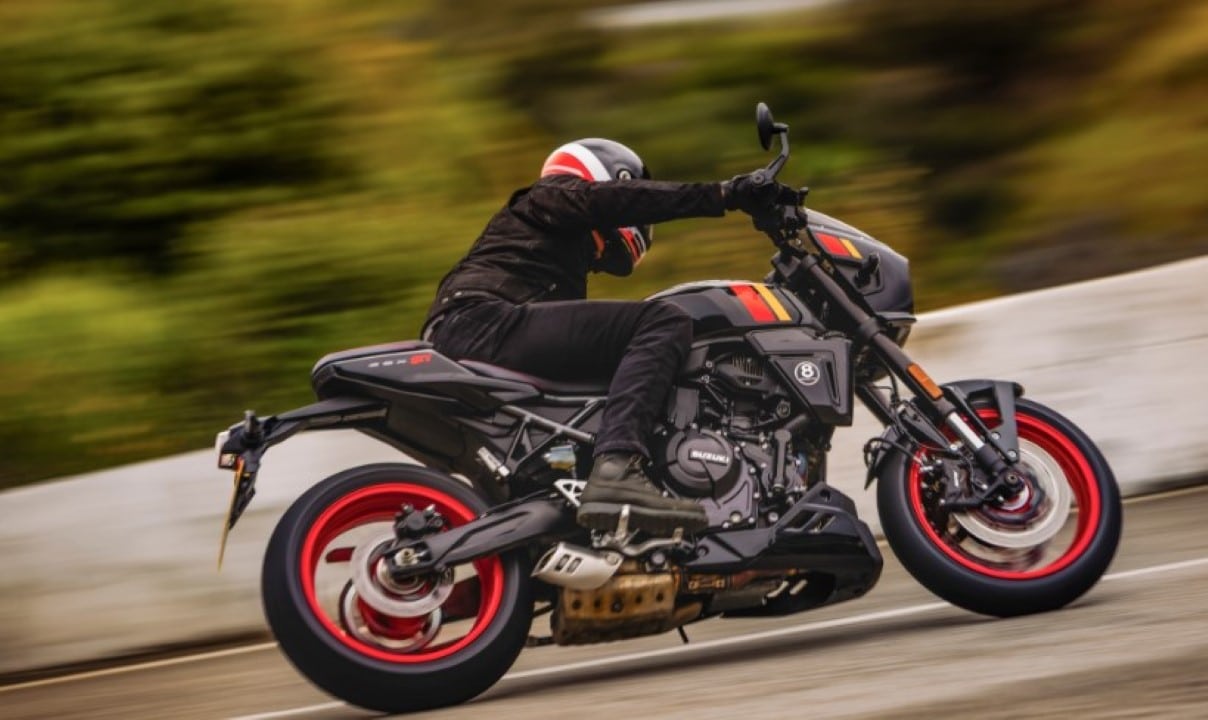
The aesthetic identity of the motorcycle makes a direct reference to the brand’s historic models, incorporating lines reminiscent of old racing machines, such as the legendary T500. The round headlight embedded in the front fairing and the subtle graphics create an interesting contrast with the modern lines of the fuel tank and tapered tail.
Specific details, such as the three-dimensional logo present on some versions and the wheels painted in gold, accentuate the nostalgic character of the project. The front fairing not only fulfills a stylistic function, but also actively reduces wind pressure on the driver’s chest when traveling at cruising speeds, improving the aerodynamic coefficient without adding excessive weight to the front assembly.
Mechanical assembly delivers linear acceleration and precise control
The heart of the motorcycle is a 776 cubic cylinder engine, configured with a long stroke to favor power delivery at low and medium speeds. Essa característica mecânica permite retomadas vigorosas no trânsito urbano sem a necessidade constante de reduções de marcha, disponibilizando grande parte do torque já a partir das 3.000 rotações por minuto.
The manufacturer’s patented two-axis balancer system drastically minimizes the vibrations inherent to parallel twin-cylinder engines. The result is smooth operation that reduces rider fatigue on long journeys, maintaining the stability of the rear-view mirrors and comfort on the aluminum pedals.
The electronic propellant management offers different driving modes, adjusting the throttle response according to the user’s preference and road conditions. The more aggressive mode guarantees instant acceleration ideal for highways and overtaking, while the softer setting facilitates driving in the rain or on roads with heavy traffic, smoothing the power delivery to the rear wheel.
Ergonomics adapted for multiple rider profiles
The riding position has been carefully calibrated to offer a compromise between sportiness and everyday comfort. The tapered aluminum handlebars provide a firm grip and a slightly forward-leaning posture, which improves directional control and reading the asphalt without putting strain on the rider’s wrists and shoulders.
With the seat positioned 810 millimeters from the ground, motorcyclists of average height can easily place both feet on the ground when stopping at traffic lights. The density of the seat’s foam was chosen to withstand hours of continuous driving, preventing excessive sinking, while the narrow shape at the junction with the tank facilitates body movement when cornering.
The tubular steel chassis demonstrates high torsional rigidity, resulting in directional stability on straight lines and agility in rapid trajectory changes. The curb weight of 203 kilograms is distributed evenly, masking the motorcycle’s mass during low-speed maneuvers and facilitating driving in narrow urban corridors.
The assisted and slipper clutch significantly reduces the effort required to operate the left lever, a relief in heavy traffic situations. Este mechanism also acts to prevent the rear wheel from locking during sudden downshifts, providing a more stable and safer corner entry, working in conjunction with the inverted front suspension and the KYB rear shock absorber with preload adjustment.
Technological package increases road safety levels
The instrument panel consists of a five-inch color TFT screen that displays all vital information clearly, regardless of the incidence of sunlight. Através From this interface, the rider manages the three-level traction control system, which acts by cutting the ignition milliseconds before the rear wheel loses grip on slippery surfaces. The electronic package also includes the low speed assistant, a technology that slightly increases the engine speed when releasing the clutch, preventing the vehicle from accidentally turning off at traffic lights.
The braking system has been sized to handle the machine’s performance, employing four-piston radial-mount calipers on the front wheel, which bite down on twin discs. The anti-lock system acts discreetly, intervening only in real emergency situations to maintain drivability. Full LED lighting ensures excellent nighttime visibility and makes the motorcycle more noticeable to other drivers in daily traffic, while the control handles follow an intuitive layout for operation without diverting attention from the road.
Energy efficiency and strategic positioning in the global market
In terms of fuel consumption, standardized tests indicate remarkable efficiency for an engine of this cubic capacity, reaching marks close to 23.4 kilometers per liter in the WMTC mixed cycle and up to 34.5 kilometers per liter at a constant cruising speed of 60 km/h. The 16-liter tank ensures theoretical autonomy that qualifies the model for both daily commuting and long trips. The 2-in-1 exhaust system, equipped with a dual-stage catalytic converter, is designed to meet stringent global emissions standards while maintaining optimized gas flow. This version’s unique lower fairing protects exhaust components from road debris and improves airflow around the crankcase. In the original market, the Japão, the motorcycle was announced with a suggested price of 1,386,000 yen, a value that reflects the level of premium finishing and the amount of technology on board. The introduction of this vehicle occurs at a time when consumers are looking for medium-sized motorcycles that deliver mechanical reliability and low operating costs. The Dunlop SPORTMAX
Dimensional specifications reinforce the project’s agile proposal
The motorcycle’s general measurements include a total length of 2,115 millimeters, width of 775 millimeters and a wheelbase of 1,465 millimeters, proportions that guarantee predictability in dynamic reactions. The ground clearance of 145 millimeters allows you to overcome common urban obstacles, such as speed bumps and gaps, without the risk of scraping the lower part of the chassis. Dependendo of the market and local regulations, the engine also has an approved version with 59 kW (80 horsepower) and 76 Nm of torque, maintaining the same linear power delivery curve and the six-speed gearbox with precise scaling.











