

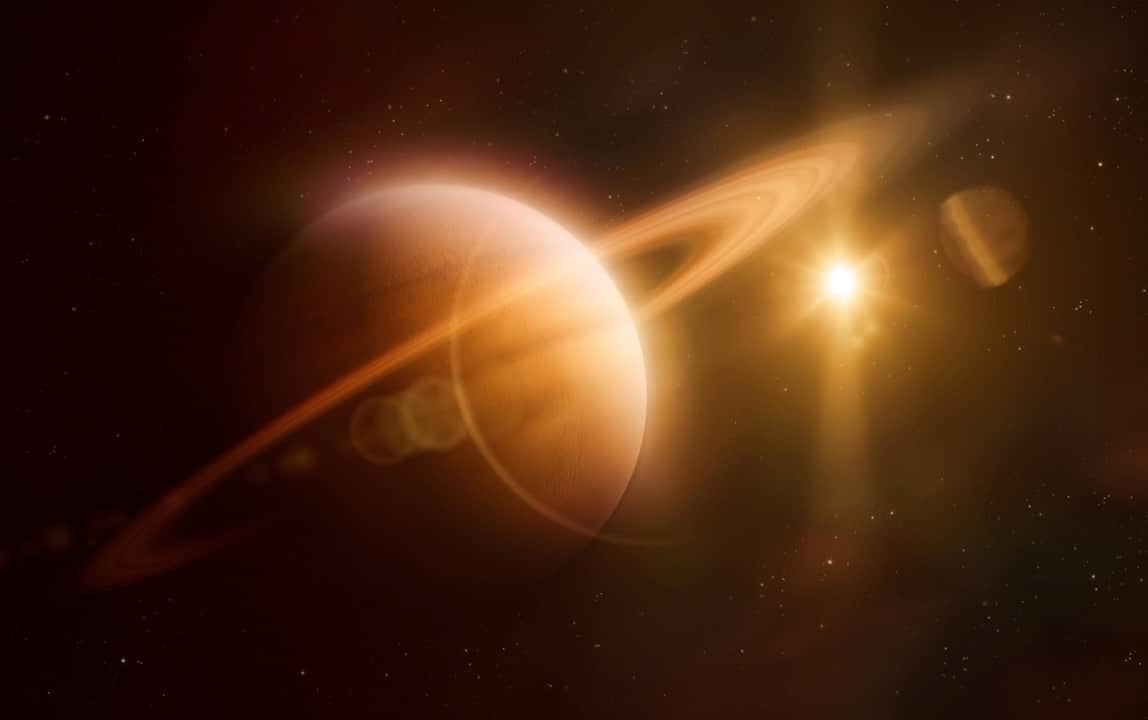
Planetary scientists have reached a significant milestone in understanding Saturno, revealing how the planet’s stunning auroras act as a “heat engine” that drives atmospheric circulation and ultimately helping solve a decades-old mystery about the gas giant’s true rotation rate. The discovery, based on in-depth data analysis, offers a new perspective on the complex interaction between the atmosphere, magnetic field and interior of gaseous planets.
For a long time, accurately determining the rotation period of Saturno posed a substantial challenge to astronomers. Diferentemente of rocky planets, Saturno does not have a solid surface to serve as a reference point, and their visible atmosphere has different rotation speeds at various latitudes, complicating direct measurements. Essa new research points to an unexpected connection between auroral phenomena and the planet’s internal dynamics.
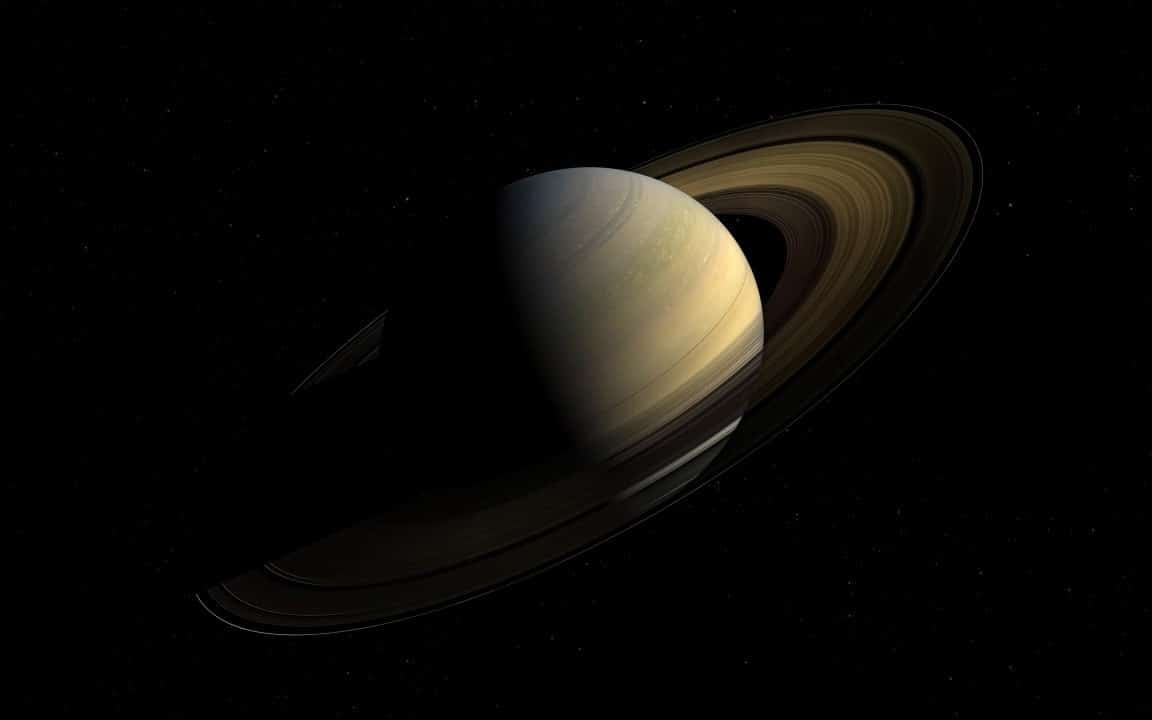
The research highlights that the warming generated by Saturno’s polar auroras is not just a visual spectacle, but a crucial driver of atmospheric energy. Esse The heating process, which occurs in the upper layers of the atmosphere, creates currents that extend deep into the planet, influencing the movement of vast masses of gas and, consequently, the way in which the magnetic field is generated and perceived.
The complexity of Saturn’s rotation
The difficulty in measuring the rotation of Saturno lay in the absence of a fixed point. The planet’s visible clouds move at varying speeds, and the magnetic field, which on other gas planets like Júpiter provides a “signature” of interior rotation, on Saturno is almost perfectly aligned with the axis of rotation. Isso rendered traditional magnetic measurements ineffective in determining the rotation of the nucleus.
For decades, different methods and observations have produced conflicting estimates for the length of a Saturnian day, varying by tens of minutes. Essa uncertainty has generated a persistent scientific debate, with each new space mission bringing more data, but without a definitive answer that could reconcile all the observations.
The role of auroras as a heat engine
The auroras of Saturno, similar to those of Terra, are generated by the interaction of charged particles from the solar wind with the planet’s magnetic field, resulting in spectacular light emissions at the poles. However, in Saturno, this phenomenon transcends the mere luminous display, assuming a fundamental role in the planet’s energetic dynamics. Auroral heating injects a substantial amount of energy into the upper layers of the atmosphere.
This heat causes the gas to expand and creates strong convection currents. Essas ascending and descending currents are not limited to high altitudes; they propagate to deeper regions of the atmosphere, acting as a “heat engine”. Este engine transfers energy efficiently, influencing large-scale circulation and heat distribution across vast atmospheric regions.
The energy released by auroras is so powerful that it can significantly alter wind patterns and temperatures throughout the stratosphere of Saturno. Essa influence manifests itself in the way different atmospheric layers interact, creating a coupled system where what happens at the poles directly affects the global dynamics of the planet, including the equatorial jet streams. Understanding this mechanism is crucial to unraveling how energy is distributed and dissipated in gas giants, which have atmospheres much thicker and more complex than those of rocky planets.
Observations and discoveries from mission Cassini
The Cassini-Huygens mission, a collaboration between NASA, ESA and ASI, was fundamental to this discovery. Durante During its 13 years in orbit around Saturno, the Cassini probe has collected an unprecedented wealth of data about the planet, including detailed observations of its auroras, magnetic fields, and the composition and dynamics of its atmosphere. Instruments on board Cassini, such as the Ultraviolet Imaging Spectrograph (UVIS) and the Composite Infrared Spectrometer (CIRS), allowed scientists to map the extent and intensity of auroras and measure temperatures and atmospheric movements.
This data allowed researchers to build three-dimensional models of Saturno’s atmosphere, incorporating the effects of auroral heating. The ability to observe auroras at different wavelengths and over an extended period of time allowed us to identify patterns and variations that were crucial to understanding how they transfer energy to the rest of the planet. Temperature and wind speed measurements in the upper layers of the atmosphere, in particular, have provided direct evidence of the “heat engine” in action.
Implications for planetary dynamics
Understanding how Saturno’s auroras act as a heat engine has profound implications for planetology. Ela suggests that energetic phenomena at high latitudes can have a far-reaching impact on the global dynamics of a planet, far beyond what was previously imagined. Essa new perspective is vital for modeling the atmospheres of other gas giants, both inside and outside our solar system.
By revealing this interconnection, scientists can refine climate and atmospheric models of giant planets, improving our ability to predict their behavior and evolution. The study also improves our understanding of how planetary magnetic fields interact with their atmospheres, a complex and fundamental field of study for the characterization of similar exoplanets.
Unraveling the mystery of internal rotation
The mystery of Saturno’s rotation has been one of the most persistent enigmas in planetary science. Sem a solid surface and an almost perfectly symmetric magnetic field, scientists have struggled to find a reliable “clock” for the planet’s interior. The discovery that auroras drive a heat engine provides a new key to this enigma.
By understanding how auroral heat moves the atmosphere and, in turn, influences the magnetic field, researchers were able to infer a more accurate rotation rate for the deep interior of Saturno. Esse indirect but robust method finally converges on a consistent estimate, which was elusive for decades.
Comparisons with other gas giants
This new understanding of Saturno may have parallels in other gas giants in our solar system, such as Júpiter, Urano and Netuno, and even in exoplanets. Embora each planet has its particularities, the principle that energetic phenomena at high latitudes can influence global dynamics and internal rotation is an idea that can be tested in other contexts.
At Júpiter, for example, where auroras are also prominent, the research could help refine existing models about the interaction between its powerful magnetosphere and the atmosphere. Estudar these mechanisms on different planets allow scientists to develop a more universal theory about the formation and evolution of gas giants.
Advances in understanding extreme atmospheres
The atmosphere of Saturno is a natural laboratory for studying extreme conditions. Temperatures vary drastically between layers, and wind speeds can reach impressive magnitudes. Research into the auroral heat engine adds a layer of complexity and sophistication to our understanding of these atmospheres. Ela demonstrates how large-scale energetic processes can shape the planetary environment in unexpected ways.
These advances not only deepen our knowledge about Saturno, but also open new avenues for research in astrophysics and planetary sciences, especially in the search for life in other systems. Compreender The atmospheric dynamics of giant planets are crucial for determining their habitability and for interpreting observations from next-generation telescopes. Solving the mystery of Saturno’s rotation through studying its auroras represents a triumph of observation and scientific modeling.



