

In April 2026, a new comet, C/2026 A1 (MAPS), will pass in an unprecedented proximity to Sol, generating great expectations in the scientific community and among astronomy enthusiasts about its potential visibility with the naked eye. Este singular event, which will involve one of Grupo Kreutz’s so-called “sungrazer comets”, promises a celestial spectacle or, alternatively, a quick disappearance.
The complexity in predicting the behavior of a comet that ventures so close to our star is considerable. Fatores how Sol’s composition, size and ability to withstand intense heat directly influence its brightness and visibility from a terrestrial point of view. The uncertainties surrounding the fate of comet MAPS are one of the main points of attention.
This article delves into the details of this fascinating approach, exploring the comet’s discovery, its classification, the characteristics of the intriguing Grupo Kreutz, and the various scenarios that could unfold when C/2026 A1 reaches its perihelion. Serão forecasts and observation possibilities were addressed, keeping the public informed about one of the most anticipated astronomical events of next year.
Discovery and orbit of comet MAPS
Comet C/2026 A1 (MAPS) was discovered on January 13, 2026, thanks to the MAPS project, an initiative of amateur astronomers at Chile. Esta recent discovery added a new member to a special category of comets, whose trajectory and behavior are of great interest to researchers.
Subsequent observations were crucial to accurately determining the orbit of this celestial body. Confirmou Comet MAPS belongs to the notable “Group Kreutz”, a set of comets known for their extremely close approaches to Sol. Este orbital detail is critical to understanding what’s to come.
Characteristics of Grupo Kreutz and historical examples
Grupo Kreutz is a fascinating set of comets that share a peculiar orbital characteristic: they all come drastically closer to Sol in their trajectories. The prevailing theory suggests that this group is composed of fragments of one or more giant comets that broke apart during previous solar approaches, and whose pieces continue to orbit and periodically return to the solar neighborhood. Essa particularity makes them objects of intensive study and great expectation. Muitos comets from this group are discovered through images from the SOHO solar observation probe, given the difficulty of observing them from Terra. Geralmente these comets dive directly into Sol or, if they only touch it, they are vaporized and disintegrated by the extreme heat they face at perihelion. Contudo There are notable exceptions. Cometas larger and brighter, when they survived these extreme passages, they transformed into so-called “great comets”, developing spectacular tails. A famous example from the 20th century is comet Sol0-Seki (C/1965 S1 (Ikeya-Seki)), observed in 1965, and from the 19th century, C/1882 R1, known as Sol1 of 1882, both belonging to this group.
The uncertainty of survival and the comet Lovejoy
Comet MAPS, although notable, was observed to be considerably fainter than comet Ikeya-Seki, suggesting that its size is smaller. Essa difference in magnitude is an important factor in predictions about its resilience in the face of intense solar radiation.
On the other hand, comet MAPS has a brighter brightness than comet Lovejoy (C/2011 W3 (Lovejoy)), which in 2011, despite its small initial size, survived the passage through perihelion and exhibited a long tail in Hemisfério Sul. Essa comparison raises the hope that comet MAPS can also resist its closest solar approach. However, the unpredictability of these events, given the rarity of detailed observations of bright Kreutz comets, makes any prognosis a complex and uncertain task.
Possible scenarios for comet visibility
The passage of comet MAPS through perihelion is scheduled for April 4, 2026. Até this date, it is possible to develop some scenarios for its behavior, based on current observations and precedents of other Grupo Kreutz comets. Uncertainty is inherent to the dynamics of these celestial bodies, but predictions help prepare for the different possibilities.
Until March 28, the comet was visible at an approximate magnitude of 8, rapidly approaching Sol and gradually increasing in brightness. Contudo, its position in the sky, extremely low just after sunset, already made it difficult to observe from Terra. From here, three main outcomes are considered.
Scenario 1: Complete disappearance
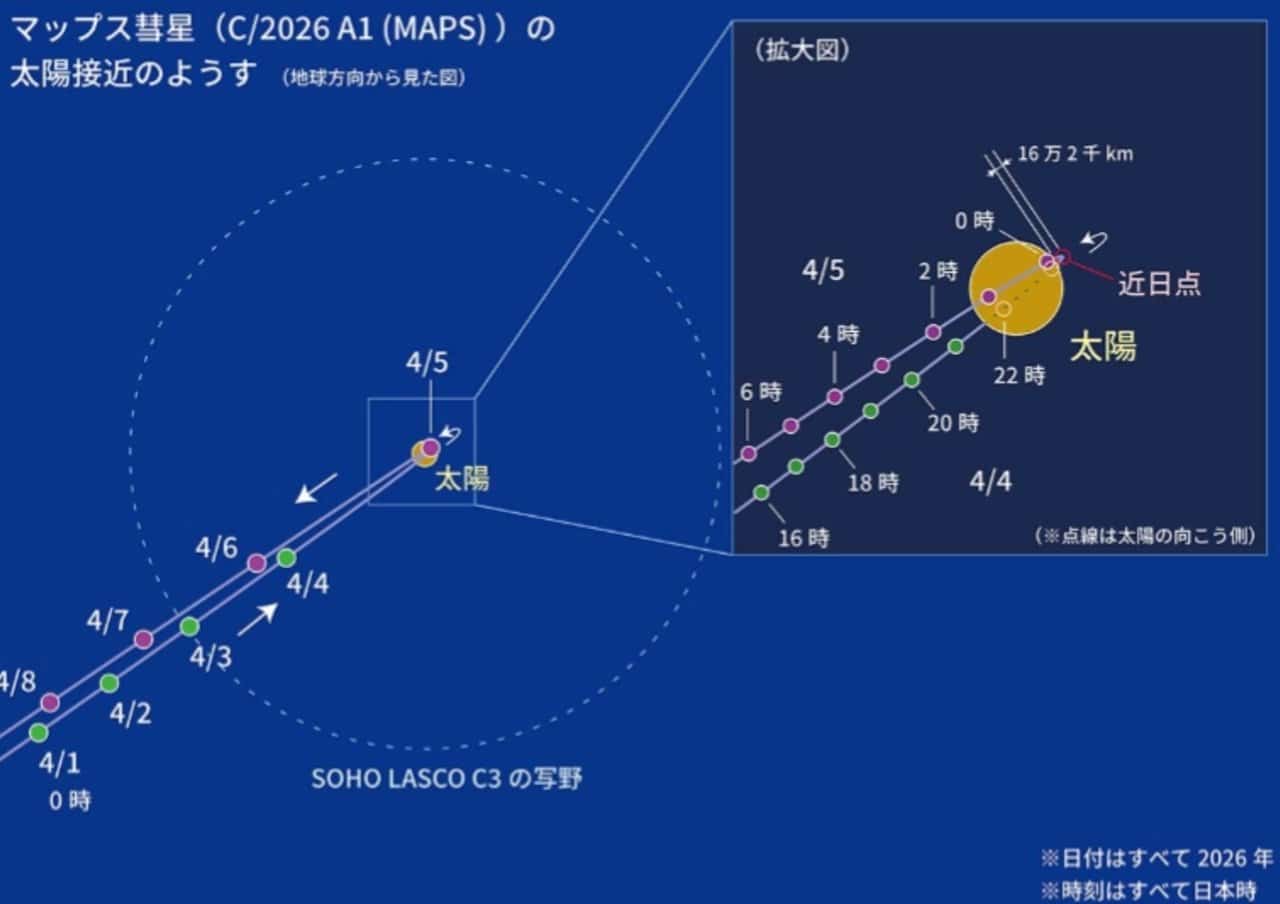
The first possibility, and perhaps the most drastic, is the complete disappearance of comet MAPS. Quando the comet reaches its closest approach to Sol, about 858,000 kilometers from the solar center — a distance of just 162,000 kilometers from the surface, less than half the distance between Terra and Lua — it will be exposed to such intense heat and radiation that its material will evaporate complete.
In this case, the comet will no longer be visible after it passes through perihelion on April 4. Imagens of spacecraft like SOHO’s LASCO C3 would be the only ones to record the event, with the comet entering C3’s field of view on April 3 and disappearing thereafter.
Scenario 2: Fragmentação and gradual disintegration
A second possibility is that the comet does not disappear completely, but fragments and disintegrates shortly after its passage through Sol. Durante At its closest approach, the comet may become temporarily unobservable from Terra due to its proximity to Sol and its intense brightness. Contudo, the core itself could survive, and gas releases and other phenomena resulting from fragmentation could be observable.
These manifestations would be captured by images like those from SOHO’s LASCO C3, which monitors “sungrazer” comets. However, the comet itself, already fragmented, would continue to gradually disintegrate. From approximately April 10, only a faint tail of dust could be discernible in the low western sky after sunset in places with little light pollution. With the appropriate photographic equipment, it would be possible to record this elongated tail, but the absence of a bright “coma” would make observation difficult in urban or suburban areas.
Scenario 3: Sobrevivência and brilliant apparition
The third and most hopeful possibility is that comet MAPS survives its solar passage and appears as a bright comet. Neste scenario, the initial behavior as it approaches Sol would be similar to that of Cenário 2, with a brief phase of direct unobservability. Entretanto, the main difference is that the comet’s body would remain intact and clearly visible after passing, transforming into a celestial spectacle.
In Japão, for example, the comet could begin to be visible around April 8 in the low western sky, just after sunset. Embora If its brightness could progressively decrease, from April 10, a comet with a magnificent tail would be discernible in the same region of the sky. Ele could be seen with the naked eye, albeit vaguely, even in urban areas, and with greater clarity in places with darker skies. Furthermore, a common camera would be able to capture the comet and its extensive tail in photographs, making it an object of great interest to amateur and professional astronomers.
Observations and monitoring tools
Currently, there are three main scenarios for comet MAPS, and although the possibility of observing it with the naked eye is considered low in the most likely scenario, the reality will only be confirmed when the event occurs. Astronomy often holds surprises, and the behavior of comets can be unpredictable.
To monitor this phenomenon, observation images from the SOHO (Solar and Heliospheric Observatory) spacecraft, especially the LASCO C3 instrument, are crucial. The astronomical unit (AU), which measures approximately 149,597,870.7 kilometers, is the average distance between Terra and Sol, and serves as a reference for cometary distances. Comet MAPS should appear in the field of view of LASCO C3 at around 0:00 on April 3 (Japão time), remaining visible until approximately 3:00 on April 6, if it survives. The scientific community will remain vigilant, and if the comet becomes visible, new information and explanatory pages will be made readily available.



