
Practical test before purchase helps to define whether a regular bicycle or pedelec best suits your daily life
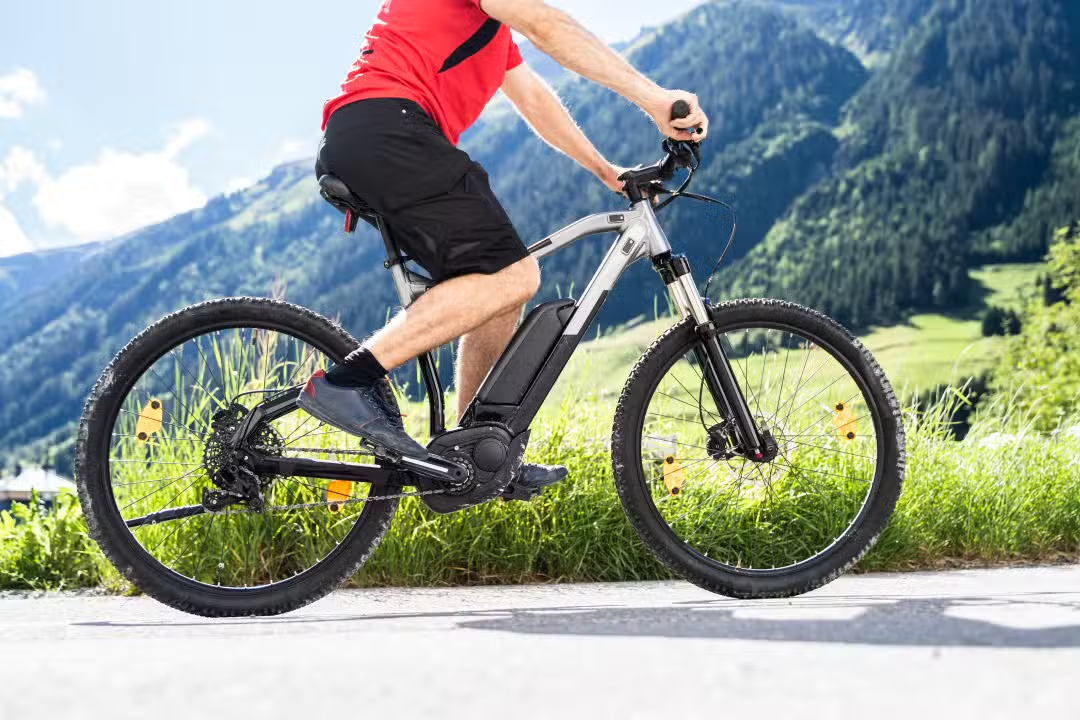
The decision between purchasing a traditional bicycle or a pedelec varies depending on the cyclist’s daily use profile. Especialistas highlight that short, flat routes in urban areas favor the classic model due to its lightness and simplicity of storage. Já Over longer distances or with steep terrain, the pedelec offers electric assistance that encourages more frequent use of the bicycle without excessive exhaustion. The choice requires evaluating factors such as initial maintenance cost and durability to avoid later regrets.
Advantages and limitations of each type of bicycle
The pedelec with a motor of up to 250 watts and assistance of up to 25 km/h allows you to overcome hills and headwinds with less physical effort. Usuários who face long or irregular routes report greater frequency in daily commuting, including to work or shopping. However, the model has a higher weight, which makes it difficult to transport on stairs or store in small spaces such as apartments or basements.
The common bicycle stands out for its agility and ease of handling on flat and short routes typical of urban centers. Seu reduced weight makes it easy to load and store in tight spaces without the need for charging sockets. Muitos cyclists prefer this option when the main objective includes regular physical activity without dependence on electronic components.

Acquisition and maintenance costs influence the choice
A traditional model of safe and durable quality costs on average one thousand euros while a good pedelec costs three thousand euros. Pedelec maintenance is around 50 percent more expensive due to the electrical components and the eventual need to replace the battery after six or seven years, costing approximately five hundred euros. Ciclistas must consider these expenses over the estimated useful life of ten years for the pedelec versus more than thirty years for the common bicycle with regular care.
- Basic models of common bicycles suit smaller budgets well
- Pedelecs require greater financial planning for purchasing and replacing parts
- Test drive helps validate whether the investment pays off in real use
- Dealers recommend evaluating the type of terrain and frequency of use before making a decision.
Safety and regulation in the use of pedelecs
Pedelecs up to 25 km/h are legally equivalent to ordinary bicycles in Alemanha without requiring a license or specific insurance. Não Helmets are mandatory although their use is recommended for greater protection. Especialistas note that the risk of accidents does not necessarily increase due to the engine but can occur with inexperienced users who return to cycling after a long break. Prática Low speed start minimizes these risks.
Charging the battery requires care to avoid incidents such as fire. Recomenda – Do not use low-cost generic chargers or leave the equipment charging overnight indoors. Baterias damaged must be taken immediately to a specialist dealer for disposal or appropriate repair.



Practical recommendations for testing and adaptation
Shopkeepers like those at Colônia suggest trying out both types of bikes before making the final purchase. The feel of the handlebars in the saddle and the response of the engine or pure pedaling influence daily satisfaction. Fatores such as frame height, position adjustment and load carrying capacity also deserve attention when evaluating.
- Check whether the usual route includes many hills or strong winds
- Assess available space for storage and ease of loading
- Consider goals such as maintaining physical fitness or commuting comfort
- Consult professionals for personalized guidance based on individual needs
Durability and impact on the cyclist’s daily life
The traditional bicycle offers simple mechanical robustness with a lower probability of electronic failures and an extended lifespan when subjected to periodic maintenance. Ciclistas Those who prioritize simplicity and autonomy without dependence on electricity tend to opt for this model on regular urban routes. The pedelec expands mobility possibilities for those who face physical challenges or distances that previously seemed unmotivating.
In rural regions or with connections between neighboring cities, the pedelec reduces fatigue and encourages the replacement of motorized routes with more sustainable options. Usuários report arriving at their destination with less sweat and greater willingness for subsequent activities. Technology continues to evolve with models that balance weight, performance and battery life in an increasingly efficient way.
Things to look out for when purchasing
Resellers emphasize the importance of aligning the choice with the intended use, avoiding oversizing or underusing the equipment. Para For journeys of less than fifteen kilometers on flat terrain, the common bicycle is fully suitable without unnecessary additional costs. On the other hand, those who travel routes longer than thirty kilometers per day or carry frequent loads benefit from electric assistance.
The final decision combines budget analysis, physical profile and characteristics of the usual route. Testes in real conditions provide concrete data on comfort and suitability. Profissionais from the sector advise that no option is universally superior and it is up to the cyclist to define priorities between economy, simplicity or motorized support.
Veja Tambem em News (EN)

Research reveals that parents are unaware of how their children use artificial intelligence

Samsung releases new system update with new features for Galaxy Watch 4 users

Digital retail reduces the value of the Galaxy S25 5G smartphone with bank bonuses and device exchange

Amazon’s wireless CarPlay adapter has a 50% discount and high approval ratings from drivers

Zach Cregger’s new Resident Evil ignores games and focuses on an unprecedented story with new characters

Rumor suggests that Nintendo is preparing a special edition of the Switch 2 with a remake of Ocarina of Time

Apple accelerates production of the iPhone 17e and develops new Air model with dual camera system

Epic Games platform releases twelve high-budget games at no permanent cost for PC users

PlayStation 5 Pro price drop accelerates digital retail sales and eliminates global stocks

New Galaxy Watch 9 firmware appears on server and confirms progress in software development

Apple’s commemorative project tests cell phone with 1.1 millimeter edge and curved screen for 2027
