

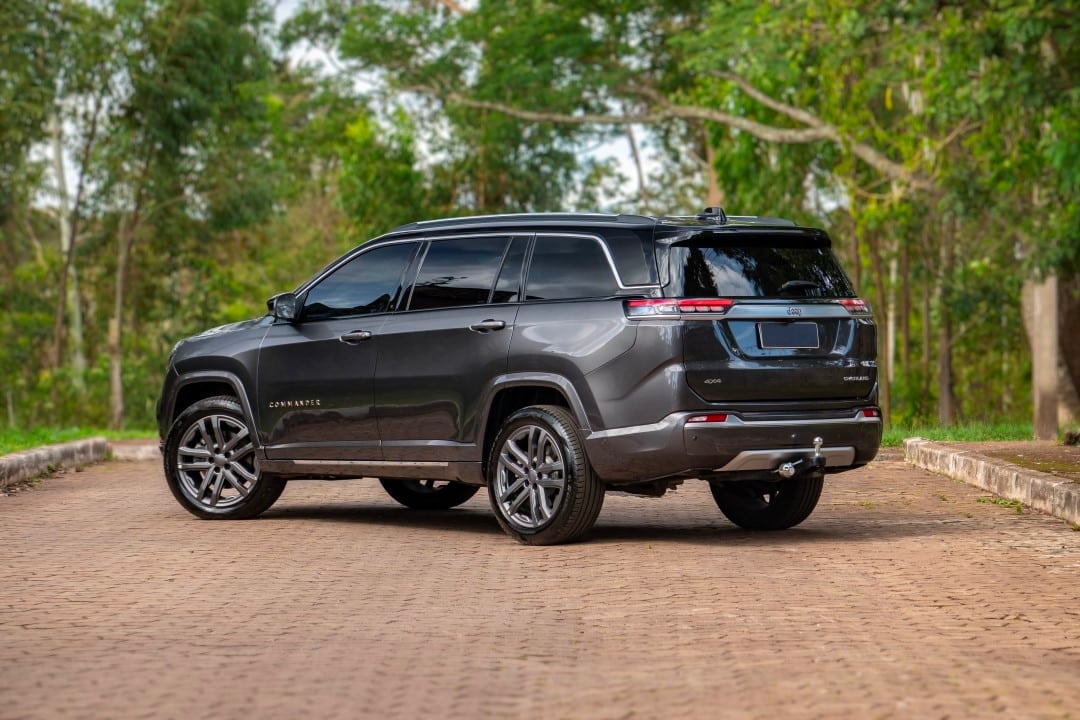
The North American automaker officially announces the arrival of the updated line of its large sports utility vehicle on the national market, bringing substantial changes to its range of engines. The new seven-seater vehicle portfolio now incorporates 48-volt mild-hybrid technology, specifically designed for variants Limited and Overland, which are equipped with the T270 engine. Paralelamente To this partial electrification, the sporty configuration Blackhawk receives an important update by adopting the 2.0 turbo engine Hurricane in its flexible version, allowing fueling with ethanol or gasoline. Essa technical movement strictly follows the same strategic guideline recently applied to the brand’s compact model, aiming to optimize energy efficiency and reduce pollutant emission rates, without compromising dynamic performance or the recognized ability to overcome obstacles on unpaved roads.
The manufacturer chose to maintain stability in most of its price list charged at dealerships. The only notable financial change occurs in the top-of-the-line version, which registered a reduction in its suggested price for the end consumer.

The main guidelines for this catalog update encompass the following technical and commercial aspects:
- Implementation of electrical assistance to reduce urban consumption.
- Upgrading the high-performance engine to the dual-fuel system.
- Full maintenance of the safety and driving assistance package.
Mechanical upgrades and thermal efficiency of the T270 engine
Configurations Limited and Overland now leave the factory equipped with the MHEV mechanical package, which works in synergy with the 1.3 turboflex engine of the T270 family. Este propulsion system delivers a maximum power of 176 horsepower and a torque of 27.5 kgfm, numbers that guarantee agility to the large sports utility vehicle. The electrical component acts directly as an aid in the acceleration and speed recovery phases, in addition to acting as a generator to recover the kinetic energy that would normally be dissipated during everyday braking and deceleration.
The official approval tests carried out by Instituto Nacional, Metrologia, Qualidade and Tecnologia indicate that the model equipped with mild hybrid technology can record consumption averages of up to 11 km/l when fueled with gasoline on strictly urban routes. Essa brand represents a reduction in fuel consumption that can reach 9.4% when compared directly with the conventional version previously offered. With regard to environmental impact, the improvement in carbon dioxide emissions reaches the mark of 5% in the combined use cycle, which includes city and highway sections.
Performance preserved in sports configuration Blackhawk
The Blackhawk variant, positioned as the highest performance option within the utility vehicle’s range, adopts the modern 2.0 turbo engine from the Hurricane family, now in its flex specification. Este four-cylinder engine continues to deliver an impressive 272 horsepower and a robust torque of 40.8 kgfm, maintaining these numbers regardless of the proportion of ethanol or gasoline present in the fuel tank.
The calibration of this mechanical assembly follows the exact technological standard that has already been successfully implemented in other high-value-added products from the automotive group. Veículos as well as the sporty versions of medium-duty utility vehicles and compact-medium pickup trucks from the same corporation already use this architecture to guarantee quick responses to the accelerator pedal.
From a commercial point of view, the automaker applied a strategic reduction in the suggested public price of this specific configuration, with a cut of R$6,500. With this readjustment, the list price of the sports option starts at R$ 329,990, fully preserving the more aggressive driving dynamics.
Catalog structure and updated price list
The organization of the catalog for the new model year maintains a well-defined version structure, designed to meet different consumer profiles and usage needs. The entry-level option, called Longitude, continues to use the T270 engine in its traditional form, without the addition of the 48-volt auxiliary electrical system.
The configurations positioned in the intermediate and upper price ranges are responsible for debuting the propulsion technological innovations announced by the manufacturer. Essa distribution aims to concentrate the added value on the versions that historically concentrate the largest volume of registrations in the national market.
For those who demand high traction capacity and autonomy on long trips, the version Overland equipped with the 2.2 turbodiesel engine continues to be offered regularly. Esta configuration maintains the four-wheel drive system, delivering 200 horsepower and 45.9 kgfm of torque, ideal characteristics for towing implements and constant traffic on dirt roads.
The suggested price list reflects the repositioning of the line, starting with version Longitude T270 for R$228,790. Next, the Limited MHEV T270 is sold for R$255,690, while the Overland MHEV T270 reaches R$283,790. The top-of-the-line options close the catalog with the Overland 2.2 Turbodiesel 4×4 for R$319,990 and the Blackhawk flex for R$329,990.
Tax advantages and exemptions for owners
The adoption of the mild-hybrid system provides advantages that go beyond fuel savings at gas stations, extending to the tax sphere. Owners of electrified versions can request tax incentives in six states of the federation, where local legislation provides for partial discounts or even total exemption from Imposto over Propriedade from Veículos Automotores, generating financial savings that can reach the R$9,000 mark depending on the regional tax rate.
In the municipality of São Paulo, which has the largest circulating fleet in the country, vehicles registered with this engine are entitled to exemption from municipal license plate rotation. Esses Government benefits act as a direct stimulus for the purchase of cars that emit less pollutants, presenting the additional advantage of not requiring the installation of home chargers or dependence on public charging infrastructure.
Internal space and safety package for seven occupants
The vehicle’s structural design preserves all the fundamental characteristics that have consolidated it as a viable option for large families and for versatile use in everyday urban and road use. The cabin maintains seating arrangements for up to seven adult occupants, distributed across three rows, with a luggage compartment that offers modular volume according to how the seats are folded. The convenience features, acoustic insulation and interior finishing with soft-touch materials remain strictly unchanged compared to previous years’ models. In terms of passenger protection, the advanced safety package continues to be standard equipment in all versions sold, encompassing technologies such as the autonomous emergency braking system with pedestrian detection, the active lane keeping assistant, blind spot monitoring and a set of six airbags distributed throughout the cabin. The brand’s engineering also ensured that the adjustment of the independent suspension system and the calibration of the electric steering kept the dynamic behavior balanced, absorbing irregularities in the asphalt efficiently and guaranteeing directional stability at cruising speeds.
Detailed operation of the auxiliary electrical system
The technical functioning of the 48-volt MHEV system is based on replacing the conventional alternator with a belt-driven electric generator, which acts bidirectionally. Essa engineering solution allows the supply of instant additional torque to the internal combustion engine, adding up to 6.6 kgfm of force in times of greatest demand, without this representing a significant increase in weight to the total mass of the vehicle, using a compact lithium-ion battery to store energy.
Market strategy in the sports utility vehicle segment
The portfolio update occurs at a time of high competition in the medium and large sports utility vehicle segment in the automotive market. Consumer demand for vehicles that combine generous internal space with more rational levels of fuel consumption has dictated the pace of innovations presented by automakers installed in the country.
With the introduction of these new propulsion technologies, the manufacturer seeks to solidify its prominent position in the category’s registration statistics. The strategy of diversifying mechanical options, offering everything from traditional engines to electrified sets and high-performance drives, aims to cover all ranges of demand without giving up the visual identity and robustness associated with the brand.



