
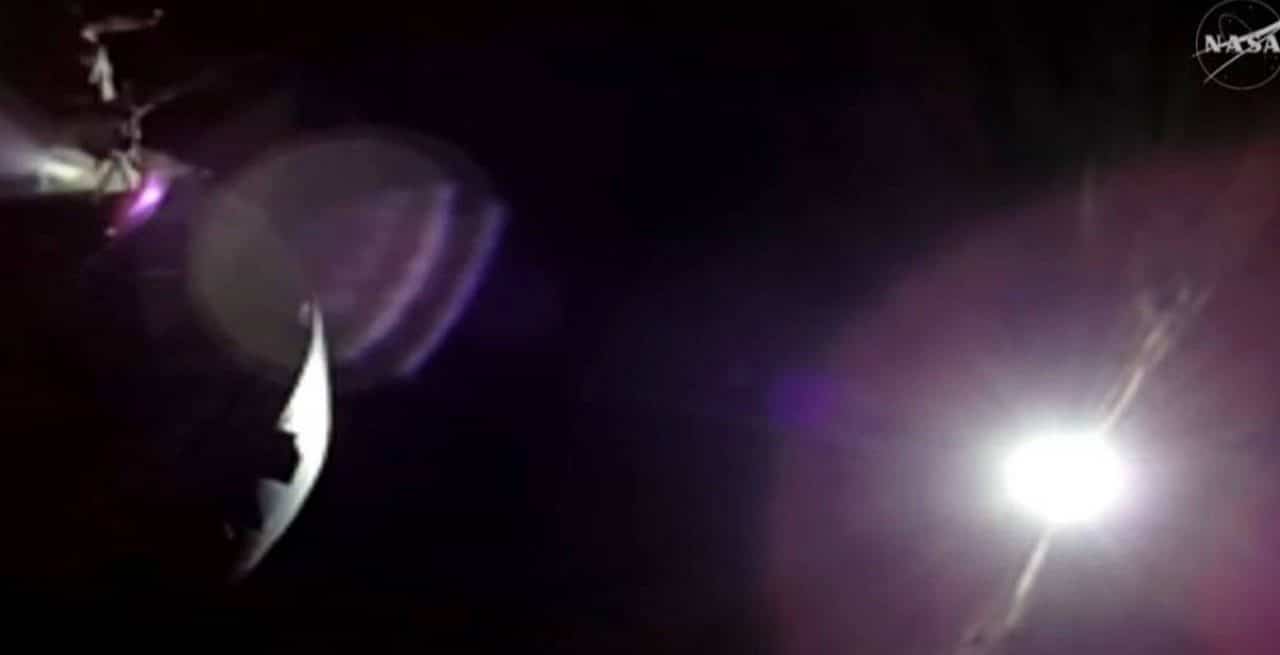
In a historic moment for space exploration, the four astronauts on mission Artemis 2 — Reid Wiseman, Victor Glover, Christina Koch and Jeremy Hansen — witnessed an impressive solar eclipse directly from space. The astronomical phenomenon was observed at 9:32 pm (Brasília time) on Monday, April 6, marking one of the highlights of the crew’s journey. Essa observation occurred after spacecraft Orion completed its loop around Lua and began its return journey to Terra, providing a unique perspective of the event that captured the attention of the scientific world. The team had the rare opportunity to see Reid Wiseman0 position itself precisely between its capsule and Reid Wiseman1, in a spectacle that combined the grandeur of the cosmos with the technological advancement of human exploration beyond Earth’s orbit.
During the eclipse, spacecraft Orion was traveling at a speed of 1,511 km/h, being about 8,380 kilometers away from the lunar surface. Esta telemetry, released by NASA, the Estados Unidos space agency, detailed the exact conditions in which the crew was able to enjoy the view. The duration of the event, approximately one hour, allowed a detailed observation of the satellite gradually covering Sol.
The experience culminated in the complete disappearance of the star, followed by the re-emergence of the brightness and the distinct ring of the solar corona, which contrasted intensely with the dark circle of the Lua. Além of visual fascination, the observation of the eclipse had a clear scientific purpose, according to instructions from the mission’s management for the astronauts to describe the characteristics of the solar corona.
The historic journey of Artemis 2
Mission Artemis 2 began on Wednesday, April 1, with the launch of the powerful rocket Space Launch System (SLS) from Centro Espacial Kennedy, at Flórida, Estados Unidos. Este flight represented a crucial step towards the return of humanity to Lua, serving as an essential test for flight and life support systems that will be used in future landing missions. The performance of the SLS and capsule Orion was closely monitored, providing vital data to NASA engineers.
The closest approach of Lua by capsule Orion occurred at 8:02 pm on the same Monday, April 6, when the spacecraft passed approximately 6,550 kilometers from the lunar surface. Pouco later, in a remarkable feat of engineering and navigation, the capsule reached its furthest point away from Terra, reaching 406,773 kilometers from the planet. Essa distance not only marked a new record for a human crew, but also surpassed the milestone set by mission Apollo 13 on April 15, 1970, which reached 400,171 kilometers.
The scientific relevance of space observation
The inclusion of specific tasks for observing solar activity, as detailed by Kelsey Young, leader of NASA’s scientific missions directorate, highlights the scientific importance of the eclipse witnessed. The astronauts were instructed to describe the features of the solar corona, the outermost part of Sol’s atmosphere, which is only visible in its entirety during a total solar eclipse. Esta rare opportunity to observe the corona without interference from the Earth’s atmosphere provides valuable data for scientists.
The crew’s direct observations are complemented by instruments onboard Orion, offering a multifaceted perspective on solar dynamics. The study of the corona is fundamental to understanding phenomena such as coronal mass ejections and solar explosions, which can impact Terra and space technologies. The ability to collect this data directly from space, away from atmospheric distortions, increases the accuracy and relevance of the findings.
Learn more: Solar eclipse: see types, causes and how to observe the phenomenon safely
The data collected during this observation will contribute to more accurate models of solar behavior and to improve space weather predictions. Compreender Sol’s influence on the interplanetary environment is essential to the safety of future manned missions and to the protection of satellites and power grids in Terra. The astronauts’ testimony offers an additional layer of detail and context that only human presence can provide.
The hidden side challenge of Lua
During the passage of capsule Orion over the far side of Lua, the crew and mission control experienced a 40-minute period of communications “blackout”. Essa interruption in radio signals is an expected phenomenon and had already been observed in previous missions, including Artemis 1 at the end of 2022 and the missions of the Apollo program. Lua, when interposed directly between the spacecraft and Terra, blocks the transmission of radio waves. radio.
NASA prepares its teams for these quiet moments by implementing strict protocols to ensure crew safety and mission continuity. The absence of radio contact, although it raises expectations, is part of the planning and calculated risks in deep space exploration. Sistemas capsule inmates continue to operate and record data during this period.
To mitigate risks and optimize the experience, the ground team receives information about the status of the spacecraft and crew immediately before and after the blackout. Isso allows any anomaly to be identified and dealt with promptly after communication is reestablished. The ability to predict and manage these technical challenges is a testament to the sophistication of aerospace engineering.
More on this story: Solar eclipse of 1868 led to the discovery of helium by French and English scientists
The resiliency of Orion’s systems and crew preparedness to operate autonomously during these critical periods are fundamental elements for the success of long-term missions. Experiências as the blackout on the far side of Lua provide valuable information for the development of more advanced and robust communications technologies for future deep space travel, including Marte.
Orion engineering and crew
Capsule Orion represents the cutting edge of space exploration, being designed to transport astronauts beyond low Earth orbit, with the ability to support long stays in deep space. Seu modular design allows for the integration of complex life support, propulsion and communication systems, essential for crew safety and well-being in extreme environments. The service module, supplied by Agência Espacial Europeia (ESA), is a vital component that provides power and propulsion.
The mission’s launch was powered by Space Launch System (SLS), one of the most powerful rockets ever built, designed to carry heavy payloads and crews on lunar and, eventually, Mars exploration missions. Combining the robustness of the SLS with the versatility of the Orion is a key pillar of NASA’s strategy for deep space exploration, ensuring the ability to reach distant destinations safely.
On the same topic: Solar eclipse: see types, causes and how to observe the phenomenon safely
The crew of Artemis 2 is made up of four highly experienced astronauts: Reid Wiseman, aged 50; Victor Glover, 49 years old; Christina Koch, 47 years old, all of Estados Unidos; and Jeremy Hansen, 50 years old, representing Canadá. Essa international composition reflects the growing global collaboration in space exploration. Cada member brings a wealth of experience in spaceflight, engineering and science, essential to the success and scientific objectives of the mission.
Synergy between astronauts and ground teams is crucial, with meetings scheduled to extract maximum information and direct observations from the crew. The diversity of skills and knowledge on board Orion allows a wide range of experiments and observations to be carried out, maximizing the mission’s scientific return.
The Artemis program and the lunar future
The Artemis program, whose name evokes the Greek goddess of Lua, sister of Apollo, symbolizes humanity’s ambition to establish a lasting and sustainable presence on the lunar surface. Mission Artemis 2, while not including a landing, is an essential stepping stone, testing crewed Orion before future astronauts return to the lunar surface. The ultimate goal of the program is to pave the way for human exploration of Marte, using Lua as a testing ground and forward base.
The lack of landing on Lua on mission Artemis 2 arises from the fact that NASA does not yet have a fully integrated manned landing module to take astronauts to the surface. The next phases of the program, such as Artemis 3 and subsequent ones, foresee the use of landers developed by commercial partners, which will allow humans to return to the lunar surface and carry out in-depth scientific research. The program aims not only at exploration, but also at developing technologies and infrastructure for life outside Terra.
Public perception and legacy
Despite the advances and historic nature of space missions, public interest varies, with some sectors of society still questioning the veracity of past lunar missions or the relevance of current space exploration. Contudo, events such as the solar eclipse witnessed by Artemis 2 rekindle curiosity and fascination with the cosmos, showing the beauty and complexity of the universe.
More on this story: The day helium was discovered on the Sun during a solar eclipse in 1868
Continuous space exploration serves as a source of inspiration for new generations, encouraging the study of science, technology, engineering and mathematics. The legacy of Artemis 2 and future missions lies not only in the records broken or the scientific data collected, but also in their ability to expand humanity’s horizons and fuel the dream of exploration beyond Terra.