
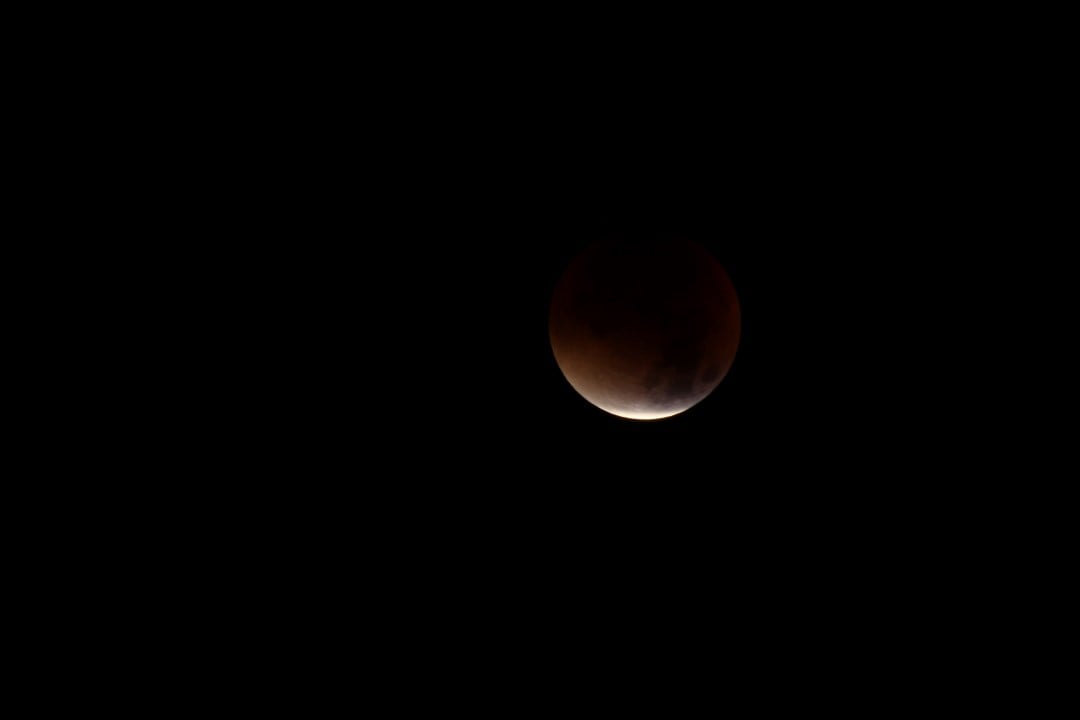
An astronomical spectacle promises to light up the French sky in the early hours of August 28, 2026, when a partial lunar eclipse will transform the Moon into an orange disk. This nearly total phenomenon will provide an impressive sight for astronomy enthusiasts across the country. With approximately 93% of the lunar diameter immersed in the Earth’s shadow at its maximum point, the event can be observed with the naked eye.
Understand the rare alignment that dyes the moon orange
The dawn of August 28, 2026 holds a particular celestial phenomenon for observers in France. This partial lunar eclipse occurs when the Earth is positioned between the Sun and the Moon, casting its shadow on the natural satellite. Unlike a solar eclipse, which obscures the Sun, this event allows the Moon to be observed safely and without the need for special protection.
What sets this spectacle apart is the orange hue that the Moon acquires. This color arises from the interaction of sunlight with the Earth’s atmosphere. While the blue wavelengths are dispersed by the atmosphere, the red and orange tones are able to cross it and refract towards the lunar surface, giving it a unique and impactful appearance.
More on this story: France prepares for partial lunar eclipse with orange moon in the early hours of August 28
August: a month of great celestial spectacles in France
The month of August 2026 has proven to be exceptionally rich for astronomy aficionados in French territory. Days earlier, on August 12, a notable solar eclipse was observed across mainland France, creating great anticipation. Now, the arrival of the lunar eclipse complements a period of intense celestial activity, offering two great observation opportunities in a short space of time.
The occurrence of a solar and then a lunar eclipse in the same month is a relatively unusual alignment, making August 2026 a memorable time for amateur and professional astronomers alike. This context highlights the uniqueness of the approaching lunar eclipse, inviting the public to enjoy this spectacle more.
Visibility and the best times to follow the phenomenon
To avoid missing the partial lunar eclipse, those interested will need to set their alarm clocks or plan a vigil. The first stages of the phenomenon will begin around 3:23 am on August 28th. Although subtle initially, the Moon’s entry into the Earth’s shadow will become more evident from 4:33 am onwards.
The peak of the eclipse, when around 93% of the lunar diameter will be covered by the Earth’s shadow, is scheduled for 6:13 am. It is at this moment that the orange color will be more intense and visible, promising a spectacular look for observers.
Practical tips for observing the moon without the need for equipment
One of the great advantages of the lunar eclipse is the safe observation. Unlike the solar eclipse, it is not necessary to use special eye protection, allowing the spectacle to be enjoyed with the naked eye.
Learn more: The race begins to observe comet PanSTARRS before it disappears from the sky
For those looking for a more detailed experience, binoculars or a telescope can highlight the nuances and tones of the lunar surface, revealing details that would be difficult to see without assistance. Finding a location with little light pollution and a clear horizon can also optimize the viewing experience.
Regional Differences in Moon Sunset During Eclipse
However, observers in mainland France should be aware of one particularity: the end of the eclipse will not be visible in all regions. The Moon will set while the phenomenon is still ongoing, and the exact time of its descent below the horizon varies depending on the location.
In Paris, for example, the Moon will disappear at around 7:09 am, before the eclipse has completely ended. It is recommended to consult local astronomical maps to check the exact time of moonset in other cities and ensure the best experience possible.