
Study shows that moons of wandering planets maintain oceans of liquid water for 4.3 billion years

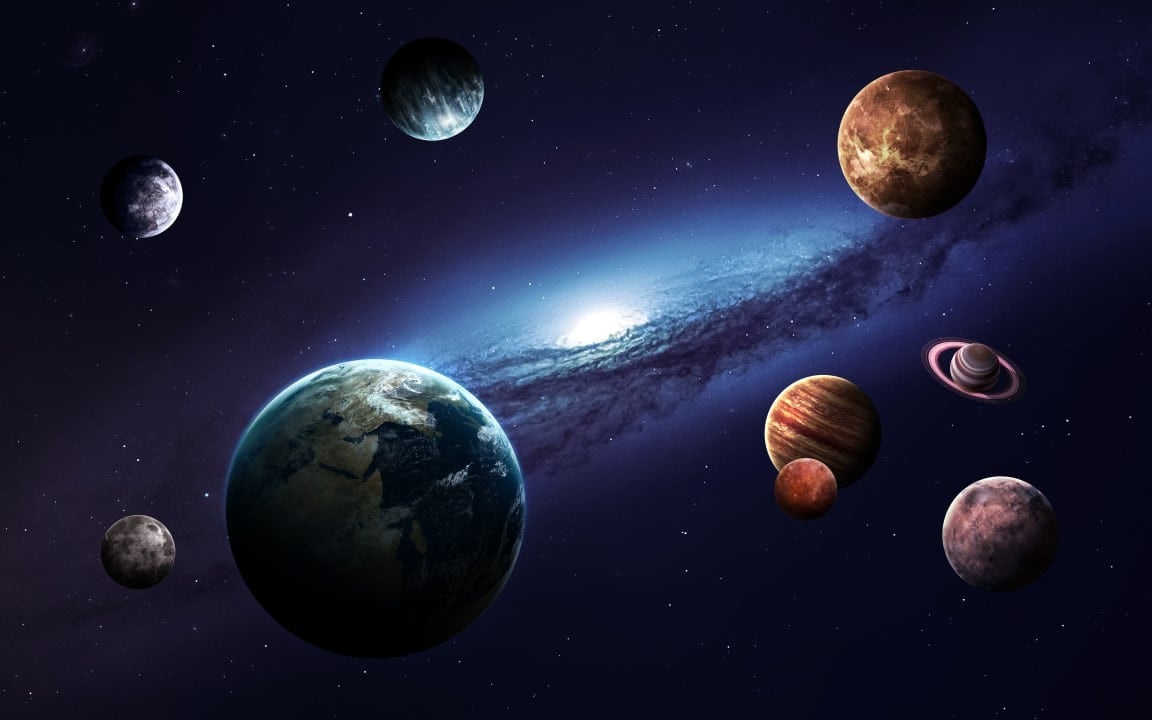
Researchers at Universidade Ludwig Maximilian of Munique have developed new astrophysical models that redefine the limits of habitability in the universe. The research demonstrates the physical feasibility of moons orbiting wandering planets being able to preserve oceans of liquid water on their surfaces or subsurfaces for extremely long periods. Esses Planetary systems roam interstellar space in total darkness, without the presence of a host star to provide heat or light.
The central mechanism that enables this thermal retention is based on the combination of intense gravitational forces and specific atmospheric properties. The absence of stellar radiation is compensated by tidal heating, a continuous physical process generated by the gravitational interaction between the massive planet and its natural satellite. The internal friction resulting from this dynamic produces enough thermal energy to melt the ice and keep the water in a liquid state.

Computer simulations indicate that, under suitable atmospheric conditions, the volume of liquid water can be preserved for up to 4.3 billion years. Esse time period is statistically comparable to the geological age of Terra itself, providing a long enough time window for complex chemical reactions to occur. The stability of this aquatic environment on celestial bodies ejected from their original systems changes the parameters of the search for biology outside the solar system.
Gravitational dynamics and the internal heating of the moons
Tidal heating occurs due to the differential gravitational pull exerted by the wandering planet on the physical structure of its moon. Durante orbit, the natural satellite undergoes continuous mechanical deformations, compressing and expanding its rocky and ice layers. Essa Structural movement generates friction on a planetary scale, which directly converts into heat dissipated from the core towards the crust.
The intensity of this process depends fundamentally on the eccentricity of the moon’s orbit. Órbitas ellipticals ensure that the distance between the planet and the satellite varies constantly, maximizing tidal forces and, consequently, the production of thermal energy. If the orbit is perfectly circular, the deformation stops and the celestial body quickly freezes in the vacuum of space.
In the solar system, analogous phenomena are observed in natural satellites of gas giants, such as Europa, in Júpiter, and Encélado, in Saturno. Nesses celestial bodies, the gravitational force of the massive planets maintains liquid oceans under thick crusts of ice, even at distances where solar energy is insufficient to melt the surface.
Applying this model to wandering planets demonstrates that the presence of a star is not a mandatory requirement for the generation of internal heat. The mass of the planet and the orbital configuration of the binary system are the determining factors for maintaining the liquid state of water throughout geological eras.
Atmospheric composition acts as a thermal insulator
Retaining the heat generated by tidal forces requires a dense atmosphere with a high insulating capacity. Models developed by astrophysicists indicate that a gaseous layer composed predominantly of carbon dioxide and water vapor creates an efficient greenhouse effect. Essa atmospheric barrier prevents thermal energy from escaping quickly into the extreme cold of interstellar space, stabilizing temperatures at or just below the surface.
The simulations reveal that the amount of water and atmospheric pressure determine the lifetime of the liquid ocean. Sem the presence of carbon dioxide to retain heat, the water would freeze in a much shorter period of time. The data indicates that the exact combination of these chemical elements allows the extension of the liquid phase to the limit of 4.3 billion years, configuring a thermally isolated and self-sustaining environment in a vacuum.
Elliptical orbits maintain constant friction in space
Maintaining the elliptical orbit is the critical factor for the thermal survival of the natural satellite. Over time, the natural tendency of binary systems is the circularization of the orbit due to energy dissipation. Quando the orbit becomes circular, tidal forces lose their variation, internal heating stops and the ocean freezes irreversibly.
The research details that the initial configuration of the system, shortly after ejection from its original stellar system, defines the longevity of the orbital eccentricity. Sistemas that manage to maintain the elliptical orbit for billions of years are those where the gravitational interaction reaches a prolonged equilibrium, delaying the circularization process.
Studying circularization rates allows scientists to calculate the exact time window in which water remains liquid. Mathematical modeling of these trajectories provides the data necessary to understand the thermodynamic evolution of satellites in environments devoid of direct stellar radiation.
Origin of planetary systems without host stars
The formation of wandering planets is associated with the early, chaotic phases of the evolution of stellar systems. Durante the consolidation of orbits, severe gravitational interactions between giant planets can result in the ejection of smaller celestial bodies out of the pull of the central star. Nesse expulsion process, massive planets often carry their natural satellites with them, forming independent systems in deep space.
The amount of gas and dust present during the ejection influences the final composition of the moon’s atmosphere. The ability to retain volatile elements, such as water and carbon, during the violent transition to interstellar space is what defines the satellite’s potential to develop and maintain a liquid ocean in the long term.
Expanding parameters for the search for extraterrestrial biology
The theoretical proof that liquid oceans can exist for billions of years in the absence of starlight substantially changes the protocols for searching for biological signatures in astrophysics. Tradicionalmente, the habitable zone is defined by the distance of a planet from its star, where the temperature allows liquid water to exist on the surface. The new model establishes that internal energy sources, combined with atmospheric insulation, create habitable zones independent of solar radiation. The chemical interaction between liquid water and the rocky mantle at the bottom of these dark oceans can generate hydrothermal reactions, providing the nutrients and energy needed to sustain chemosynthetic metabolisms. Esse scenario expands the number of potential targets in Via Láctea, suggesting that environments conducive to the development of single-celled organisms may be distributed across vast regions of interstellar space, far from any recognized stellar system.
Technical challenges for detecting dark celestial bodies
Direct observation of wandering planets and their moons represents a significant technological hurdle for contemporary astronomy. Como These celestial bodies do not emit their own light in visible spectra and do not reflect the light of a nearby star, they remain undetectable by traditional transit or radial velocity methods. Identification depends exclusively on gravitational microlensing events.
The microlensing phenomenon occurs when the errant planet passes directly in front of a distant star, from Terra’s point of view. The planet’s gravity acts like a lens, temporarily magnifying the light from the background star. The precision of current telescopes makes it possible to detect the distortion caused by the planet, but identifying the gravitational signature of a moon orbiting that planet requires next-generation instruments with improved sensitivity.
Computational modeling guides future space missions
The data generated by Universidade Ludwig Maximilian of Munique serves as a structural guide for the development of new space telescopes. By defining the atmospheric and thermal characteristics expected on these satellites, researchers provide exact parameters for calibrating infrared sensors.
The search for residual thermal emissions or specific chemical signatures in gravitational microlensing events will be the focus of future observatories. Empirical validation of these mathematical models will depend on the technological ability to isolate the weak signals emitted by these distant, dark systems.



