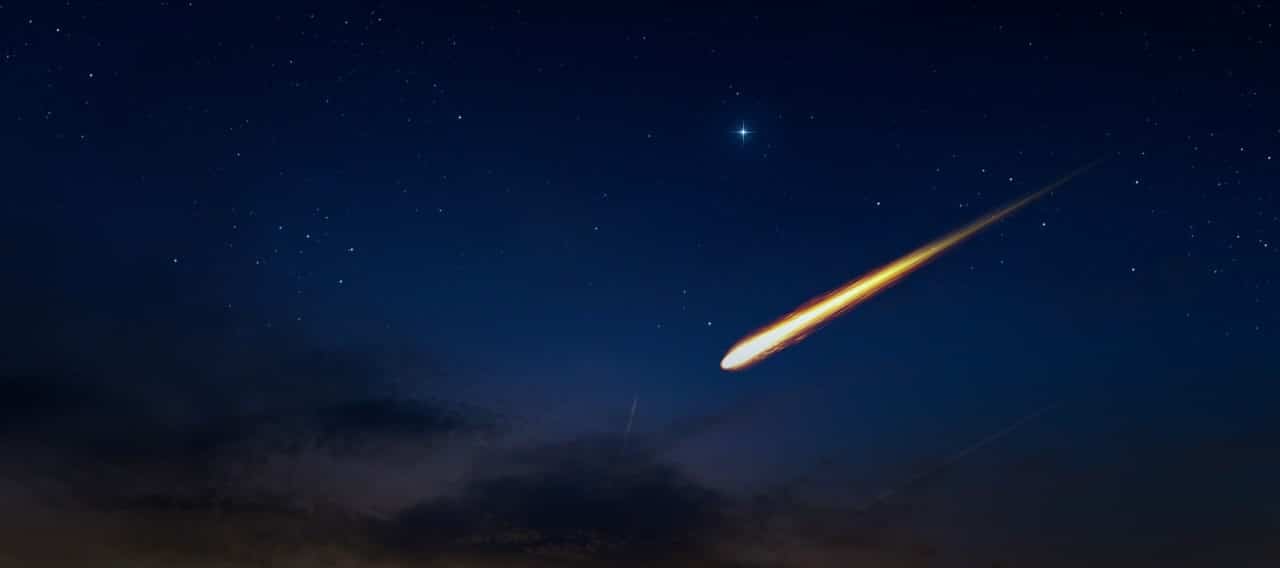
A bright fireball crossed the northeastern sky from Estados Unidos on Tuesday afternoon. Nasa confirmed that the phenomenon was a meteorite visible in broad daylight. Moradores from five states reported the sighting at around 2:34 pm local time. The object entered the atmosphere over ocean Atlântico and followed a defined trajectory before disintegrating.
The event generated hundreds of eyewitness accounts. Most observations were concentrated in areas of Nova Jersey, although there were also records in other regions. Especialistas analyzed the statements along with images from public cameras to reconstruct the meteorite’s complete path. Initial speed and altitude were accurately calculated from this data.
- Reports came from Connecticut, Delaware, Nova Jersey, Nova York and Pensilvânia
- First visibility occurred at 48 miles altitude
- Recorded speed reached 30 thousand miles per hour
- Disintegration happened 27 miles above the ground
Details of the meteorite’s trajectory
Nasa indicated that the meteorite first became visible 48 miles above the ocean Atlântico, near the coast of Mastic Beach, in Long Island, in the state of Nova York. Ele headed in a southwesterly direction at a speed of approximately 30 thousand miles per hour. The object traveled 117 miles through the upper atmosphere before completely disintegrating.
The final disintegration occurred 27 miles above the city of Galloway, in the north of Atlantic City, in Nova Jersey. Essa’s short but intense trajectory explains why the phenomenon could be observed in broad daylight by so many people in different locations. The analysis combined human reports with visual records available in the region.
The majority of sightings in Connecticut were concentrated in the county of Fairfield. However, there were reports even further north, including the areas of Hartford, Glastonbury, and Manchester. Mesmo thus, the greater volume of reports originated from Nova Jersey, where the disintegration point was closer to the observers.
#MeteorSighting: Eyewitnesses in Connecticut, Delaware, New Jersey, New York, and Pennsylvania reported a daytime fireball on Tuesday, April 7, at 2:34 p.m. EDT. First visibility of the meteor was at 48 miles above the Atlantic Ocean, off the shore of Connecticut0 on Connecticut1.…pic.twitter.com/OYsbPC3sbT
— NASA Space Alerts (@NASASpaceAlerts)April 7, 2026
Distribution of sightings across states
Residents of Connecticut, Delaware, Nova Jersey, Nova York and Pensilvânia sent detailed descriptions of the event to American Meteor Society and Nasa channels. The intense brightness allowed the meteorite to be noticed even against the clear afternoon sky. Muitos described a fast luminous band that crossed the horizon in a few seconds.
The concentration of reports at Nova Jersey reflects the proximity to the end of the trajectory. Em Nova York, observers closer to the Atlantic coast recorded the beginning of the phenomenon with greater clarity. Delaware and Pensilvânia contributed side observations that helped map the total length of the route.
The data collected allowed experts to draw an accurate map of visibility points. Essa reconstruction confirms that the meteorite maintained a stable path during almost its entire atmospheric passage. The high speed contributed to the characteristic glow of fireballs.
Technical characteristics of the event
The meteorite traveled at 30,000 miles per hour, which represents a typical speed for these objects as they enter Earth’s atmosphere. The initial altitude of 48 miles indicates that the fragment began to heat and glow in the upper layer of air. Over the 117 miles covered, atmospheric friction caused progressive heating until disintegration.
The disintegration 27 miles above Galloway marked the end of the visible phenomenon. Nessa height, the object had already lost most of its mass due to friction and the heat generated. Não There are records of fragments reaching the ground or causing any damage to the surface.
Occurring during daylight hours makes the event relatively rare, as sunlight usually masks weaker celestial phenomena. The size and composition of the meteorite allowed it to produce enough brightness to surpass daylight. Especialistas highlight that fireballs like this provide valuable opportunities to study the entry of space materials into the atmosphere.
Witness reactions and reports
Several people recorded the moment with cell phones and cameras, contributing images that complemented the data from Nasa. Reports ranged from a simple luminous stripe to descriptions of a sudden brightness that caught immediate attention. In urban areas, the phenomenon surprised pedestrians and drivers who normally circulated at that time.
The rapid duration of the event, estimated at a few seconds, explains why not everyone in the same region was able to observe the same angle. Ainda Thus, the high number of independent confirmations allowed a reliable triangulation of the trajectory. Authorities did not record any incidents related to the sighting.
The phenomenon reinforces the constant monitoring carried out by space agencies and networks of amateur observers. Sistemas Automatic and human reporting work together to identify and catalog these events in a timely manner. In this specific case, the combination of data resulted in a detailed and consistent description of the meteorite’s path.
Importance of meteorite monitoring
Events like Tuesday’s daytime fireball help scientists refine models about the frequency and behavior of objects entering the atmosphere. The velocity, angle of entry, and disintegration altitude provide useful information about the composition and strength of meteoroids. Esses data contributes to the general understanding of the risk of major impacts.
Public camera networks and reporting apps facilitate the collection of information on a regional scale. In the northeast of Estados Unidos, population density and the number of recording devices increase the chance of accurate documentation. Nasa uses these records to validate orbital calculations and trajectories.
The absence of fragments on the ground in this case is common in meteorites that completely disintegrate in the atmosphere. Quando pieces survive and fall like meteorites, specialized teams carry out targeted searches. Até At the moment, there is no evidence that material reached the ground after Tuesday’s event.
The sighting occurred in a region with good observer coverage, which allowed for a quick and detailed analysis. Nasa continues to receive and process additional reports that may further refine the data already released. The event serves as an example of the current ability to track celestial phenomena in real time.