
Scientists record the devouring of more than 10 million fish in just a few hours in the Barents Sea

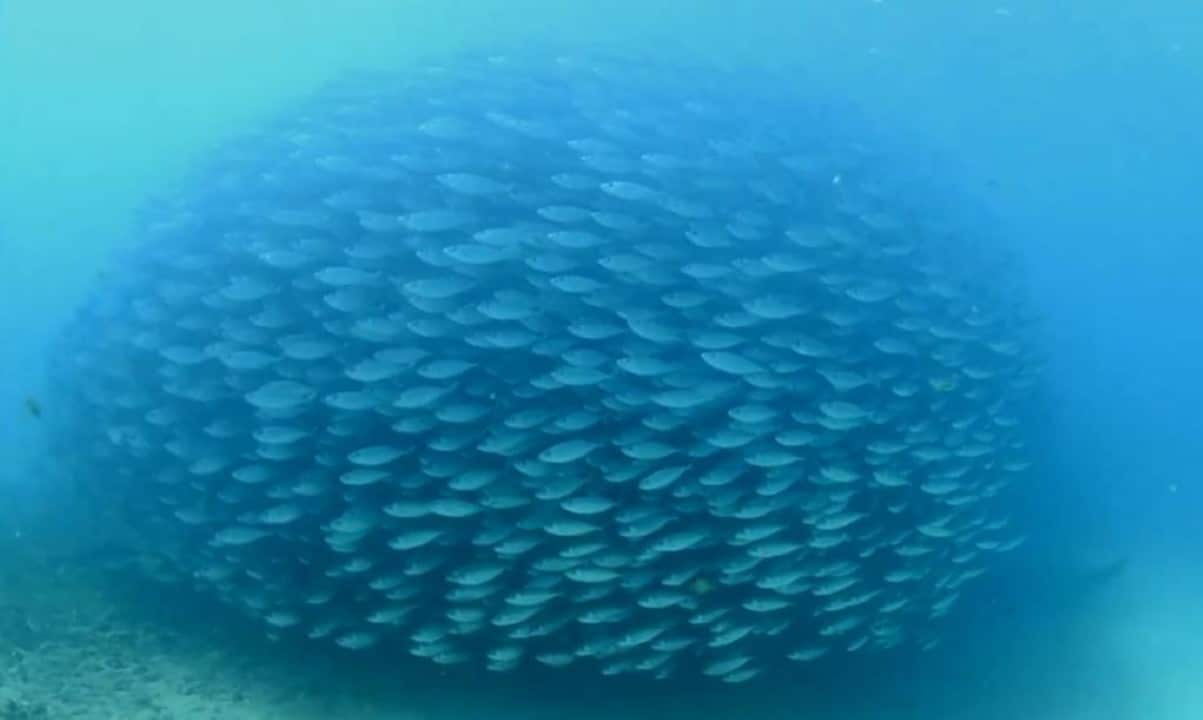
Scientists observed one of the largest marine predation events ever documented. Mais of 10 million capelins were consumed by a school of Atlântico cod in just a few hours on Mar of Barents, off the coast of Noruega. The interaction occurred during the capelin spawning season in February, when these small fish grouped together in large quantities and attracted predators.
Researchers from teams at MIT and Noruega used advanced acoustic technology to monitor the phenomenon in real time. The OAWRS system made it possible to map the movements and densities of fish precisely, differentiating the sounds emitted by the swim bladders of the species involved. Essa approach represented the first detailed observation of a predator-prey interaction on such a large scale.
- The school of capelins extended for more than 10 kilometers.
- Approximately 2.5 million cod converged on the site.
- Predators consumed about half of the grouped capelins.
- The event lasted just a few hours before the schools dispersed.
Details of predation event recorded on Mar of Barents
During spawning, capelins formed a dense school that acted as a signal to cod. The small fish reached a critical density, lining up and moving in a coordinated manner. Essa Aggregation quickly attracted predators, who also organized themselves into a large group to attack.
The researchers calculated that the initial shoal of capelins comprised around 23 million individuals. In just a few hours, the cod consumed more than 10 million of them. Acoustic technology captured the moment when the school of prey began to dissipate after the action of predators.
Capelins represent a key species in the region’s marine ecosystem. Eles They serve as important food for several predators, including cod. The observed event highlighted how the formation of dense schools can influence feeding dynamics in the ocean.
Acoustic technology allows unprecedented observation of interactions between species
The oceanic acoustic wave remote sensing system identified differences in the tones emitted by the swim bladders of capelins and cods. Enquanto Capelins produced higher tones, codfish generated lower tones. Essa distinction facilitated real-time mapping of both schools.
The research validated in practice a physical theory about critical density in schools. Quando The fish are close enough, they can sense the speed and direction of their neighbors and form a cohesive and massive group. Scientists have observed this behavior directly in the natural environment.
The results were published in the journal Communications Biology. The study involved collaboration between MIT oceanographers and Norwegian teams. The data collected offers new insights into how large-scale interactions occur at sea.
Impact of the formation of dense schools on the marine food chain
Capelins travel greater distances to spawn due to retreating Arctic ice. Essa Prolonged migration may increase exposure to predators at certain points. The recorded event illustrates how a temporary grouping can turn into an opportunity for intense feeding.
Around 2.5 million codfish participated in the coordinated action. The predators overwhelmed the capelin school and quickly consumed a significant portion of it. The phenomenon occurred over an extensive area, covering dozens of kilometers.
Experts highlight that the school of prey corresponded to just 0.1% of the total capelin population spawning in the region. Isso indicates that the local ecosystem maintains recovery capacity even after large-scale predation events.
Environmental context and capelin migration no Ártico
Retreating ice in Ártico changes capelin migration patterns. Fish need to travel longer routes to spawning sites, which can modify their interactions with predators. Researchers monitor these changes to better understand the effects on ecological balance.
The observation took place in an area known for the presence of large populations of fish during winter and early spring. The use of acoustic tools allowed us to record details that traditional methods would not capture with the same spatial and temporal scope.
The data reinforces the importance of monitoring predator-prey dynamics in real time. Ferramentas how OAWRS helps identify variations before they become more widespread. Scientists continue to analyze how these events fit into the bigger picture of Mar’s Barents ecosystem.
Observation confirms theory about critical density in schools
When capelins reach sufficient proximity, they adopt the average speed and direction of nearby individuals. Esse mechanism generates the cohesive shoal observed by researchers. The validation of this physical theory in the wild represents an advance in understanding the collective behavior of fish.
The event does not compromise the general health of the capelin population. The species has several spatially distributed population centers, which favors resilience. Mesmo Thus, the record serves as a reference for future studies on environmental pressures in the Arctic region.
The cod took advantage of the feeding opportunity efficiently. The rapid convergence of predators demonstrated how species respond to visible or acoustic signals generated by large aggregations of prey.





