

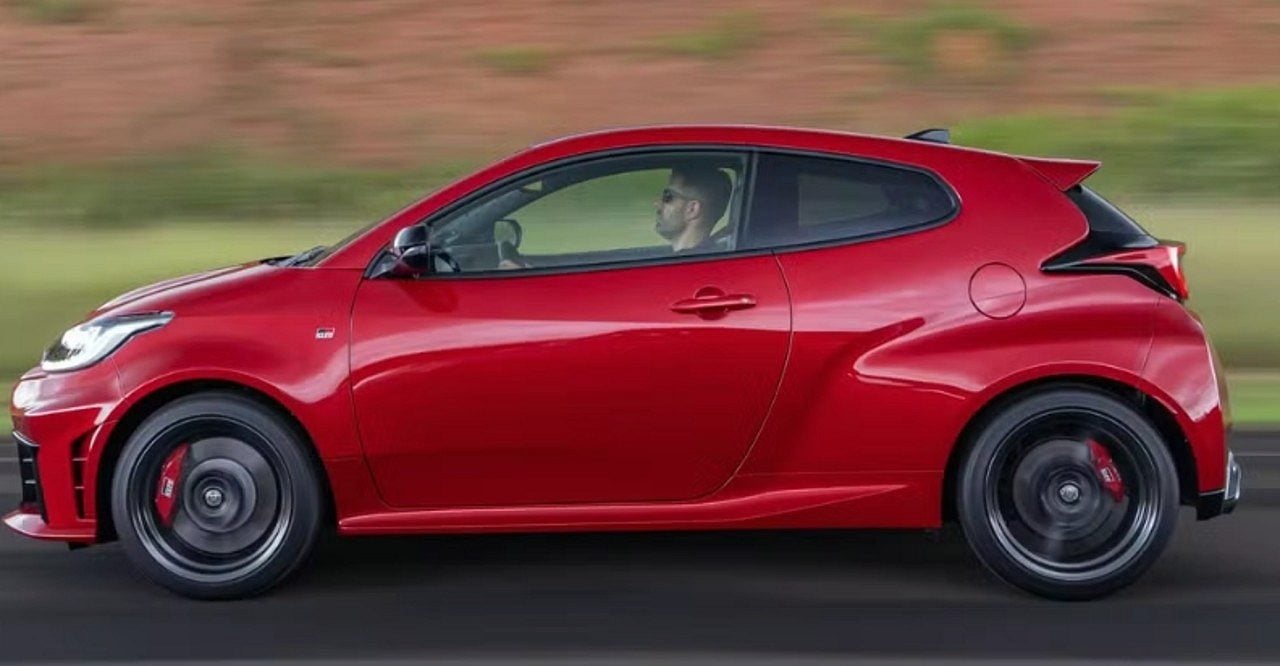
The national automotive market receives one of the most awaited updates by performance enthusiasts with the official arrival of the Toyota GR Yaris. Este model, which carries the seal of division Gazoo Racing, represents a total break with the concept of urban vehicle that the name Yaris held in the country between 2018 and 2025. Importado directly from Japão and based on the European configuration, the hot hatch arrives with a suggested price of R$354,990, offering a visceral driving experience modeled on international competitions.
The Japanese manufacturer’s strategy for Brazilian territory is extremely exclusive, making only 198 units available in total. Este lot is divided equally between two transmission configurations: 99 units equipped with a six-speed manual transmission and 99 units with the eight-speed automatic system. Metade of this volume has already been reserved even before official deliveries, scheduled to begin this April. The vehicle was originally developed as a homologation model for the Campeonato Mundial of Rali (WRC), which justifies its engineering focused on rigidity and power delivery.
Advanced engineering and the most powerful three-cylinder engine in the world
The heart of the Japanese sports car is a power unit that defies industry conventions for compact engines. Sob under the hood, the GR Yaris houses a 1.6 three-cylinder turbo engine with direct injection, capable of generating 304 hp and a torque of 40.8 kgfm. Estes numbers guarantee the model the title of the most powerful three-cylinder engine in mass production on the planet, even surpassing larger-liter engines from competing brands. The Toyota’s engineering prioritized mass reduction, using aluminum for the hood and doors, as well as a molded carbon fiber roof.
This strict diet resulted in a total weight of just 1,305 kg for the manual version, establishing a weight/power ratio of 4.29 kg/hp. Tal index is higher than that of larger and more expensive models, such as the GR Corolla and the Honda Civic Type R. In terms of acceleration, the hatch reaches 100 km/h in 5.1 seconds in the manual option, while the automatic achieves the same test in 5.4 seconds. Performance is supported by a permanent all-wheel drive system, called GR-Four, which allows force to be distributed between the axles according to the driving mode chosen by the driver.

- Technical differences of the GR-Four traction:
- Mode Normal: Distribuição of 60% power at the front and 40% at the rear for everyday use.
- Mode Gravel: Ajuste of 53% front and 47% rear for low grip surfaces.
- Mode Track: Sistema variable that oscillates between 60:40 and 30:70 for maximum performance on the track.
Functional design focused on aerodynamics and high-performance cooling
The look of the Toyota GR Yaris is aggressive and strictly follows the premise that form follows function. Diferente of the previously sold civilian model, the sports car has just two doors and a lowered roofline to optimize airflow to the rear spoiler, which was redesigned to facilitate customization. The bumpers have wide openings to ensure that the braking system, made up of ventilated discs, and the radiator work at ideal temperatures even under severe use on circuits or rally sections.
The compact dimensions reinforce the agility of the package, measuring 4 meters in length and having a wheelbase of 2.56 meters. The 18-inch wheels are forged, which reduces unsprung mass and improves suspension response. At the rear, the dual-exit exhaust system reinforces the sporty character, while the headlights are connected by a light bar, following the brand’s most recent visual identity. The model is available in colors Emotional Red, Precious Metal, Platinum White Pearl and Precious Black.
Pilot-oriented cockpit with competition-specific adjustments
Internally, the environment of the GR Yaris reflects its vocation for the track, although it presents a finish focused on functionality and weight reduction. The center console is tilted 15 degrees towards the driver, facilitating access to controls during quick maneuvers. Para improve visibility and the center of gravity, the sports seats were positioned 2.5 cm lower, and the instrument panel was reduced by 5 cm in its total height. The instrument panel is 12.3 inches digital and prioritizes telemetry and performance data.
The ergonomics have been refined in collaboration with professional drivers, ensuring the riding position is ideal for rallying. The seats use a combination of suede and leather with contrasting red stitching. However, space for passengers in the rear seat is limited and is only recommended for short journeys or to accommodate small volumes, as the focus of the project is not family transport. The trunk capacity is reduced to 174 liters, prioritizing the all-wheel drive structure and rear suspension system.
Transmission technology and sporty driving assistance features
The GR Yaris’s six-speed manual transmission features Intelligent Manual Transmission technology, which automatically levels the rotations during downshifts. Esse system perfectly simulates the “punta taco” technique, guaranteeing stability and fluidity when entering corners. Já the new eight-speed automatic transmission, called GR-DAT, was calibrated to anticipate the driver’s needs, performing ultra-fast shifts that always keep the engine in the maximum torque range, and can be operated via paddles behind the steering wheel.
Even though it is a car focused on pure performance, the model does not give up active safety systems and connectivity technology. The 8-inch multimedia center is compatible with wireless mirroring for smartphones. The safety package includes advanced features that assist the driver in different risk situations.
- Safety and assistance equipment:
- Six airbags and stability and traction controls as standard.
- Blind spot monitoring and lane change alert.
- Adaptive cruise control (ACC) and pre-collision assist.
- Front and rear parking sensors with reversing camera.
Driving dynamics enhanced by structural reinforcements and rigidity
The hot hatch’s handling is the result of a hybrid chassis that uses elements from different Toyota platforms to create an extremely rigid base. The bodywork received 15% more spot welds and extensive use of structural adhesives, which minimizes twisting during high-speed cornering. The suspension has been recalibrated to offer immediate responses, working in conjunction with direct-ratio electric steering, tuned to transmit every detail of the road to the driver’s hands.
During tests carried out on racetracks in the interior of São Paulo, the model demonstrated the ability to change direction with surgical precision. Structural rigidity allows the suspension to work more efficiently, keeping the tires in constant contact with the ground. Essa configuration makes the GR Yaris an extremely predictable and safe vehicle, even when pushed to the limit on asphalt tracks or dirt sections, where its rally heritage becomes even more evident.
Fuel consumption and energy efficiency in urban and highway cycles
Despite being a high-performance vehicle, the Toyota GR Yaris presents consumption figures that can be considered efficient for its category. Segundo official measurements carried out following Brazilian standards, the version with manual transmission delivers averages of 8.6 km/l in urban sections and reaches 10.1 km/l on highways. The automatic variant has a slightly higher consumption, recording 7.8 km/l in the city and 9.7 km/l on the highway, always using gasoline as fuel.
These figures demonstrate that the Toyota’s engineering managed to balance the delivery of 304 hp with modern fuel management. The use of direct injection and the efficiency of the turbocharger allow the three-cylinder engine to operate economically when not pushed to its maximum capacity. Para a rally sports car adapted for the streets, these brands guarantee satisfactory autonomy both for recreational use on tracks and for occasional trips between cities.



