
Artemis 2 crew completes crucial maneuver for the safe return of the Orion capsule to Earth

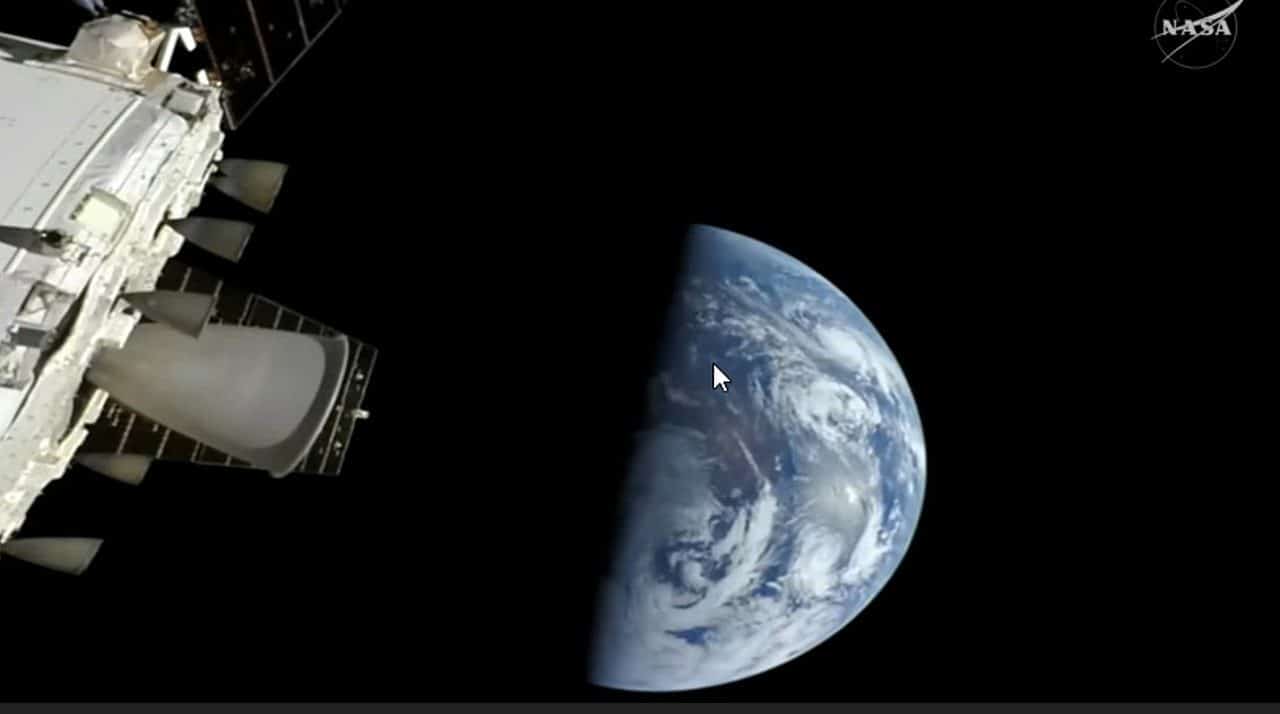
The astronauts of mission Artemis 2 successfully completed the last trajectory correction maneuver of spacecraft Orion, a fundamental step towards the safe return of the crew to Terra. Esta decisive step marks the final stretch of a historic journey around Lua.
Mission Artemis 2, the first with humans on board towards the natural satellite since 1972, launched on April 1st. The ten-day journey took four astronauts into a complex lunar orbit, testing systems crucial for future exploration.
The final maneuver, performed this Friday, April 10, ensures that capsule Orion is on the ideal route to its planned landing point, demonstrating the precision and resilience of NASA’s navigation systems. The mission control team monitored every detail, ensuring flawless execution.
The final step towards the blue planet
The trajectory correction maneuver is a high-precision procedure that adjusts the spacecraft’s path to ensure it re-enters Earth’s atmosphere at the correct angle and location. Qualquer deviation could compromise the safety of the capsule and its occupants. Este Adjustment is the last major command before the final approach to the planet.
For the crew and ground teams, the successful execution of this phase brings palpable relief. Significa that the spacecraft’s complex calculations and advanced engineering are working as expected, paving the way for a smooth and effective splashdown. Accuracy is vital to mitigate risks inherent in the space environment.
Mission trajectory and timeline Artemis 2
Mission Artemis 2 is a milestone in NASA’s lunar program, which aims to establish a sustainable human presence on Lua and, eventually, Marte. Este manned test flight is primarily aimed at validating the systems of Orion and the Space Launch System rocket (SLS), in addition to exposing the crew to the deep space environment.
The launch, carried out in early April, propelled Orion on a journey that included orbiting Terra and then a free return trajectory around Lua. Durante During these ten days, the astronauts performed a series of tests and checks, collecting vital data for the next phases of the program.
The long-awaited splashdown of capsule Orion is scheduled to take place on Friday, April 10th. Recovery teams are already mobilized at strategic points in the ocean, ready to receive the astronauts and the spacecraft after their successful return. Este event will be broadcast globally, capturing the attention of space enthusiasts and the general public.
Historical significance of space flight
Artemis 2 represents a generational leap in manned space exploration. Desde the last mission Apollo in 1972, no human being had traveled so far since Terra. Este flight is not just a rehash of the past, but a bridge to the future, testing technologies and procedures that will be crucial to the construction of a lunar base and future interplanetary travel. The ability to take a crew beyond low Earth orbit, bypass Lua, and return safely demonstrates a significant advance in aerospace engineering and in the human ability to operate in extreme environments. It is the prelude to Artemis 3, which will once again take astronauts to set foot on the lunar surface.
Advanced technology driving exploration
Spacecraft Orion is a marvel of modern engineering, designed to support long-duration missions in deep space. Seus life support systems are advanced, capable of recycling water and air, in addition to constantly monitoring the astronauts’ health and environmental conditions inside the capsule. The Orion’s resistance to high temperatures and extreme speeds during atmospheric reentry is crucial, with a state-of-the-art heat shield protecting crew and equipment.
The Orion’s ability to perform trajectory correction maneuvers with such precision is the result of decades of research and development. Onboard computers and propulsion systems work together to make minute adjustments that, over millions of kilometers, ensure the correct course. Esta technology not only makes flights safe, but also opens the door to more ambitious and longer-lasting missions in the future of space exploration.
Preparations for the long-awaited return of the crew
With the trajectory correction maneuver complete, attention turns fully to splashdown preparations. NASA and US Marinha teams are on high alert, with ships and aircraft positioned at the designated landing area Oceano Pacífico. The recovery process is meticulously planned to be quick and efficient, ensuring that the astronauts are safely extracted from the capsule and receive first medical care immediately upon return.
Constant simulations are carried out for each possible landing scenario, ensuring that teams are ready for any eventuality. Divers are trained to operate in a variety of marine conditions, and engineers work to ensure the Orion’s buoyancy and stability in the water. Mission control maintains constant communication with the crew, providing updates on reentry and landing conditions.
Anticipation surrounding the crew’s return is immense, both in the scientific community and among the public. Milhares people will follow the event live, waiting for the moment when Orion touches the surface of the water. Este Success will be celebrated as a triumph of human ingenuity and international collaboration for space exploration.
Reactions from NASA and government leaders highlight the strategic importance of the mission. Artemis 2’s success reinforces Estados Unidos’s leadership in space and inspires renewed interest in science and engineering. Para the space agency, each successful step of Artemis 2 is a step towards the greater goal of returning to Lua and, in the future, going to Marte.
Challenges overcome on the lunar journey
During the ten-day mission, the crew and flight control teams faced and overcame numerous challenges. Estes included everything from the need for real-time adjustments to flight plans to resource management in a hostile environment. The resilience of technology and the adaptability of astronauts were put to the test.
Each small problem or unforeseen event was a learning opportunity, providing valuable data that will be incorporated into the planning and execution of future missions. The ability to solve problems in real time and remain calm under pressure is a testament to the excellence and intensive training of the entire team involved in the Artemis program.
Artemis’s legacy to humanity
Mission Artemis 2 isn’t just a trip around Lua; it lays the foundation for the future of human space exploration. By proving Orion’s ability to safely transport people beyond Earth’s orbit, a new chapter opens in the search for knowledge and the expansion of human presence in the cosmos.
This flight inspires a new generation of scientists, engineers and explorers. Ele demonstrates that collaboration and innovation can overcome great barriers, propelling humanity towards previously unimaginable frontiers in the vast universe.





