
Scientists explain the origin of the cosmos and the mysteries of dark energy in the structure of the universe


Human understanding of the cosmos has undergone profound transformations since the beginning of the 20th century, when science began to uncover the true scale of time and space. Atualmente, researchers use advanced technologies to investigate Big Bang and the invisible forces that make up most of the physical reality that surrounds us. Contemporary space exploration, driven by large-scale international missions, seeks to answer fundamental questions about the composition of matter and the origin of life. Este scientific movement not only expands the frontiers of technical knowledge, but also reconfigures Terra’s position in a landscape of billions of galaxies.
The development of modern astronomy has allowed humanity to realize that the universe is vast and constantly changing, driven by complex physical laws. Diversos Studies show that what we see in the night sky represents only a minimal fraction of what actually exists in deep space. Abaixo, the main pillars that support current astronomical knowledge and recent discoveries about the universal structure stand out:
- The Big Bang theory explains that the universe emerged from an extremely dense and hot state approximately 13.8 billion years ago.
- The cosmic microwave background acts as a luminous echo of this initial event, allowing scientists to map the universe in its infancy.
- Dark matter acts as a “gravitational glue”, holding galaxies together without emitting any detectable light or radiation.
- Dark energy is the mysterious force responsible for accelerating the expansion of galaxies, moving celestial objects away from each other at increasing speeds.
- Space Telescope James Webb and other high-precision observatories capture images of stars that shone in the first million years after everything began.
Time scale and the evolution of scientific thought
Until the mid-19th century, the prevailing view was of a young planet and a static universe, but geology and evolutionary biology have changed this perspective drastically. By understanding that Terra is billions of years old, scientists paved the way for astrophysics to estimate stellar and galactic ages with greater precision. The realization that our solar system occupies a peripheral position at Via Láctea was one of the most important milestones in the acceptance of the cosmic immensity.
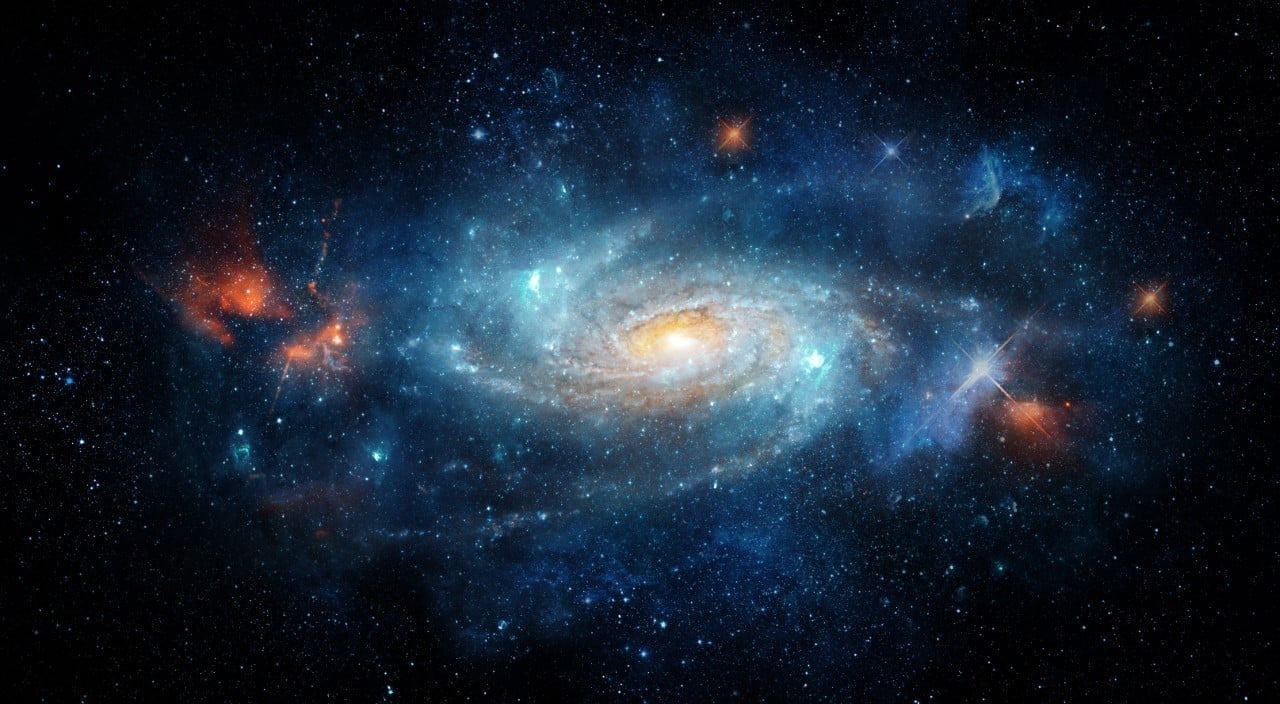
This paradigm shift revealed that Via Láctea is around 100,000 light-years in diameter and houses hundreds of billions of stars similar to Sol. The movement of Sol around the galactic center, which takes millions of years to complete, demonstrates the slowness and magnitude of astronomical processes. Compreender these distances and times are essential for modern society to be able to interpret the data collected by probes sent to the ends of the solar system.
Invisible components that dominate spatial reality
Contemporary science faces the challenge of studying what cannot be seen, since 95% of the universe is made up of invisible elements. Ordinary matter, which forms planets, living beings and stars, is just a small part of a much larger and more complex system. The presence of dark matter is inferred through the gravitational influence it exerts on the light and movement of visible stars in galaxies.
Researchers have dedicated decades to trying to detect dark matter particles in underground laboratories around the world, aiming to understand their mass and properties. Simultaneamente, dark energy remains one of the biggest enigmas of modern physics, as its negative pressure appears to overcome gravity on cosmological scales. Sem these two components, the universe we observe today would have a completely different structure and destiny than current equations suggest.
Astronomical observation as a trip to the past
Observing the night sky is, in practice, looking at the history of the universe due to the time it takes for light to cross the space vacuum. A star located ten light years away is seen today exactly as it was a decade ago, as its light needed that long to reach human eyes. Esse phenomenon allows astronomers to construct a visual chronology of the development of the first galaxies to the present.
Powerful telescopes work like time machines, capturing photons that have traveled through space for billions of years before reaching Earth-based sensors. Quanto The further a telescope can see, the closer it gets to the moment of original creation, providing data on the formation of chemical elements. Essa The capacity for historical reconstruction is what underpins theories about the chemical and structural evolution of the entire known cosmos.
Cosmic microwave background and evidence for its beginnings
The discovery of the cosmic microwave background radiation in the 1960s provided definitive proof that the universe had a hot, explosive beginning. Detectada Initially as a persistent noise in radio antennas, this radiation fills all space almost uniformly in all directions. Ela represents the moment when the universe became transparent to light, approximately 380 thousand years after the event of Big Bang.
Mapping the small temperature variations in this radiation allows physicists to understand how the seeds of galaxies were planted at the beginning of time. Esses Data is essential for testing mathematical models about cosmic inflation and the distribution of matter on a large scale. Continuous study of this “echo” helps refine the age of the universe and accurately determine the rate of its current expansion.
Iconic images and their impact on the perception of humanity
The photograph titled “Pale Ponto Azul”, captured by the probe Voyager 1, has become a symbol of fragility and the importance of planetary preservation. By showing Terra as a tiny pixel surrounded by absolute darkness, the image provoked deep reflection on humanity’s place in the universe. Outras missions, such as Apollo 8, brought records of Terra rising on the lunar horizon, which helped raise global environmental awareness.
These visual records serve to connect complex science with the sense of curiosity and wonder that drives space exploration. The release of high-resolution images of nebulae and stellar nurseries brings the lay public closer to academic discussions on astrophysics. In the end, these photographs are pedagogical tools that illustrate the magnitude of what remains to be explored by the next generations of researchers.
Current research on black holes and the fabric of space
The study of black holes and the curvature of space-time represents the final frontier of theoretical physics, uniting general relativity with quantum mechanics. Cientistas around the globe investigate how these massive objects influence the evolution of the galaxies where they reside, generally occupying galactic centers. The detection of gravitational waves has opened a new window to observe cataclysmic collisions between neutron stars and black holes in remote regions.
The universe remains a natural laboratory where extreme conditions of pressure and temperature test the limits of the laws known to science. Cada new discovery about the nature of spacetime has direct implications for understanding gravity and energy. The incessant search for answers about the dark origin and final destiny of the cosmos keeps astronomy as one of the most dynamic areas of human knowledge.





