
Researchers evaluate whether the trail of the interstellar body 3I/ATLAS magnifies meteors in the atmosphere


Planet Terra reached the point of closest proximity to the trajectory of space visitor 3I/ATLAS during the second half of March. The distance recorded between the Earth’s globe and the trail left by the celestial body was approximately 54.6 million kilometers. The object now follows its path away towards the deepest areas of outer space.
The scientific community has begun a series of investigations to determine the origin of an unusual increase in the incidence of small meteorites observed recently. The main focus of the work is to discover whether there is a direct relationship between these luminous phenomena and the solid fragments released by the celestial body during its journey. The object’s passage generated a rare opportunity to analyze materials from outside our planetary system.
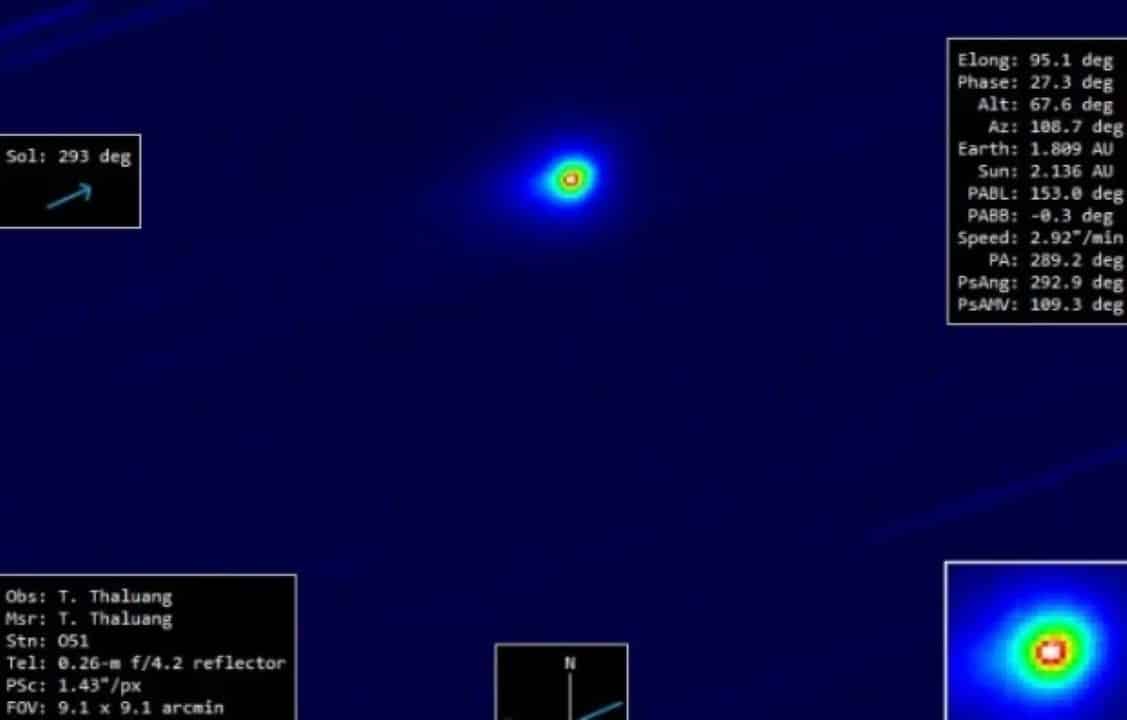
Astronomical data indicates that the interaction between Earth’s orbit and space debris occurs at the exact moment that Terra crosses the particle wake. Researchers monitor entries into the atmosphere to map the trajectory of each luminous fragment recorded by meteorological radars. The crossing of information aims to isolate common events from those potentially linked to the distant visitor.
Historical context of observations and spatial records
Information collected by the SPHEREx space observatory in August last year revealed unprecedented details about the structural composition of 3I/ATLAS. The instruments detected a dense plume of carbon dioxide that extended thousands of kilometers from the object’s core. The massive presence of this gas cloud indicates that solid particles and various rocky debris were ejected from the surface during the approach to Sol.
The most recent astronomical calculations demonstrate that the detachment of these fragments occurred several years ago, allowing the exact time for the debris cloud to intercept our planet’s orbit this semester. Orbital dynamics explains how materials ejected at relatively low speeds can travel vast distances and cross Earth’s path. The specific characteristics of this astronomical phenomenon were precisely documented during the first quarter:
– The volume of light events witnessed by large population groups grew significantly throughout March.
– The average number of reports per incident reached 142.7 witnesses, a number that exceeds records from previous years.
– The incoming trajectory of small meteors has become the main target for tracking the interstellar origin of particles.
– Research teams organize expeditions to recover physical remains for chemical and mineralogical analyzes in specialized laboratories.
Ejection dynamics and particle velocity
The speed required for a rocky fragment to travel between the trail of the celestial body and the Earth’s atmosphere is considered low in astronomical relative speed standards. The ejection that occurred about a decade ago, when the nucleus was still far from solar influence, generated a detachment comparable to the thermal agitation of gaseous molecules.
This physical scenario makes the hypothesis that debris of external origin is colliding with the upper layers of Terra in this exact period of maximum approach perfectly viable. Celestial mechanics corroborates the possibility that cosmic dust travels in groups until it encounters a large gravitational obstacle.
Mass estimates and fragment dispersion
Studies focused on the total mass of the space visitor estimate that the main structure houses about a billion metric tons of rocky material and ice. The fragmentation of a minimal portion of this structure results in a massive amount of smaller debris.
Transforming a small fraction of this mass into particles just a centimeter in diameter would scatter trillions of fragments throughout the vacuum of space. The debris cloud travels silently until it interacts with the atmosphere of some rocky planet.
The statistical probability calculated by experts indicates that up to 34,000 of these small particles may have penetrated the Earth’s atmosphere recently. Friction with air at high speed generates the luminous phenomenon popularly known as a shooting star.
The direct result of this atmospheric interaction is the formation of small fireballs visible to the naked eye on different continents simultaneously. Global monitoring makes it possible to map the geographic distribution of these light inputs.
Assessment of recent energy explosions
Events of great visual impact recorded recently, such as the explosions documented over the regions of Houston and Lago Erie, underwent rigorous kinetic energy analyses. On March 21, a meteoroid weighing one ton exploded in the sky of Texas with a destructive force equivalent to 26 tons of TNT. Poucos days earlier, on March 17, a seven-ton space rock generated an intense sonic boom that was picked up by several seismic and atmospheric sensors in the state of Ohio.
Experts in the field categorically state that these large-magnitude explosions are too energetic to have any direct link with 3I/ATLAS. The distant visitor does not have enough mass to eject multiple fragments with dimensions greater than one meter in diameter capable of reaching the globe simultaneously. The large fireballs observed in March have different origins, probably associated with stray rocks from the asteroid belt located between Marte and Júpiter.
Technical reports and population engagement
Technical reports released this week confirm that the volume of small, bright meteors showed an impressive quantitative jump in official records. Quase half of all events cataloged in March included direct visual observation of at least 50 people per isolated occurrence. Esse high level of public engagement reflects not only the rise of civilian surveillance and the popularization of security cameras, but testifies to the real and unusual frequency with which these objects are penetrating the upper layers of the atmosphere. Systematic analysis of the entry direction and terminal velocity of these meteoroids will allow scientists to separate what is re-entry space debris or ordinary asteroids from possible fragments of external origin. Rigorously screening observational data is the key step in directing ground search teams to the correct impact coordinates.
Importance of chemical and spectral composition
Confirming the origin of a recovered meteorite depends on its compatibility with previously mapped 3I/ATLAS spectral signatures. Obtaining a physical sample with these characteristics would deliver to science the first rock proven to come from a distant star system.
Continuous monitoring and fluid dynamics
The trajectory of the celestial body has remained under constant monitoring since the time of its original detection by scanning telescopes. Moving the object to a mark greater than five times the distance between Terra and Sol does not nullify the influence of its wake on the nearby spatial environment.
Fluid dynamics and the pressure exerted by solar radiation play crucial roles in driving small particles over time. Esses Physical factors push the dust in the wake directly onto the collision course with Earth’s orbit.
Satellite search and integration operations
Ground search teams were strategically deployed to regions where trajectory calculations indicate the highest probability of survival of rock fragments. The identification of rare isotopes, absent in terrestrial rocks or common meteorites, will represent definitive proof of the material connection with the space visitor.
Most particles weighing approximately ten grams undergo complete disintegration due to extreme atmospheric friction. However, fragments with higher density can leave metallic residues in desert areas or ice plains, environments that facilitate visual contrast and location.
Global monitoring remains on high alert, as the orbital proximity window may still generate light events in the coming weeks. Integrating data from civilian and military satellites is vital to triangulate exact entry points and refine mathematical models of debris dispersion.





