
Global telescopes spot giant trail of anomalous dust in interstellar body 3I/ATLAS


The international astronomical community has identified an unusual formation on the celestial body 3I/ATLAS, the third confirmed visitor from outside our planetary system. Observações recently revealed the existence of a directional jet of dust that extends more than 400 thousand kilometers into space. The ejected material points directly towards Sol, contrary to the standard behavior of local comets that usually form tails in the opposite direction to the star. Pesquisadores found that this structure is composed of grains significantly larger than those found on traditional celestial bodies. The phenomenon challenges current mathematical models about mass loss and sublimation of ice in a vacuum. Especialistas from several countries are now analyzing data captured by ground-based observatories to understand the exact dynamics of this light emission. The discovery calls for a revision of theories about the physical composition of errant objects that cross our cosmic neighborhood.
Directional structure and beam monitoring
The luminous trail projected by the interstellar visitor displays an extremely narrow and elongated geometric configuration. Medições point to an angular opening restricted to about eight degrees throughout its visible extent. Essa Morphological particularity indicates that the material escapes from a tiny fraction of the surface of the solid core. The directional focus remains unchanged even after the celestial body reaches its closest point to the central star of our system.
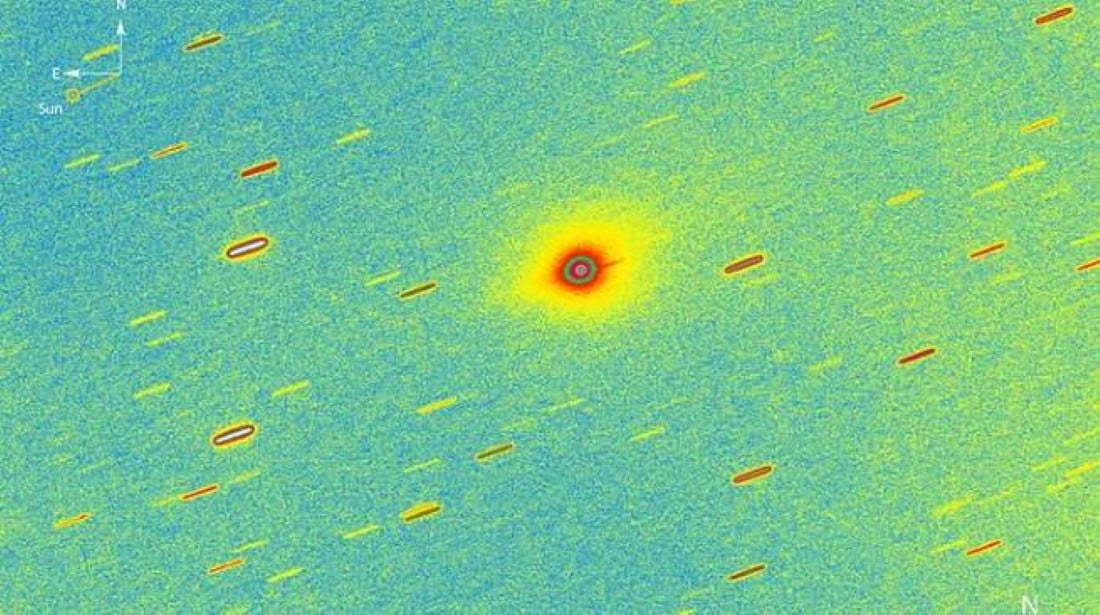
Astronomers use advanced image processing techniques to isolate the brightness of the jet from the natural luminosity of the nucleus. The application of high contrast filters, such as the Larson-Sekanina method, highlights the light gradient emitted in the opposite direction to the conventional dust tail. Continuous monitoring by global observatories confirmed that the structure persists over the weeks. Essa This finding rules out the initial hypothesis that the shape was just an optical illusion caused by geometric perspective during the orbital transition.
The object’s current distance from Terra is estimated at two hundred and seventy million kilometers. Monitoring this anomaly mobilizes an international network of ground-based and space-based telescopes equipped with high-precision spectrographs. Collecting uninterrupted photometric data allows scientists to separate the different wavelength ranges emitted by the material.
Interaction of fragments with solar pressure
The dynamics of starlight on the ejected matter impose strict physical limits on the size of the elements that form the frontal jet. Partículas with dimensions smaller than one micron suffer an immediate and violent radiative repulsion. Essa force prevents the microscopic fragments from advancing towards the light source, pushing them back and forming the traditional tail seen in most comets.
Fragments larger than a hundred microns in diameter face a different mechanical obstacle shortly after ejection. The initial gaseous drag, generated by the sublimation process on the surface of the nucleus, does not have enough force to accelerate very large pieces of rock or ice. The aerodynamic limitation in vacuum suggests that the material present in the beam belongs to an intermediate size category. Esses Specific grains can balance the initial thrust with the resistance against deceleration imposed by light.
Astrophysical calculations assume a standard solid density of one gram per cubic centimeter for these ejected fragments. The escape velocity necessary for the dust to maintain the anomalous trajectory towards Sol varies according to the radius of each particle. The scenario requires a considerable impulse from the main body to overcome the physical barrier formed by solar photons. The solar wind, composed of electrically charged particles, also acts on the environment, although it plays a secondary role in braking the material.
Sublimation rate and polar alignment
Sustaining a luminous structure hundreds of thousands of kilometers long requires a continuous supply of particulate matter. Especialistas calculate that the rate of mass loss of the celestial body reaches the mark of five hundred kilograms per second during the post-perihelion period. Esse Intense flow of material constantly feeds the directional anomaly. The beam density decreases proportionally to the square of the distance as the dust moves away from the solid surface.
The drag force must act extremely efficiently in the first moments of ejection. The gas dilution time in deep space establishes a maximum limit for particle acceleration before the buoyancy disappears completely. Modelos Mathematicians fitted with restricted nuclear dimensions help explain how continuous ejection manages to maintain the brightness of the projected material against the radiation stream.
Tracking the pre-perihelic motion revealed a key detail about the physical origin of the jet. The direction of the light beam is directly aligned with the axis of rotation of the errant body. Spatial stability indicates that the emission source is positioned very close to one of the nucleus’s poles. Essa geographic location ensures that the dust is always released in the same orientation, without suffering direct interference from the object’s daily rotation.
Implications for wandering body research
The visitor’s physical behavior fuels debates about the true chemical composition of objects formed outside our cosmic neighborhood. Traditional models based on the sublimation of water ice and carbon monoxide fail to explain the speed and selectivity of ejected particles. The scientific community investigates alternative fragmentation mechanisms that involve exotic materials or porosity structures different from those known.
The celestial body’s passage provides an unprecedented database for the study of distant star systems. The existence of larger, resistant dust grains suggests that the agglomeration of matter in the original protoplanetary disk occurred under extreme conditions of temperature and pressure. Mapping these features delivers direct information about the building blocks that orbit other stars.
The researchers established specific protocols for continuing observations in the coming months:
- Collecting spectroscopic data to measure the displacement Doppler of the ejecta.
- Application of computer simulations to recreate the exact beam acceleration conditions.
- Wavelength isolation to identify novel chemical signatures in dust.
- Astrometric mapping to refine the hyperbolic trajectory away from the planetary system.
The observation window for the phenomenon becomes more restricted every day due to the decrease in the luminosity of the nucleus. The celestial body continues on its trajectory away towards the darkness of interstellar space. The accumulation of current photographic records will form the definitive catalog for analysis by future visitors who present similar structural anomalies.





