
Scientists discover pair of supermassive black holes in galaxy Mrk 501 near historic merger

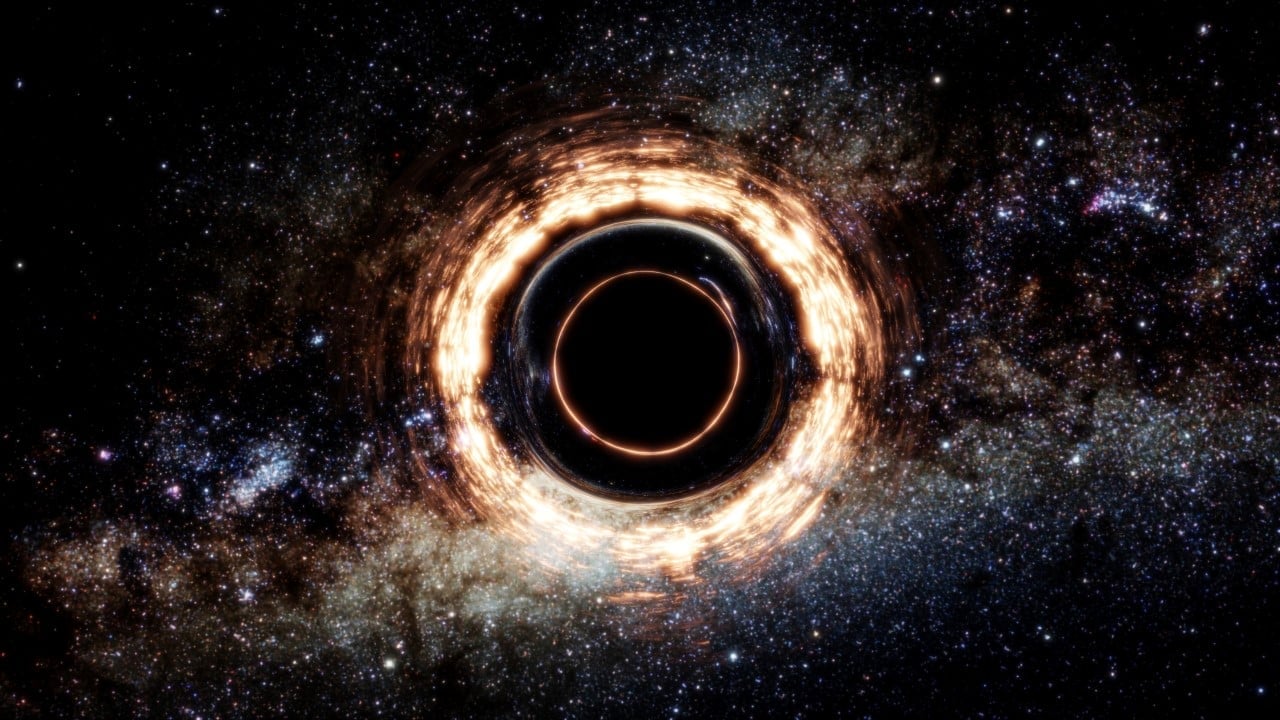
Researchers from Instituto Max Planck to Astronomia from Rádio have found strong evidence of a binary system of supermassive black holes at the center of the galaxy Mrk 501. The two celestial bodies orbit each other at a distance of 500 million light-years from Terra, in constellation Hércules. The current configuration indicates that a merger between the objects should occur within a period of up to one hundred years.
The finding represents an unprecedented opportunity for science to monitor the collision of structures of this magnitude in real time. The data results from more than two decades of observations made by high-resolution radio telescopes. Cada one of the black holes has a mass that varies from hundreds of millions to billions of times that of Sol. The distance that separates them is currently considered extremely small by astronomical standards.
A second jet has been detected for the first time in a blazar—a sign of a rare black hole pair!
A second jet has been discovered in the core of the blazar Markarian 501 (Mrk)—rare evidence of the possible existence of a close pair of supermassive black holes on the verge of…pic.twitter.com/kzPzYPsI3O
— Black Hole (@konstructivizm)April 10, 2026
Orbital dynamics and overcoming theoretical barriers
The scientific team analyzed the behavior of the light emitted by the blazar over 23 years of continuous recordings. Astronomers noticed specific oscillations that could not be explained by the presence of a single massive body in the galactic nucleus. The study revealed a broader cycle of variation that lasts about seven years, accompanied by a much shorter orbital period, estimated at 121 days. Essa Rapid movement confirms that the objects are in an advanced phase of approach. The distance between them varies between 250 and 540 times the space that separates Terra from Sol.
The scenario observed in Mrk 501 helps solve an old dilemma in astrophysics known as the final parsec problem. In many theoretical simulations, pairs of supermassive black holes lose energy and approach each other, but end up stagnating before fusion takes place. The current configuration of this binary system shows that the gravitational barrier has been definitively broken.
Emission of independent relativistic jets
One of the most striking factors of the discovery involves the energy emission structure of the galaxy’s nucleus. The data points to the existence of two distinct jets of matter being expelled at speeds close to that of light. The main jet has an intense brightness and points almost directly at Terra, which makes it easier for terrestrial instruments to capture the signals. The second jet appears weaker and rotates around the primary flow, demonstrating the presence of a second massive body with its own accretion disk. Essa Structural independence occurs despite the strong mutual gravitational attraction that distorts the environment around both. The constant interaction affects the flow of gas and dust that feeds black holes, changing the direction and strength of emissions over the years. Monitoring these variations allowed scientists to map the orbital trajectory with a level of precision unusual for objects located at such extreme distances. The maintenance of separate accretion disks in this final phase of approach provides new parameters for models of galactic evolution.
The role of gravitational waves in the final phase
The extreme proximity between the two cosmic colossi accelerates the system’s loss of energy through the emission of gravitational waves. Esse mechanism works like a brake that continually reduces the orbit, forcing objects to spiral towards each other. Diferente of the stellar mass black hole mergers already captured by laboratories such as LIGO, the event in Mrk 501 generates ripples in space-time at extremely low frequencies. Detecting these signals requires specialized pulsar timing networks, which function like high-precision cosmic clocks. Continued monitoring of this orbital reduction sets the stage for the first direct observation of a supermassive collision.
The hundred-year window for the final shock is considered a blink of an eye in the chronology of the universe. Para the scientific community, the deadline means that future generations of astronomers will have the chance to record the exact moment of impact. The visual and gravitational confirmation of this event will transform the understanding of the formation of large cosmic structures.
Monitoring and data collection methodology
The work published in the scientific journal Monthly Notices of the Royal Astronomical Society details the technical complexity involved in the research. Scientists needed to combine historical observations from multiple observatories with state-of-the-art computer simulations. The blazar’s favorable orientation in relation to our planet acted as a natural lens that amplified the signals needed for analysis. The crossing of multispectral information guaranteed the elimination of noise and confirmed the binary nature of the nucleus.
- Use of radio interferometry to obtain very high resolution images of the active nucleus.
- Mapping of luminosity variations at different wavelengths over two decades.
- Reconstruction of orbital dynamics based on periodic deviations of matter jets.
- Calculation of combined mass and orbital decay rate by gravitational emission.
Impact on understanding the evolution of the universe
The galaxy Mrk 501 is now established as the most important natural laboratory for the study of extreme gravitational interactions. Mergers between supermassive black holes are identified by cosmological theories as the main driver of galaxy growth throughout the billions of years of history of the universe. However, the lack of practical examples at such advanced stages of collision kept many of these hypotheses in the field of mathematical speculation. Detailed observation of how matter behaves in the moments before the final shock will help fill gaps in current physical models. Astronomers plan to intensify the use of space and ground-based telescopes so as not to miss any details of the changes in the pattern of light emission. Qualquer Abrupt change in the system’s total luminosity may indicate the beginning of the critical phase of fusion. The success of this research also encourages the search for other similar binary systems that may be hidden in the centers of distant active galaxies. Mapping these cosmic pairs reveals how often large galaxies collide and merge to form the superstructures we observe today.



