
Imminent cosmic merger of colossal black holes in the galaxy Mrk 501 mobilizes astronomers

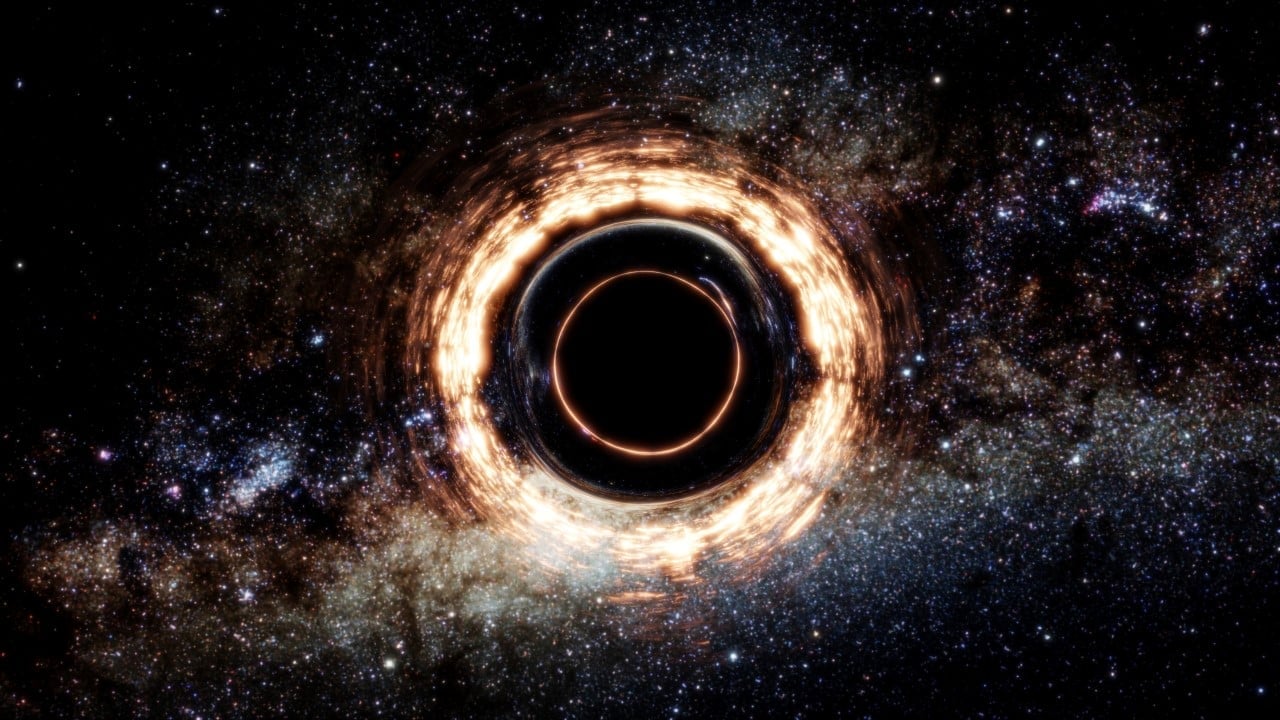
Astronomers have detected a binary system composed of two supermassive black holes in the nucleus of the galaxy Mrk 501, located about five billion light years from our planet. The colossal celestial bodies are trapped in an extremely closed orbit and are heading towards a historic shock. The researchers’ prediction indicates that the definitive merger of these structures will occur in less than a century.
The find ends decades of debate about the oscillations of light emitted by this deep region of space. Trata An unprecedented opportunity for science to follow the final stages of an event of unimaginable proportions. Cada One of the giants has a mass equivalent to billions of suns, generating a gravitational field that severely distorts the surrounding space-time and alters the dynamics of the entire stellar neighborhood.
首次在耀變體中檢測到第二股噴流——這是一對罕見黑洞的跡象!
在耀變體 Markarian 501 (Mrk)的核心發現了第二個噴流——這是一個罕見的證據,表明在…的邊緣可能存在一對緊密的超大質量黑洞。pic.twitter.com/kzPzYPsI3O
— 黑洞 (@konstructivizm)2026 年 4 月 10 日
Luminous oscillation reveals gravitational dance
The identification of this cosmic pair required a detailed analysis of light records collected over more than twenty years by different ground and space observatories. Scientists realized that the glow coming from the galactic center showed a rhythmic variation that did not fit the behavior of a solitary object. In-depth study of the data revealed a periodic cycle of changes in luminosity that repeats every 121 Earth days. Esse constant and fast pattern acts as an unmistakable visual signature that there are two massive bodies orbiting each other in a very confined space.
Currently, the distance separating the two black holes ranges between 250 and 540 astronomical units. Embora may seem like a considerable distance by human standards, on an astronomical scale and considering the colossal size of the objects, they are practically touching. Continuous monitoring of this dynamics confirmed that the system loses orbital energy uninterruptedly. Essa Energy degradation works like an invisible drain, pulling the two giants inexorably towards a meeting point that will culminate in an energy release unprecedented in the history of human observation.
Physical characteristics and the emission of jets of matter
One of the most fascinating aspects of the system located at Mrk 501 is the way it expels matter into deep space. The violent interaction between gravitational fields creates beams of highly energized particles that travel at speeds close to that of light. Close observation of these jets provided crucial clues to unravel the inner mechanics of the binary system.
- The primary jet has an intense brightness and is pointed almost directly at Terra, facilitating data capture by telescopes.
- The secondary jet exhibits a lower luminous intensity and carries out a continuous oscillation movement along its trajectory.
- The cross-talk between these two energetic emissions helps astrophysicists map the exact orbit of black holes.
- Constant friction with the surrounding interstellar gas and dust acts as an additional orbital braking mechanism.
This complex configuration of jets and surrounding matter creates an extreme physics environment that defies traditional models. The gravitational force exerted by such absurd masses can tear nearby stars and swallow entire clouds of gas. As the material is consumed, it heats to unimaginable temperatures before crossing the event horizon. Parte of this matter escapes through the magnetic poles, forming the light beams that reach our instruments. The spectral analysis of this light allows us to calculate the exact speed at which the giants approach each other.
The practical solution to the final parsec puzzle
For many years, theoretical astrophysics faced a mathematical obstacle that became known in academic circles as the final parsec problem. Computer simulations showed that supermassive black holes on a collision course could get closer to a distance of about three light years, or one parsec. However, upon reaching this mark, the models indicated that the approach process simply stopped, as there was no apparent mechanism to dissipate the remainder of the orbital energy. The system discovered in the galaxy Mrk 501 offers empirical proof that nature has found a way to overcome this theoretical barrier. The presence of large amounts of gas and the complex interaction of multiple celestial bodies in the vicinity appear to provide the necessary friction to continue draining the pair’s energy. Researchers now have a perfect natural laboratory to observe how this loss of angular momentum occurs in practice. The data extracted from this observation will serve to rewrite astrophysics textbooks and adjust the equations that describe the evolution of galaxies over billions of years.
Confirmation that fusion actually happens paves the way for new investigations into the past of our own universe. Acredita Similar collisions are thought to have shaped the structure of the large galaxies we observe today, including Via Láctea. The imminent event will serve as a temporal window into the structural formation process of the cosmos.
Ripples in spacetime and the new era of detection
As the distance between the two black holes shrinks, the emission of gravitational waves takes the main role in the system’s loss of energy. Essas Invisible ripples travel through the fabric of spacetime, carrying crucial information about the mass and speed of the objects that generate them. Diferente of the stellar mass black hole mergers already captured by equipment such as LIGO, the event at Mrk 501 operates on a much higher magnitude scale.
The frequencies generated by supermassive giants are ultralow and require detection networks based on pulsar timing arrays. The scientific community is already preparing the next generation of instruments to record this gravitational boom. Capturing these signals will provide definitive proof of the theories of general relativity in extreme gravity conditions, establishing a new paradigm for astronomical observation.
Global 24/7 Monitoring Effort
The galaxy Mrk 501 has become the priority target of an international network of ground and space observatories. Pesquisadores from several countries coordinate schedules of optical telescopes and radio telescopes to ensure that the binary system is continuously monitored. The objective of this task force is to capture any anomaly or sudden change in the light emission pattern that could signal the beginning of the acute phase of the collision. The combination of data from multiple technological platforms makes it possible to build a highly accurate three-dimensional model of the galactic nucleus and its energetic interactions.
If the final impact occurs within the estimated one hundred year time frame, humanity will have the privilege of documenting the climax of a supermassive merger for the first time in history. Recording this phenomenon will provide definitive answers about the behavior of matter under the most extreme conditions possible. The continued cataloging of similar systems will end a long cycle of searches for the hidden engines that drive the evolution of the deep universe, leaving an invaluable legacy for future generations of scientists.



