

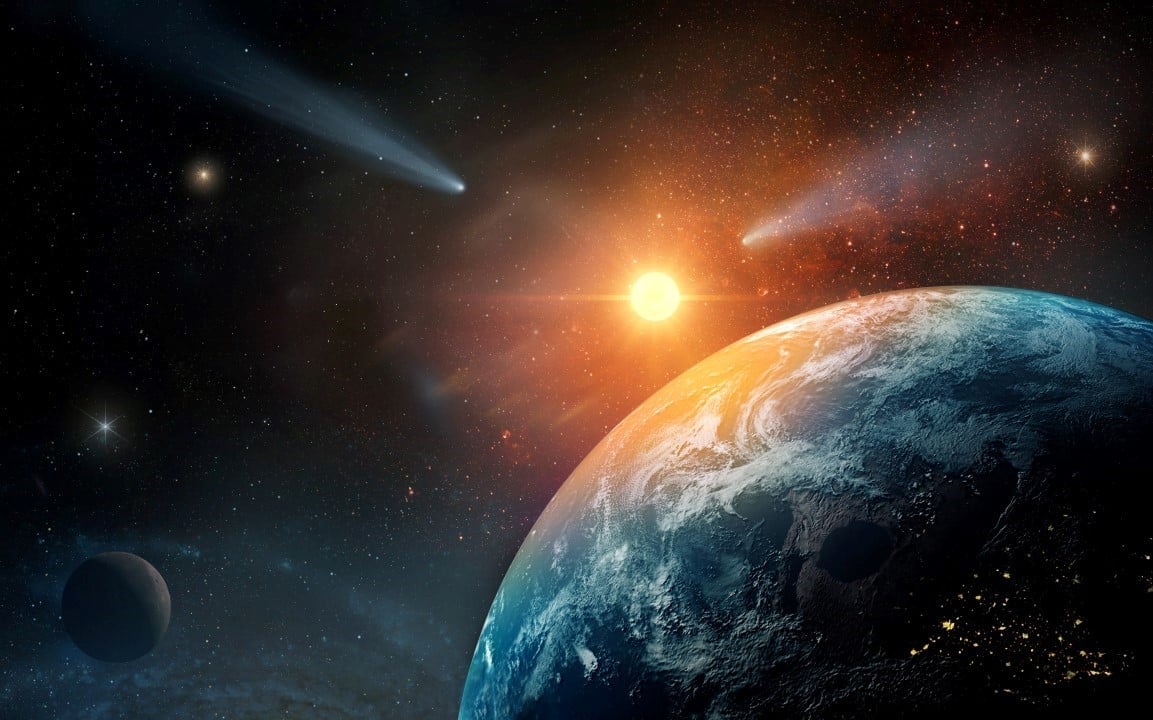
Scientists have estimated that Terra will lose its oxygen-rich atmosphere in about a billion years. The prediction comes from a study that used advanced computational models supported by data from Instituto, Astrobiologia and Nasa. Previous Pesquisas indicated a longer period, of around two billion years, but the new calculations point to a shorter period.
The work was published in the journal Nature Geoscience. Researchers Kazumi Ozaki, Universidade, Toho, Japão, and Christopher T. Reinhard, Instituto Tecnologia of Geórgia, nos Estados Unidos, conducted the simulations. Eles analyzed how the gradual increase in luminosity of Sol will affect the planet over time.

Solar change alters composition of the atmosphere
Sol becomes more luminous over billions of years. Esse process will cause more ocean water to evaporate and enter the atmosphere. The extra presence of water vapor and the resulting heating will reduce the amount of oxygen available.
Currently, oxygen represents about 20% of the Earth’s atmosphere. The study indicates that this level will drop significantly. Sem Sufficient oxygen, complex life forms will not be able to sustain themselves. The planet will undergo transformations that will make it uninhabitable for most species known today.
Scientists ran almost 400,000 different simulations to arrive at the result. The models included variables such as climate, oceans, atmospheric chemistry and interactions with life. The main conclusion is that the loss of oxygen will occur even before the complete evaporation of the oceans.
Specific prediction for the year of uninhabitability
Estimates suggest that Terra will become uninhabitable around the year 1,000,002,021. Essa date represents approximately one billion years from now. The calculation considers the moment when atmospheric conditions will no longer support life as it currently exists.
- The Sol will continuously increase your luminosity
- More water will evaporate from the oceans into the atmosphere
- Oxygen levels will drop sharply
- Complex life forms will cease to exist
- Resistant microorganisms can persist for longer
The study rules out that human actions could change this distant scenario. The changes are driven by natural astronomical processes that occur over very long geological time scales.
Data from Nasa supports computational models
Instituto of Astrobiologia of Nasa provided information that helped in building the models. The space agency also develops projects such as Large Ultraviolet Optical Infrared Surveyor, or LUVOIR. Esse Future space telescope will allow us to observe exoplanets and better understand the life cycle of planetary atmospheres.
The researchers highlight that the study helps to understand how life can emerge or disappear on other worlds. Observar the distant future of Terra serves as a reference for identifying signs of habitability on planets outside Sistema Solar.
Difference from previous predictions
Older estimates predicted that Terra would remain habitable for about two billion years. The new work corrects this view by showing that oxygen loss will occur sooner. The difference of about a billion years arises from refinements in models of interaction between Sol, atmosphere and oceans.
Gradual solar heating triggers a greenhouse effect that alters atmospheric chemistry. Isso happens long before Sol enters the red giant phase, expected in about five billion years. Naquele future stage, Sol will expand and swallow the inner planets, but uninhabitability due to lack of oxygen will come first.
Implications for the study of life in the universe
Understanding the end of habitability in Terra contributes to astrobiology. Scientists can use this data to refine searches for life on other planets. Missões space and advanced telescopes will compare exoplanet atmospheres with what is known about the evolution of Terra.
Relógio Juízo Final, maintained by atomic scientists since 1947, warns of human risks such as nuclear wars or climate change. Já this study focuses exclusively on long-term natural processes linked to Sol, unrelated to current human activities.
The work reinforces that life in Terra has a finite term defined by cosmic forces. Ainda Thus, this period is measured in hundreds of millions of years, which gives a scale to the planet’s geological time.
Next steps in scientific research
Teams continue to refine models with more observational data. Avanços in computing and new Nasa missions should improve the accuracy of projections. The focus remains on understanding how stars and planets evolve over billions of years.
These simulations do not predict sudden events. The process will be slow and will occur in stages over vast periods. The published research offers a vision based on consolidated scientific evidence about the distant future.