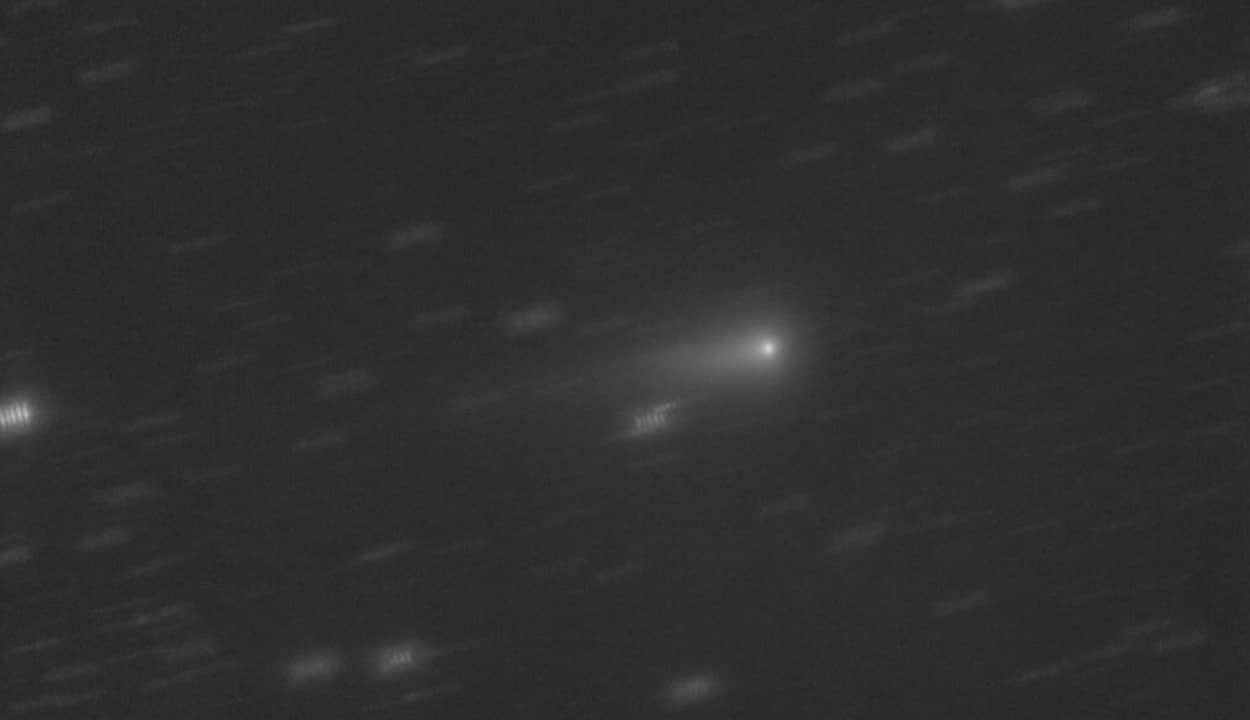
The Agência Espacial Europeia JUICE probe observed the interstellar comet 3I/ATLAS and recorded the release of about two tons of water vapor per second. The measurement took place in November 2025, a few days after the object’s perihelion. The volume is equivalent to approximately 70 Olympic-size swimming pools of water ejected into space every day. Comet 3I/ATLAS is the third confirmed interstellar visitor to the solar system.
The discovery happened unplanned during JUICE’s journey towards Júpiter. The probe activated five scientific instruments to monitor the comet’s activity after its closest passage to Sol. The data arrived at Terra in February 2026 and is now undergoing detailed analysis.
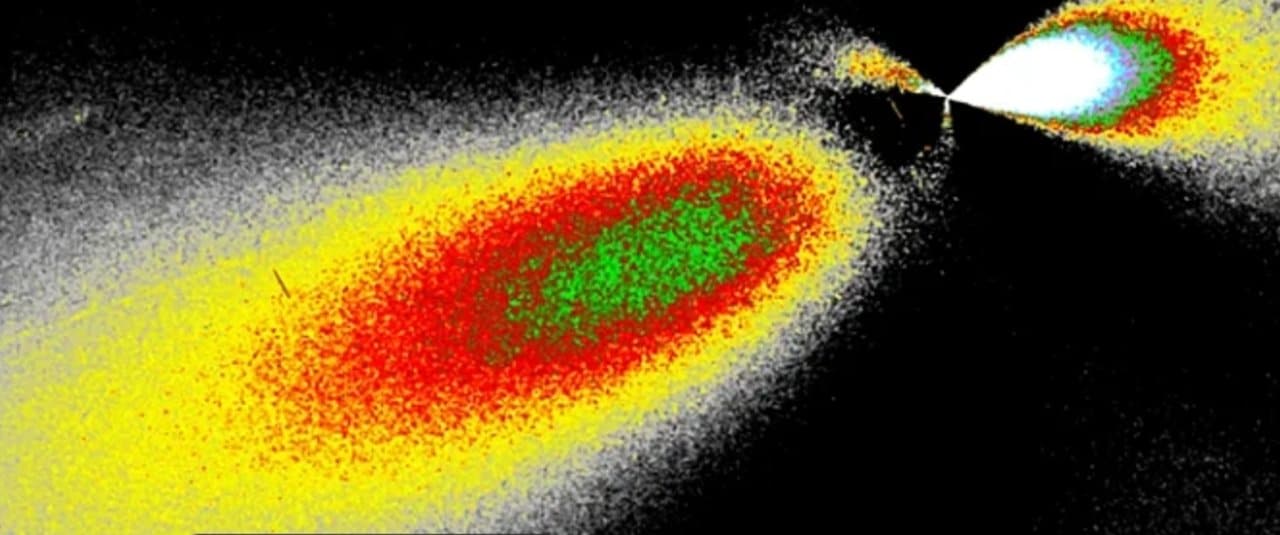
MAJIS instrument captures water and carbon dioxide emissions
The MAJIS imaging spectrometer identified infrared emissions from water vapor and carbon dioxide molecules. Essas Substances are known as volatile and evaporate easily under sunlight. Repeated detections indicate that ices buried beneath the surface of the core were actively released shortly after perihelion.
The process involves sublimation, when solid ice turns directly into gas due to heating from solar radiation. Esse Gas escapes and forms the coma and tail typical of comets. 3I/ATLAS showed brighter brightness than initially predicted by experts.
- Emission of water vapor at a rate of about two tons per second
- Confirmed presence of carbon dioxide along with water
- Activity observed on November 2, 2025, four days after perihelion
- Weaker signals detected on November 12th and 19th
- Release of volatiles from underground layers of the core
The researchers estimate that the core’s outflow corresponds to the daily equivalent of 70 Olympic-size swimming pools of water vapor. The amount falls within the upper range observed in comets, but is not exceptional.
JANUS images reveal structures of the coma and tail
The JANUS camera recorded more than 120 images of the comet between November 5 and 25, 2025. The photographs show an extensive coma, a tail and several morphological structures, such as jets, filaments and rays. The core remains hidden by the surrounding cloud of gas and dust.
These images offer the first detailed look at intense 3I/ATLAS activity just past Sol’s closest point. The team highlighted the camera’s performance as a preview of what it will do when studying the icy moons of Júpiter from 2031 onwards.
The SWI instrument also contributed by mapping the direction of water ejection. Most of the vapor was released from the side facing Sol. Grande volume appears to come from ice grains in the coma rather than directly from the solid core.
Challenging observations and late received data
JUICE was not designed to study comets, but its position in space allowed for a rare opportunity. The comet was discovered on July 1, 2025 by the ATLAS telescope at Chile. The probe’s observations occurred in a short window and required rapid adjustments in operation.
The data took months to reach Terra due to the distance and volume of information transmitted. Cientistas of Instituto Nacional of Astrofísica of Itália and other institutions involved in the mission highlighted that the wait was worth it. The information makes it possible to study materials formed around another star billions of years ago.
3I/ATLAS followed typical comet behavior as it approached Sol. However, its interstellar origin offers a unique chance to compare chemical composition with objects native to the solar system.
What comet activity reveals about distant star systems
The release of volatiles such as water and carbon dioxide helps to understand processes that occur during the formation of planets in other systems. Cientistas hope that data from MAJIS and JANUS will contribute to models on the chemistry of exocomets and the distribution of ice in interstellar clouds.
Complementary observations from other telescopes and missions, such as James Webb, also accompany the object. 3I/ATLAS poses no risk to Terra and will continue its trajectory out of the solar system.
The JUICE mission now follows its main route towards Júpiter. The experience with the comet serves as a test for the instruments that will be used on the giant planet’s icy moons starting in the next decade.