
High-tech examination rewrites the history of marine fossil mistaken for primitive octopus

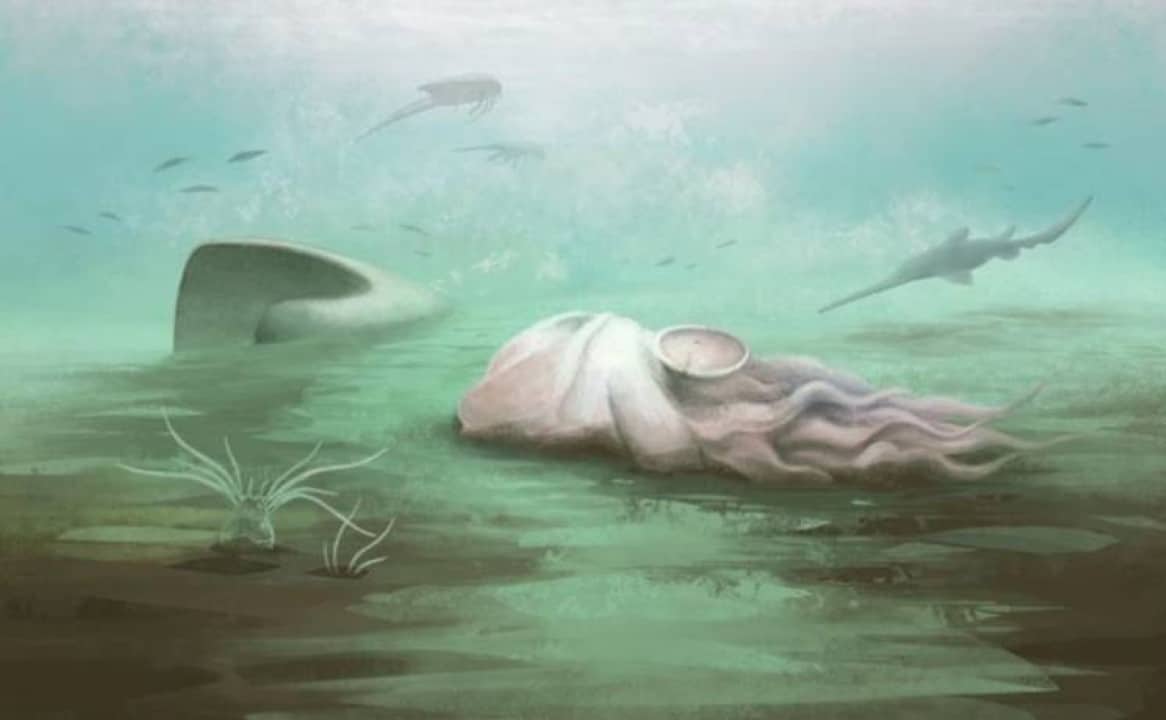
A marine fossil discovered in the southern region of Chicago has lost its title as the world’s oldest octopus after 26 years. The 300-million-year-old specimen belongs to an extinct lineage of modern nautilus relatives. The reclassification occurred thanks to the use of extremely high-precision imaging equipment.
Pesquisadores of Universidade of Reading led the investigation that corrected the historical error. The detailed study was published on April 8, 2026 in the scientific journal Proceedings of the Royal Society B. The failure in the original identification was due to the animal’s severe state of decomposition before fossilization. Rot created deceptive shapes in the rock. Agora discovery adjusts evolutionary timeline of early oceans.
The synchrotron light revolution in rock analysis
Taxonomic correction depended entirely on the application of synchrotron light beams. Esse complex machinery acts as a large-scale particle accelerator. The equipment generates extremely powerful X-rays, with a luminosity that surpasses that of sunlight itself. Essa technology allowed scientists to perform full three-dimensional scans of the interior of the rock matrix. The fossilized material remained intact throughout the process.
In the early 2000s, the first evaluations of the specimen used only scanning electron microscopes. Esses old instruments were only able to map the external topography of the piece. The initial interpretation was based exclusively on the visible outline left on the stone. The synchrotron light passed through the dense mineral layers with ease. The method revealed microscopic internal organs with a resolution unprecedented in paleontology.
Technological advances ended decades of debates among experts in the biological field. Alguns Scientists were already questioning the strange proportions of the animal’s supposed tentacles. The internal visualization provided the definitive data to rule out the early octopus hypothesis. Advanced scanning has proven that superficial analysis can hide the true identity of prehistoric organisms.
Estrutura dental mismatch and decomposition deception
The crucial element revealed by the new scan goes by the name radula. Trata is a mouth structure that molluscs use to scrape and process their food on the sea floor. The X-ray equipment identified the animal’s row of teeth perfectly preserved within the rock. Visualization of this tiny internal organ provided the exact comparative basis for the study. The researchers compared these characteristics with living and extinct species.
Detailed analysis of the radula demonstrated that the organism had at least 11 teeth in each food row. Esse number contrasts absolutely with the anatomy of octopuses known to science. Members of the Octopoda group present a strict pattern that varies from only seven to nine teeth in the same region. The incompatible tooth count represented the final proof against the previous classification. The scientists crossed the data with databases from other mollusc families.
The external shape that deceived the scientific community resulted from an extreme deterioration process. The animal’s body spent weeks decomposing on the ocean floor before being buried by sediment. Esse prolonged rotting completely disfigured the original structure of the marine organism. The process created folds and stretches in the flesh that simulated the appearance of long, thin arms. The optical illusion generated by atypical fossilization masked the true biology of the species for more than two decades.
Impactos directs the chronology of oceanic evolution
Removing this fossil from the octopus category drastically changes the evolutionary timeline of cephalopods. The estimated age of 300 million years placed the emergence of these animals in a remote and isolated time. With the official reclassification, the oldest confirmed records of true octopuses undergo a significant temporal leap. The concrete evidence is once again concentrated in the range of 90 million years ago. The chronological adjustment resolves inconsistencies that bothered marine biology theorists.
The specimen was recovered from geological deposits of the Carbonífero period in América of Norte. The southern region of Chicago is home to rock formations with rare and exceptional chemical conditions. Esse environment allowed the preservation of soft tissues of several prehistoric creatures. Carbonífero marked a phase of broad diversification of fauna in the planet’s primitive oceans. Correctly cataloging the inhabitants of this era provides vital data on the geographic distribution of molluscs.
The taxonomic correction generates immediate developments in evolutionary biology studies and in the classification of extinct species around the world:
- Ajusta the mathematical models on the mutation rate and genetic divergence of ancient cephalopods.
- Redefine the nautilus family tree with the addition of a new relative from the Carbonífero period.
- Estabelece a new mandatory verification protocol for soft-body fossils with ambiguous shapes.
Esses developments reinforce the need for caution when interpreting very old organic remains. The scientific community begins to adopt more rigorous criteria before announcing discoveries that alter established timelines. The Chicago fossil now serves as the prime example of the risks of superficial morphological analysis.
Revisão of global collections and the future of paleontology
The case of the North American fossil drives a profound methodological change in research institutions. The discovery that decomposition forges entire anatomical features raises a global alarm. Experts recognize the urgency of re-examining other dubious pieces that have been stored in museums for decades. The use of synchrotron light is consolidated as a standard and indispensable tool. Validation of paleontological descriptions will increasingly require the support of particle physics.
The work conducted by the British team involved strategic partnerships with cutting-edge international laboratories. Essa collaboration ensured the necessary usage time in the particle accelerator for the complete scan. The publication of the results underwent a rigorous peer review process before official release. The original fossil remains under the careful custody of institutions at Estados Unidos. The piece remains available for future investigations should new technologies emerge in the coming years.
Relocating the specimen to the tree of life does not diminish the historical value of the discovery in the rocks of Chicago. The piece consolidates modern understanding of the complex anatomy of nautilus relatives. The material provides concrete evidence for the study of fossilization conditions in low-oxygen environments. Paleontólogos maintains continuous mapping of the region in search of new preserved specimens. The goal is to find fossils that complement the structural information revealed by recent X-ray scanning.





