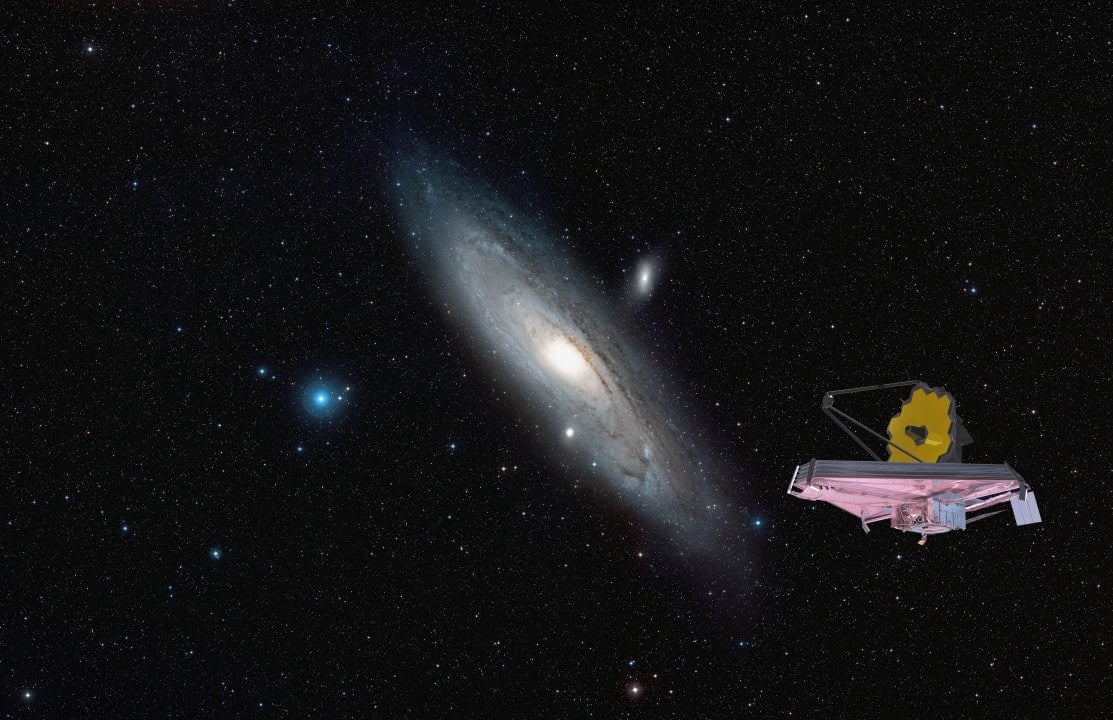
Telescópio Espacial James Webb has picked up signs of a thick atmosphere on the exoplanet TOI-561 b. The rocky planet orbits its star about 280 light-years from Terra, in the constellation Sextans. Ele completes a lap in just 10.56 hours.
Extreme proximity creates harsh conditions. Measurements show dayside temperatures of around 1,800°C. Esse value is below what would be expected for a bare rock surface exposed to intense radiation. The data came from observations made in May 2024 with the NIRSpec instrument.
NIRSpec’s Dados shows planet colder than predicted
The exoplanet TOI-561 b is classified as an ultrahot super-Terra. Sua measured density is around 4.3 g/cm³, a value lower than that of a completely rocky composition similar to Earth. Modelos without atmosphere predicted daytime temperatures close to 2,700°C or more.
Pesquisadores observed the infrared glow during secondary eclipses, when the planet passes behind the star. The emission spectrum between 3 and 5 micrometers indicated that the day side radiates less energy than pure rock would release. A layer of gases appears to redistribute heat around the planet.
- The planet has a radius about 1.4 times that of Terra
- The estimated mass is around twice that of Earth
- The host star is approximately 10 billion years old and is poor in iron
- The ultra-short orbit locks the planet with one side always facing the star
- The radiation received is tens of times greater than that which reaches Terra
Essa configuration keeps the surface in a molten state most of the time.
Webb detected the strongest evidence yet for an atmosphere on a rocky planet outside of our solar system! Findings suggest ultra-hot super-Earth TOI-561 b is surrounded by a thick blanket of gases above a global magma ocean. https://t.co/d6g3z4pnUr pic.twitter.com/2VdiyU8LMs
— NASA Webb Telescope (@NASAWebb) December 11, 2025
Oceano of magma fuels possible volatile cycle
The surface of TOI-561 b forms a constantly churning global magma ocean. Rochas vaporized and internal processes release gases that contribute to the atmospheric layer above. The study published in The Astrophysical Journal Letters suggests that this reservoir of volatiles explains the retention of gases despite strong stellar radiation.
Equipes analyzed four consecutive secondary eclipses in a row. The results reject the bare rock model with high confidence. Instead, an atmosphere rich in volatile elements cools the dayside by transporting heat to other regions.
The planet belongs to the category of lava worlds. Nessas conditions, minerals evaporate from the molten surface and form a kind of mineral atmosphere. The observed low density fits better when considering the contribution of a thick gaseous layer.
Espectroscopia emission details thermal characteristics
NIRSpec operated in bright object time series mode with G395H high-resolution grid. The total observation lasted more than 37 hours and covered nearly four full orbits of the system. Dois independent data reduction pipelines were used to validate results and minimize artifacts.
The spectrum obtained shows patterns that bare rock surface models do not reproduce well. Já scenarios with thick volatile atmosphere come closest to brightness measurements. Pequenas discrepancies still require refinement in future analyzes to define the exact composition of the gases.
The star TOI-561 is old and belongs to the thick disk of Via Láctea. Sua’s chemical composition, rich in alpha elements and poor in metals, differs from Sol and influences the planet’s formation environment. Esse context helps understand why TOI-561 b exhibits properties distinct from other ultrashort exoplanets.
Modelos of atmospheric loss are questioned
Planetas rocks with such short orbits should experience intense atmospheric escape. Stellar radiation would easily strip off gaseous particles over time. However, James Webb observations indicate that TOI-561 b maintains a significant layer of gases.
A magma ocean can act as a continuous source of volatiles. Gases escape into the atmosphere, but the magma reacquires them in a dynamic cycle. Esse mechanism rejects the idea that ultrahot worlds completely lose their atmospheres.
The discovery opens up possibilities for studying extreme geophysics through atmospheric spectra. Poucos rocky exoplanets close to stars have shown similar evidence so far. Webb has expanded infrared observation windows for these objects.
The exoplanet does not offer conditions for life as we know it. Suas extreme temperatures and constant radiation make it uninhabitable. Ainda thus serves as a natural laboratory for planetary processes in hostile scenarios.
Comparação with early stages of Terra gains traction
Early Terra also went through periods with a partially molten surface and intense volcanic activity. Embora TOI-561 b is much hotter, it allows us to test ideas about how atmospheres interact with magma oceans on a planetary scale.
Estudar helps these worlds refine models of planetary evolution. Internal Processos, such as convection in the molten mantle, may play a greater role in maintaining atmospheres than previously assumed. The connection between geology and atmosphere becomes clearer in these extreme cases.
The low density of TOI-561 b has already intrigued researchers in previous measurements. Algumas Initial estimates suggested a high water content composition, but the new observations point to a volatile-rich secondary atmosphere over magma.
Observation Detalhes Strengthen Instrument Capability
The campaign involved continuous observations from May 1 to 3, 2024. The Bright Object Time Series mode made it possible to capture subtle variations in the star’s brightness when the planet was hidden. The G395H grid covered the range of 2.67 to 5.14 micrometers with high resolution.
Independent Reduções with Eureka pipelines! and ExoTiC JEDI produced spectra consistent with each other. The effective dayside temperature was around 1,740°C to 1,830°C depending on the model, well below the 3,000°C expected for bare rock.
Esses numbers confirm that the heat is not only concentrated on the daytime side. The atmosphere distributes energy, also heating the night side and keeping magma moving.
Implicações for other lava worlds
TOI-561 b is part of a growing class of exoplanets known as lava worlds. With the advancement of telescopes like James Webb, scientists are able to test theories in environments that do not exist on Sistema Solar. The amount of data about these objects increases rapidly.
Future Observações can map variations throughout the orbit and better investigate the night side. Análises transmission spectrum during transits are also planned to complement the emission data.
The discovery reinforces the central role of James Webb in the characterization of rocky exoplanets. The instrument detects signals that previous telescopes could not identify clearly.
Avanço expands understanding of planetary diversity
The study published in December 2025 adds evidence that atmospheres can persist in extreme conditions. Classical atmospheric escape Modelos needs to be adjusted to include cycles with magma oceans.
Equipes from institutions such as Carnegie Science and partner universities participated in the analysis. The results highlight the importance of observing not only potentially habitable planets, but also extreme ones.
By defining atmospheric survival limits, scientists refine criteria for identifying worlds with milder conditions. TOI-561 b shows that the universe holds unexpected scenarios even in hostile environments.
Research continues with new data from Webb on other similar candidates. Cada observation helps piece together a more complete picture of the formation and evolution of planets outside of Sistema Solar.