

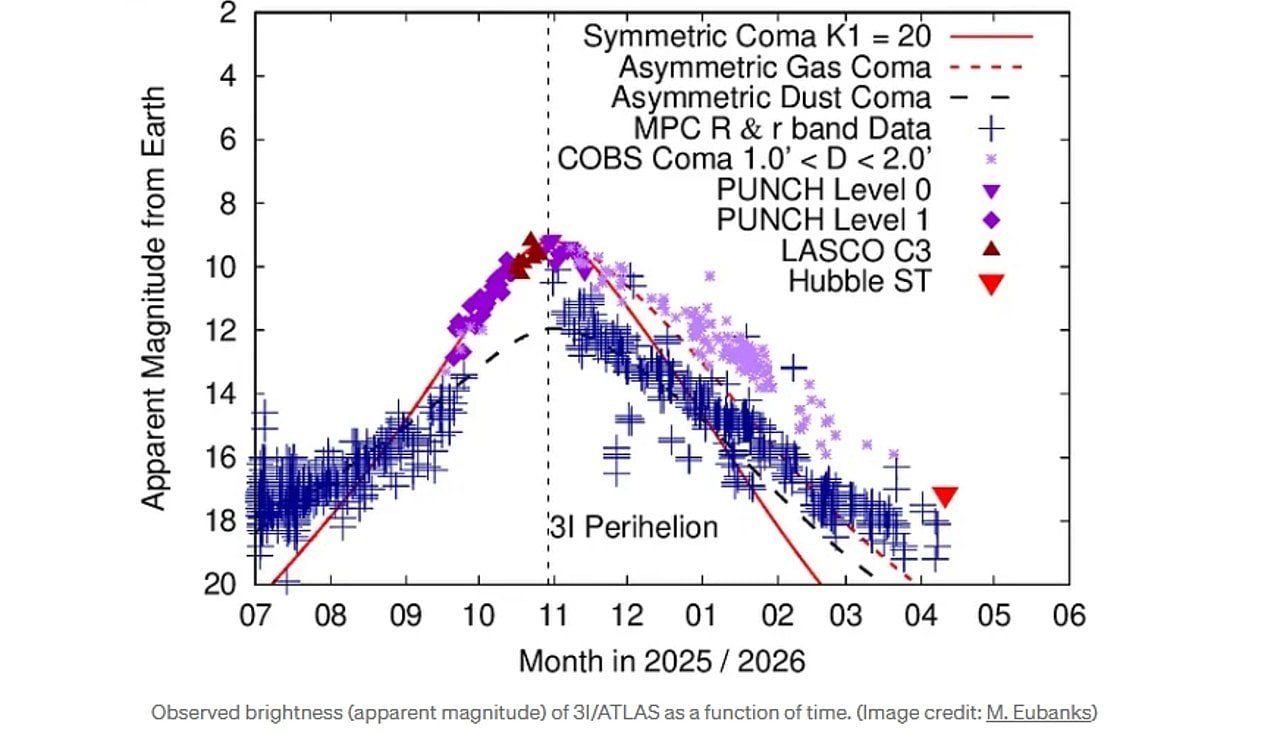
The celestial body 3I/ATLAS is currently one billion kilometers from Terra. The distance is almost seven times the space between our planet and Sol. The interstellar visitor has already surpassed the orbit of Júpiter. Agora, it continues its return trajectory into deep space. Recent Imagens captured by Telescópio Espacial Hubble on April 10, 2026 shows the object as a fuzzy point. The mystery surrounding its nature continues to challenge astronomers, who seek answers to the celestial body’s atypical behavior. The journey back to the interstellar void will be long and silent.
Apesar from continuous clearance, the brightness of the space body remains surprisingly high. The phenomenon occurs due to the intense emission of gases and dust generated during its passage close to Sol. The scientific community awaits with great anticipation the data collected by the American space agency’s Juno probe. Nasa equipment recorded crucial information on March 16, 2026. Naquela date, the visitor reached its closest approach to the gas giant. Scientists hope the sensor readings will reveal previously unseen details about the object’s surface and core. Thorough analysis of this data could rewrite astrophysics textbooks.
Composição unusual chemistry raises hypotheses about nuclear fusion
Analysis of the elements present in 3I/ATLAS revealed drastic deviations from known cosmic standards. The most intriguing detail involves the extraordinarily high proportion of deuterium. The hydrogen isotope appeared at levels a thousand times higher than the average found in space water. Quando compared to planetary methane, the value is thirty times higher. The numbers surpass any previous record made on local comets or meteorites. The discovery forced research teams to recalibrate their theoretical models about the formation of celestial bodies outside our stellar domain.
The researchers also detected atypical ratios in the carbon isotopes present in carbon monoxide and dioxide. The combination of abundant deuterium and these readings sparked intense debate at observatories. Alguns experts speculate about a possible technological signature. The detected material serves as highly efficient fuel for nuclear fusion reactors. A chain reaction could explain the anomalous release of energy observed by terrestrial instruments.
Outro question mark involves the survival of complex organic molecules. Compostos like methanol and methane have withstood a billion-year interstellar journey. Preserving this material would require it to be buried beneath a thick protective layer. The late detection of methane suggests an internal structure divided into artificial layers. Organic Moléculas of this type often function as biosignatures in astrobiological research.
Calculated Trajetória and geometric alignment surprise researchers
The object’s orbital dynamics presented a geometry that defies mathematical probabilities. The celestial body adopted a retrograde route perfectly aligned with the plane of the solar planets. The chance of a natural event occurring this way is only 0.2%. Via Láctea’s disk has an inclination of sixty degrees in relation to our ecliptic. The extraordinary coincidence suggests that the route may have undergone some kind of directional adjustment.
The arrival schedule also appears to have optimized close encounters with the planets in our system. The visitor passed 29 million kilometers from Marte and 54 million kilometers from Júpiter. Durante its perihelion, it remained strategically hidden from the terrestrial point of view. The perijove distance in March 2026 was extremely close to the radius limit of Jovian Hill. The level of precision fuels the hypothesis of a targeted reconnaissance mission.
Comportamento anomalous in the emission of gas and dust jets
The space body’s rotation axis maintained a constant alignment with Sol. The slope has remained below eight degrees since its entry into the system. The probability of a chance alignment of this magnitude is no more than 0.5%. Stability would guarantee consistent temperatures and continuous lighting for a supposed technological artifact. The scenario would provide a controlled environment throughout the space crossing.
The processed images from Telescópio Espacial Hubble revealed structures that do not match traditional comets. Entre November 2025 and February 2026 filters highlighted a complex propulsion system with the following characteristics:
- Três symmetrical minijets appeared separated by exact 120 degree intervals.
- A jet aimed at Sol spanned hundreds of thousands of kilometers.
- The extreme brightness surpassed any previous record and displayed an atypical bluish color.
The symmetry of the three smaller jets suggests a three-dimensional stabilization mechanism. The main jet, nicknamed the inverted tail, occurred before and after perihelion. The phenomenon could act as a particle shield against the solar wind. Nenhuma known space rock emits material toward the star with such intensity and precision. The extreme negative polarization of the reflected light adds yet another inexplicable factor to the object’s visual behavior. Astronomers remain perplexed by the body’s ability to maintain its structural integrity under such extreme conditions of radiation and heat.
Teorias on the origin and dimensions of the cosmic visitor
The physical characteristics of 3I/ATLAS vastly surpass previous interstellar visitors. The nucleus has a mass much greater than that of ‘Oumuamua and comet Borisov. The travel speed also broke the records set by its predecessors. The origin point of the trajectory coincides with a margin of nine degrees from the place where the famous radio signal captured in the past was detected. Geographic correlation raises questions about the original emission source.
Professor Avi Loeb, Universidade researcher of Harvard, proposed that the anomalies defy purely natural explanations. The Trojan horse theory suggests that an advanced civilization may have adapted a natural comet for exploration. The excess of nickel in relation to iron in the gas cloud reinforces this idea. Nickel Ligas are widely produced by the human industry for aerospace applications. The visitor continues his journey into the unknown and consolidates his place as the greatest enigma in modern astronomy.





