3I/ATLAS: Chinese equipment in Mars orbit captures unprecedented details of fast interstellar comet

The Tianwen-1 space probe achieved a historic milestone by recording detailed images of comet 3I/ATLAS from the orbit of Marte. The celestial object has an origin external to our Sistema Solar and travels at an impressive speed of 58 kilometers per second. The photographic capture took place at the end of 2025. The record marks the first time that an interstellar body has been documented directly by equipment positioned in the vicinity of Planeta Vermelho.
The monitoring took place at a distance of approximately 30 million kilometers from the Chinese orbiter. The operation provided valuable data to the international scientific community about the composition of distant worlds. Especialistas consider the observation a notable advance in the technological ability to track dynamic targets in deep space. Images released by Administração Espacial Nacional of China reveal the nucleus and gas coma with surprising clarity.

Hyperbolic Trajetória and the history of cosmic visitors
Comet 3I/ATLAS represents the third interstellar visitor confirmed by astronomers in the recent history of space exploration. The passage follows the records of the object ‘Oumuamua in 2017 and the comet 2I/Borisov in 2019. The ATLAS telescope system initially detected the new celestial body in July 2025. Confirmation of its extrasolar origin occurred quickly after rigorous mathematical analysis of its route in space.
The object’s trajectory is classified as hyperbolic by researchers. Diferente of the elliptical orbits common to local asteroids, this pattern indicates that the body has enough speed to escape the gravitational pull of Sol. The comet will continue its journey through outer space after crossing our cosmic region. Essa characteristic testifies that the material formed in another star system very distant from Terra.
Corpos celestial bodies with this dynamic function as true time capsules for modern science. Eles carry crucial chemical information about the physical conditions of their places of origin. The analysis of these fragments offers a practical counterpoint to theoretical models based solely on the formation of our own planetary system. Cada gas molecule and ejected dust fragment bear the signature of a distant stellar environment. Astronomers can indirectly study worlds that are light years away through this cosmic dust. Compreender the density of the nebula where the comet was born helps refine theories about the evolution of planetary systems over the millennia.
Desafios engineering for photographic recording
Capturing the images required meticulous planning by the mission control team at Terra. The probe’s high-resolution camera, known technically as HiRIC, had to undergo complex adaptations. The equipment was originally developed to map Martian topography with extreme precision. Rastrear a small, dimly glowing, fast-moving target against the dark background of space differs fundamentally from observing a static planetary surface. Experts faced a challenge unprecedented in the history of Chinese robotic exploration.
Engineers needed to develop an entirely new observation strategy to ensure the success of the endeavor. The process involved several critical steps of calibrating and adjusting equipment millions of kilometers away from the command center.
- Recalibração complete space probe targeting systems.
- Execução of precise orbital maneuvers to align the lens with the predicted path of the comet.
- Realização of exhaustive simulations to determine ideal photographic exposure times.
- Ajuste of the thermal stability of the instruments to guarantee operation at the ideal temperature.
The observation window only lasted a few crucial minutes. The exposure time needed to be short enough to avoid blurring caused by the relative motion between the probe and the comet. At the same time, the lens needed to capture the weak light reflected by the nucleus. The raw data was immediately transmitted to the control center on Pequim via the deep space network. Expert Algoritmos processed the multiple exposures to generate the sharp photographs that have amazed astronomers around the world. The operation tested the absolute limits of the hardware available in space.


Pistas on the chemical composition of the distant object
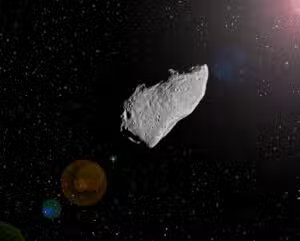
The spectral data collected by Tianwen-1 provide important indications about the physical nature of 3I/ATLAS. The photographs show a dense, well-defined core. Scientists believe the structure is made up of a complex mix of rocks and different types of ice. The light reflected by the surface points to the presence of reddish organic dust.
Essa reddish coloration is a common feature of celestial bodies formed in extremely cold regions far from their host stars. The object likely originated in an icy protoplanetary disk. Elementos volatiles can remain preserved for billions of years in these remote environments before beginning a journey through interstellar space.
Espectrômetros aboard other missions have also detected complementary chemical signatures. The instruments recorded the sublimation of water ice and carbon dioxide on the comet’s surface. The presence of carbon monoxide confirmed the typical activity expected for this type of celestial body when approaching a heat source.
International Esforço and the future of space exploration
The observation of the comet mobilized an international fleet of equipment positioned in the orbit of Marte. Agência Espacial Europeia and the US space agency directed their own orbiters to study the gaseous composition of the coma. Essa coordinated campaign significantly expanded the quantity and quality of data collected about the object. On the surface of the planet, the exploration vehicles Perseverance and Curiosity received commands to try to locate the visitor in the Martian sky. Essa joining forces demonstrates the importance of scientific collaboration in exploring the cosmos.
The success of the Chinese operation proved the versatility of the Tianwen-1 probe far beyond its main mission. The equipment demonstrated robustness in its navigation and attitude control systems. The original mission, launched in July 2020, had already reached important milestones with the landing of the Zhurong vehicle in 2021. The orbiter continues its work regularly mapping the Martian surface.
The experience gained from tracking the interstellar visitor will serve as a basis for the next steps of the Asian space program. The Tianwen-2 mission, launched in 2025, has the ambitious objective of collecting samples from an asteroid and studying another comet. The recently developed observation protocols will be directly applied to these new deep space exploration operations.
See Also em Latest News (EN)

Researchers advocate instrumental UFO data over report analysis
30/04/2026
Luka Doncic’s slow recovery leaves Lakers without star in possible clash with OKC
30/04/2026
Does Jefferson Savarino play today? Bolívar x Fluminense in the third round of the Libertadores
30/04/2026
Visa scandal in the Netherlands threatens to cancel 133 national championship games
30/04/2026
Does Germán Cano play today? Where to watch Bolívar x Fluminense in the Libertadores
30/04/2026
Jensen Ackles, Jared Padalecki and Misha Collins have a bloody reunion in The Boys
30/04/2026
SpaceX launches Falcon Heavy with communications satellite for the first time in 18 months
30/04/2026
Lucho Acosta plays today? Where to watch Bolívar x Fluminense in Libertadores 2026
30/04/2026
Full Flower Moon in Scorpio brings intense transformation to all signs in May 2026
30/04/2026
Chinese smartphones adopt iPhone visual features and create their own identity
30/04/2026
Bolívar x Fluminense in the Libertadores: where to watch and likely lineup for the game in La Paz
30/04/2026