
Scan reveals two unprecedented cavities in the east face of the Pyramid of Micah in Egypt


An international team of scientists has identified two air-filled cavities inside Miquerinos’s pyramid. The monument makes up the famous burial complex of the Gizé plateau. The discovery occurred behind a specific section of the east face of the ancient structure. The granite blocks in this area have an exceptionally smooth and polished surface. The unusual finish has attracted the attention of experts for several years.
The find is part of the operations of the ScanPyramids project. The researchers combined different probing methods to map the interior of the building without causing any physical damage. Data fusion generated accurate images of structural anomalies. The result validates previous theories about the site’s architecture. The official publication of the data took place in the scientific journal NDT&E International.
/ shutterstock.com
Acabamento polished on the east face prompted investigation
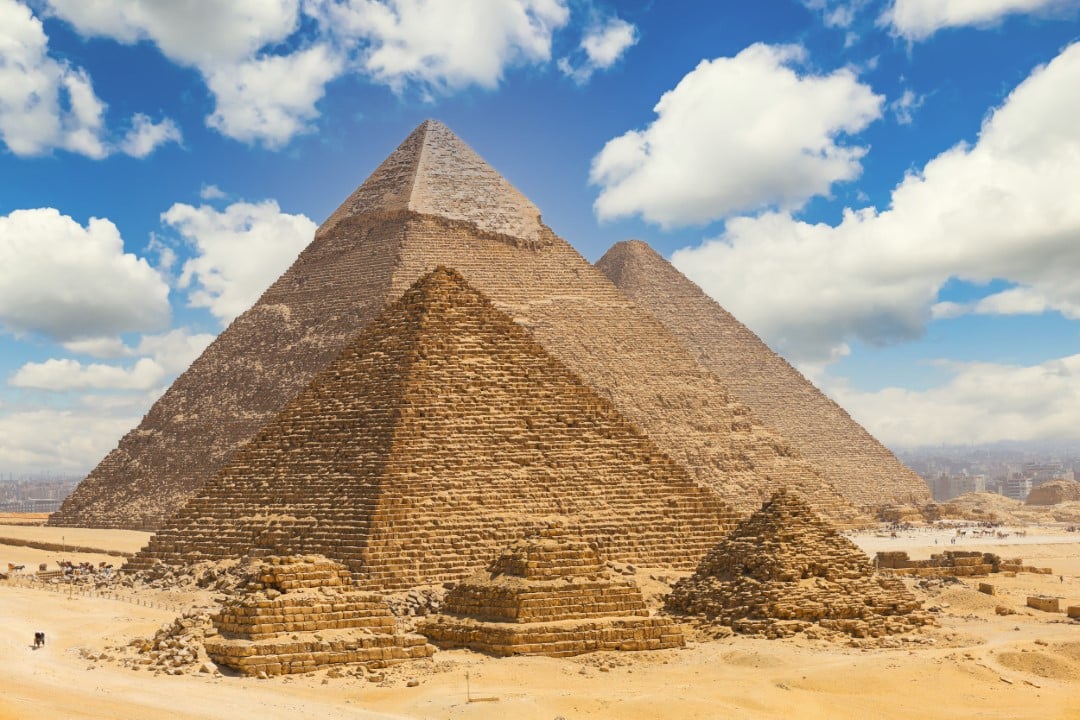
The eastern face of Miquerinos’s pyramid rises more than 60 meters high. A very limited area contains granite blocks measuring four meters high by six meters wide. Archaeologists have noted that the extreme polish of this section represents an architectural rarity. Esse texture type traditionally appears only in known main input. The official access is on the north side of the ancient building.
The visual similarity has instigated recent academic debates. Researcher Stijn van den Hoven suggested the possibility of a second entry into the site in 2019. Faltavam provided concrete evidence to support the hypothesis at the time. The scenario has completely changed with the application of new scanning technologies. The current data provide the missing material basis for the theory.
The monumental construction took place approximately 4,500 years ago. The building forms the iconic trio of Gizé alongside the imposing pyramids of Quéops and Quéfren. The structure of Miquerinos is the smallest of the three main ones. Ela maintains much of its original coating preserved to this day.
Cutting-edge Equipamentos ensures drill-free analysis
The scientific team used three distinct technological approaches during the investigation process. Ground-penetrating radar operated in conjunction with ultrasound devices. Electrical resistivity tomography completed the scanning arsenal. Cada method generated an independent set of information about the density of materials. The superimposition of these readings allowed us to draw the exact shape of the anomalies.
The experts carried out several numerical simulations on high-performance computers. The objective was to rule out alternative explanations for the readings obtained by the sensors. Natural Fissuras in the rock would not produce the recorded pattern. Variações common in limestone density were also discarded after testing. The conclusion pointed unequivocally to artificial empty spaces.
- Penetrating Radar emitted waves of different frequencies into the rock.
- Ultrassom captured millimetric acoustic variations behind the granite facade.
- Electrical resistivity Tomografia mapped the conductivity levels of the material.
- Fusão data consolidated all measurements into a single three-dimensional model.
- Virtual Simulações confirmed the presence of air inside the rock cavities.
Medidas reveal the exact size of hidden cavities
The two hollow spaces rest directly behind the polished granite wall. The first cavity is located approximately 1.4 meters away from the external face. Ela is approximately one meter high by 1.5 meters wide. The estimated total volume of this larger space is around 1.5 cubic meters. The irregular shape required complex approximation calculations.
The second anomaly has slightly more modest dimensions. Ela is 1.13 meters deep in relation to the surface of the monument. The measurements indicate 0.9 meters high by 0.7 meters wide. The calculated volume reaches the mark of 0.63 cubic meters. Ambas internal structures house only air.
The scientists did not carry out any type of physical access to the discovered enclosures. Todas metrics are derived exclusively from the mathematical processing of external exams. The precision of modern sensors guarantees a minimum margin of error. The method preserves the physical integrity of one of humanity’s most important heritage sites.
Descoberta changes understanding of old architecture
Confirmation of the voids strengthens the hypothesis of an alternative access route. The presence of a second entrance changes the way Egyptologists view the original project. The circulation routes used by builders in Antiguidade gain new contours. The Miquerinos monument stands out precisely for the excellent conservation of its primary characteristics.
Those responsible for the study remain cautious about the exact contents of the cavities. Eles avoid unfounded speculation about hidden treasures or artifacts. The central statement is restricted to the gain in strength of the secondary entry theory. Scientific rigor guides all official statements by the research team.
The future schedule foresees the refinement of the three-dimensional models generated. The integration of new imaging techniques may occur in the next phases of the project. The absolute focus remains on the structural conservation of the building. Modern archeology increasingly relies on non-destructive solutions.
International Parceria boosts complex exploration
Field activities took place under strong government supervision. Conselho Supremo of Antiguidades of Egito authorized all stages of the research. Ministério of Turismo and Antiguidades followed the work closely. Pesquisadores of Universidade of Cairo and Universidade Técnica of Munique led the operations. Profissionais of Universidade Estadual of Portland and Instituto of Inovação and Preservação of Patrimônio also collaborated.
Professor Christian Grosse coordinated the analysis of non-destructive tests. The specialist from the German institution highlighted the effectiveness of the methodology applied on the Gizé plateau. The ScanPyramids consortium has a track record of impressive results. The group had already validated the existence of a hidden corridor in Quéops’s pyramid last year. The current success in Miquerinos consolidates the project’s importance for global science.



