
BYD and Huawei expand autonomous technology offensive at Beijing Motor Show
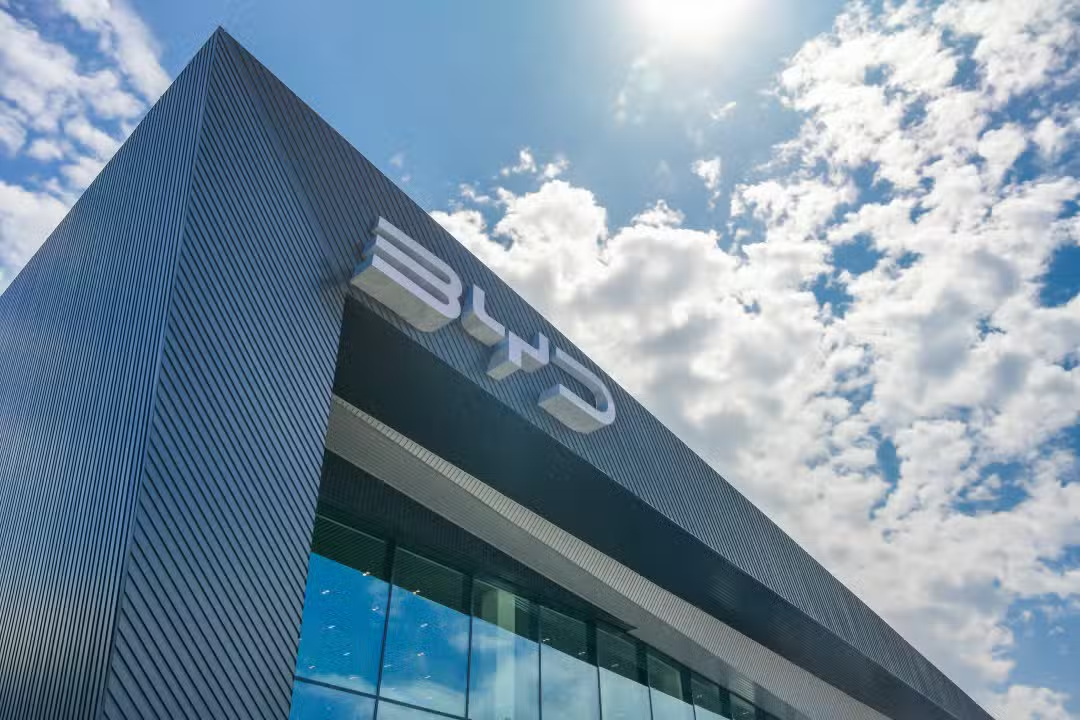
The Salão Internacional of Automóvel of Pequim has established itself as the stage for the biggest bets on autonomous technology in the Chinese automotive industry. BYD and Huawei announced significant advancements in driver assistance systems and sensor equipment, marking an escalation in competition for smart vehicles in a market facing slowing sales. The announcements reflect the technology giants’ strategy of maintaining leadership in autonomous driving, especially in Nível 3 systems, which allow automatic control in certain conditions.
The event, held on April 24, 2026, brought together the main global manufacturers in a context of accelerated transformation in the sector. With the growth of electric vehicles and plug-in hybrids slowing in China, automakers are looking to differentiate products through advanced technologies. Nissan also announced plans to use China as an export base for new energy vehicles, demonstrating the strategic importance of the Chinese market.
BYD will equip low-cost models with LiDAR
BYD presented updates to its famous Seagull electric hatchback, now with a LiDAR sensor integrated into the roof. The equipment, absent from previous versions, will allow more affordable vehicles to offer advanced driver assistance systems on public roads, not just highways. The strategic change increases the competitiveness of products in a price-sensitive and rapidly expanding segment.
Current Seagull models retail for between 69,800 and 78,800 yuan, equivalent to approximately 1.63 to 1.84 million yen. The Yuan Plus compact SUV, another vehicle equipped with the new technology, sells in the range of 115,800 to 145,800 yuan, or 2.7 to 3.4 million yen. BYD did not disclose the prices of models with LiDAR until the time of the event.
The assistance system that will equip these vehicles is called “Eye of Heaven B”, a mid-range solution from the company. Além LiDAR sensor, it integrates 11 to 12 cameras and 5 millimeter wave radars. The set allows the operation of “Navigate on Autopilot (NOA)”, a system that autonomously controls steering and braking on public roads to the destination while continuously monitoring the driver’s behavior. Este automation level represents a qualitative leap for vehicles in entry-level segments.
At Auto China 2026, #BYD booth debuted multiple new models including Seal 08 and Sea Lion 08.
— ThinkerCar (@thinkercar) April 24, 2026
Seal 08 (Ocean Network flagship sedan, new design language):
Dimensions: 5150/1999/1505 mm, wheelbase 3030 mm, mid-to-large sedan.
Powertrain:
• BEV: 800V high-voltage platform, 2nd-gen… https://t.co/1Qkxf8xEt7 pic.twitter.com/wt3zqNjRjA
BYD’s Novos premium sedan and SUV arrive with updated battery
BYD also revealed two high-end models during the event. The large sedan “Seal 08” and the large SUV “Sea Lion 08” will hit the market in fully electric and plug-in hybrid versions. Ambos will utilize the second generation “Blade Battery” battery, the proprietary lithium iron phosphate battery that was upgraded in March 2026. The new battery generation promises higher energy density and improved safety.
The PHEV (plug-in hybrid) models will offer an electric range of 400 kilometers, a competitive specification in the premium segment. The focus on two engine options reflects the Chinese strategy of gradual transition, maintaining hybridity as an alternative during the period in which the charging infrastructure is still expanding. The duplicity of versions broadens the appeal to different consumer profiles and regional markets.
Huawei invests billions in Nível 3 technology
Huawei announced on April 23, one day before the opening of the show, its aggressive investment strategy in autonomous driving. The company will allocate an additional 18 billion yuan, equivalent to approximately 414 billion yen, for research and development of autonomous driving systems in 2026. The amount reaffirms the telecommunications giant’s commitment to consolidating itself as a supplier of cutting-edge automotive technology.



Segundo data released by Huawei on April 19, the accumulated mileage of vehicles using its “Qiankun” autonomous driving system has exceeded 10 billion kilometers. The number highlights the reach and reliability of the company’s systems in real use conditions, reinforcing its competitive position against other global ADAS suppliers.
Sistema ADS 5 promises to reduce collisions by 50%
Huawei introduced the latest version of its advanced driver assistance system, called “Qiankun ADS 5” or simply “ADS 5”. The company defines the new system as “an artificial intelligence agent evolved for autonomous driving.” ADS 5 was developed with a complete architecture redesign, including the AI learning model. Segundo to Huawei, learning intensity and efficiency have increased tenfold from the previous generation.
Improvements in processing capacity allow artificial intelligence to make real-time decisions with greater security. The company claims the system can reduce the risk of collisions by 50%. Este advancement is significant as security remains a critical factor in the mass adoption of autonomous systems. The stated reduction in accidents aligns with increasingly stringent regulations on autonomous driving safety.
Primeiro model Qijing already awaiting approval for Nível 3
Huawei presented a wide range of new energy vehicles equipped with ADS 5 at the exhibition. The highlight was the “GT7”, the first model of the joint brand “Qijing”, the result of the partnership between Huawei and Guangzhou Automobile Group. The GT7 is now ready for highway testing under Nível 3 regulations, enabling autonomous driving in certain controlled conditions.
Também on display was the “X9”, the first model of the “Yijing” brand, a joint venture between Huawei and the state-owned group Dongfeng Motor Group. The presence of multiple automotive partners reinforces Huawei’s strategy of not depending on a single manufacturer, diversifying its influence on technological launches. The consolidation of partnerships demonstrates the industry’s growing acceptance of integrating Huawei technology into its products.
Slowdown Contexto Accelerates Innovation
The aggressive technology strategy is a direct response to the challenging market environment. Sales growth of electric and plug-in hybrid vehicles slowed dramatically at China during 2025 and early 2026. In response, manufacturers and technology suppliers invest in differentiation through advanced assistance systems, which become key competitive factors. Autonomous driving emerges as the main field of innovation to justify price premiums and win customers in competitive segments.
The Salão of Pequim, held every two years, has established itself as a barometer of global automotive technology trends. The event brings together more than a thousand exhibitors and attracts hundreds of thousands of visitors, functioning as a showcase for launches that later expand to international markets. BYD and Huawei’s announcements in this edition set new expectations for the rest of the industry.
Principais Salão highlights from Pequim 2026:
- BYD Seagull with LiDAR in low-cost segment (from 69,800 yuan)
- Top-end BYD Yuan Plus with built-in LiDAR sensor (from 115,800 yuan)
- Novos sedan Seal 08 and SUV Sea Lion 08 in EV and PHEV versions
- Bateria Blade Battery second generation with lithium iron phosphate
- Sistema Huawei ADS 5 with 50% reduction in the risk of collisions
- Primeiro model Qijing (GT7) ready for Nível 3 testing
- 10 billion kilometers accumulated by the Qiankun system
- Investimento 18 billion yuan in research and development
Ongoing technological developments establish new parameters for safety, functionality and accessibility in autonomous vehicles. The competition between BYD, Huawei and other participants in the Chinese market promises to accelerate the adoption of Nível 3 systems in commercial vehicles in the coming years, transforming the driving experience on a continental scale.
See Also em Latest News (EN)
SpaceX could siphon investors away from Tesla with $1.75 trillion IPO
28/04/2026
Does Olise play today? Bayern x PSG in the Champions League semi-final with a strong squad
28/04/2026
Does Vitinha play today? Where to watch PSG vs Bayern in the Champions League semi-final
28/04/2026
PS6 ray tracing sparks debate among leakers about real graphics capabilities
28/04/2026
Research reveals that playing League of Legends improves brain functions for up to 10 weeks
28/04/2026
Abel Ferreira defines Palmeiras lineup with return of starting defender and mystery in attack
28/04/2026
Scientific community mobilizes for solar eclipse of 2027, the longest of the century on Earth
28/04/2026
Huawei expands line of wearables with focus on continuous health monitoring
28/04/2026
Apple prepares foldable iPhone Ultra for launch in September 2026
28/04/2026
Mario film grosses 1.6 billion yen in Japan, but falls short of its predecessor
28/04/2026
IML report reveals that a five-year-old girl was buried alive in Itapetininga in the interior of SP
28/04/2026