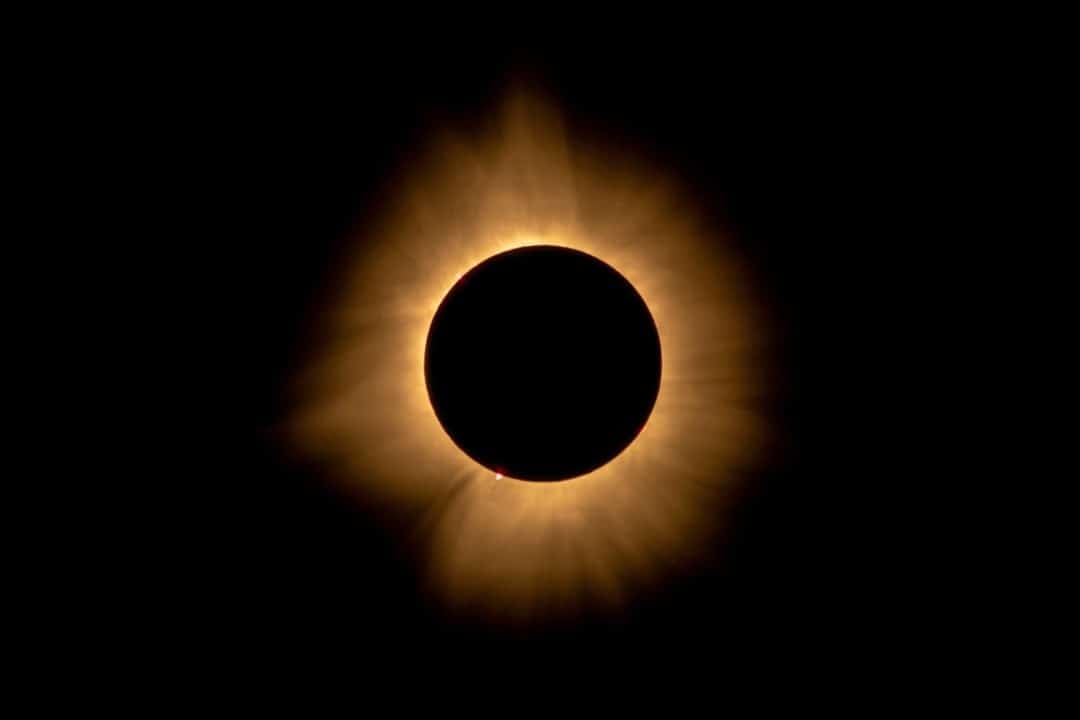
Cientistas confirmed that the next major solar eclipse will exceed in duration similar events recorded in the last hundred years. In certain regions of the path of totality, Lua will completely obscure Sol for a period of up to seven minutes — a rare exception compared to most modern eclipses, which last just two or three minutes. The phenomenon promises to transform entire cities into observation points and attract thousands of people from all over the world.
The difference of a few minutes, although it may seem small, drastically changes the experience. Durante During this interval, the sky visibly darkens, the temperature drops, the birds fall silent, and the world takes on an unreal quality of deep twilight. Estrelas appear in the middle of the afternoon, streetlights light up automatically, and a silver halo of fire surrounds the black disc that covers Sol.
The perfect geometry of an exceptional eclipse

Para For an eclipse to reach such extraordinary duration, three astronomical conditions must align with near-perfect precision. Lua needs to be in a close relative position to Terra in its orbit, appearing slightly larger in the sky. The phenomenon should occur close to noon on a large part of the route, keeping the Sol at a high height. And the shade strip needs to move slowly over the ground—never too fast.
Quando these variables converge, the result exceeds any expectations. Astronomical calculations already map, approximately, where Lua’s shadow will cross the planet. The path of totality will trace a narrow strip over continents and oceans, functioning as a scar made entirely of darkness. Cidades that on normal days go unnoticed will gain global relevance. Hotéis already takes reservations years in advance.
The impact on tourism and mobility
The migration that accompanies a long-lasting eclipse resembles a worldwide pilgrimage. Campos of farmers turn into makeshift camps. Estradas quiet rural brakes with vans equipped with telescopes. Pesquisadores, amateur and curious astronomers set up observation structures at strategic points along the band of totality. The phenomenon carries a particular energy — neither exactly scientific nor purely touristic, but a mixture of both.
Operadores hosting in regions where the eclipse will be visible is already facing extraordinary demand. Alguns establishments report full capacity for dates that are still years away. Transport Empresas increase fleet in anticipation. Autoridades locals begin discussing transit infrastructure. It is the type of event that redefines the expectations of a community for a specific period.
Como live the experience without getting lost in technology
Especialistas in astronomical observation highlight a recurring pattern: people travel great distances, invest in sophisticated equipment, reserve privileged locations — and then spend crucial minutes distracted by cell phones, cameras or digital filters. The physical experience ends up eclipsed by technological mediation. Para To circumvent this pitfall, experienced observers suggest dividing the event into three distinct phases.
The first phase is purely preparatory. Descubra exactly where the band of totality will pass, choose a location with open skies and an unobstructed horizon, and arrive long before the rest of the world realizes the importance of the point. Testes with equipment in advance avoids surprises at a critical moment. The second phase begins minutes before totality: purposely move away from devices, put down your cell phone, let the last moments of light belong to your senses. Ouça the silence in the trees, feel the cold creeping up your arms, notice the collective murmur as the last trickle of Sol disappears. Apenas after the light returns you can check the photos. The instant itself deserves to escape the screen, as no capture can replicate the raw sensory intensity.
Segurança and practical decisions
Qualquer honest planning recognizes that not everyone follows every security protocol to the letter. Num eclipse of this magnitude, temptations arise: looking beyond what is allowed without adequate protection, running between observation points in congested traffic, trying risky images from improvised rooftops. The wisest choice is to set a clear goal before the day. Will Você live the experience as a pure observer or as a photographer documenting the event? Tentar doing both perfectly in a few precious minutes invariably ends in frustration. Quando the sky literally changes color above your head, frustration is a waste of an unrepeatable moment.
One veteran eclipse chaser sums it up like this: “If you’re lucky enough to be in the range of a long eclipse, remember this: The most advanced instrument you carry remains your own nervous system. Você will forget the exact camera settings. Não will forget how your heart reacted when Sol went dark.”
Simple Checklist for event day
Manter a clear mind at the time requires minimizing decisions beforehand. A small paper list in your pocket reduces anxiety and prevents forgetting:
- Localização confirmed where you will stay, plus a reserve point in case crowds make access difficult
- Óculos proper observation with extras in hands of companions
- Identificação of people who will be physically by your side during the entirety
- Additional Roupa predicting sudden drop in temperature
- Garrafa thermos with hot drink
- Return Rota set in advance for post-event period
Naquela shadow track, you won’t just be a passive spectator observing a phenomenon. Você will be an integral part of the scene, contributing with his presence to a collective experience that transcends generations.