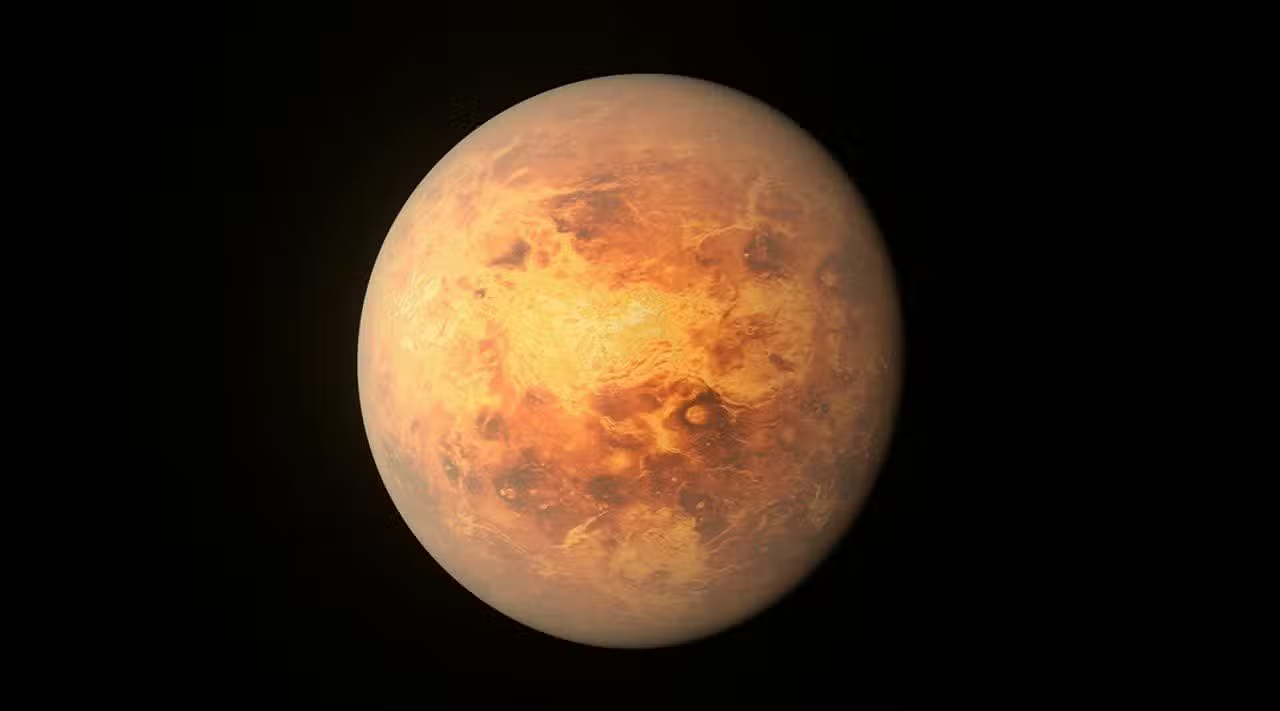
A state-of-the-art telescope installed north of Chile began operations with an ambitious objective: to locate Planeta 9, a celestial body whose existence remains theoretical until now. Astrônomos are closely following the first results of the equipment, considered the most powerful ever built to scan the night sky in search of distant objects. The discovery, if confirmed, would rewrite entire chapters in the history of Sistema Solar.
Constantine Batygin e Michael Brown, pesquisadores da Universidade da Califórnia, defendem a existência do corpo desde 2016. Ambos analisaram seis órbitas anômalas de planetas distantes e concluíram que apenas um objeto massivo explicaria os padrões observados. Esse hypothetical planet would have a mass ten times greater than Terra, orbiting at a distance twenty times greater than that of Netuno. A complete orbit would take up to 20 thousand years.
Evidências accumulated over a decade
Pesquisadores point out that a massive celestial body would be necessary to justify the gravitational anomalies detected. The supposed planet would have dimensions comparable to those of Netuno and would orbit in an extremely distant region. Sua’s highly inclined orbit would make detection even more challenging. Brown participated in the discovery of Éris in 2005, an event that led to the reclassification of Plutão as a dwarf planet in 2006. Atualmente, he leads research into new worlds.
“If Planeta 9 did not exist, many strange phenomena would remain unexplained,” stated Brown in a recent interview. Alternative Candidatos have already appeared in the scientific literature. Equipes research analyzed infrared images collected over 23 years, identifying points of light that moved. The authors acknowledge that it is still too early to confirm the discovery. Cientistas and Universidade Yale consider it possible that Terra is already cataloged in old files.
- Corpos celestial bodies outside Sistema Solar exhibit inclined and anomalous orbits.
- Modelos computational tests demonstrate gravitational influence of a massive object.
- Extreme Distância makes direct detection extremely difficult with previous technology.
- The planet would reflect very little sunlight, making traditional observation difficult.
Telescope Capacidades Vera Rubin
The equipment, located on a mountain in northern Chile, began operations in 2025. Utiliza is the most advanced digital camera in the world, with 3.2 gigapixels. The telescope captures wide swaths of the southern sky with each observation. Espera is expected to map tens of thousands of new celestial bodies in ten years, including thousands of worlds beyond Sistema Solar. The observatory’s Astrônomos emphasize the revolutionary potential of the technology.
Sarah Greenstreet, astronomer at the telescope, highlighted the detection possibilities. The Rubin equipment identifies darker and more distant objects than any previous instrument. If Planeta 9 exists in the predicted dimensions and position, the telescope should locate it. Brown remains optimistic. Segundo it, the equipment will provide conclusive evidence about the existence or non-existence of the body. The project has already produced notable initial results. In brief tests, it identified more than 11 thousand small celestial bodies, several of them worlds beyond Sistema Solar. Esses data demonstrates the system’s high-speed image processing capabilities.
Significado of possible discovery
If confirmed, Planeta 9 would be the fifth largest Sistema Solar body. Seria the first addition to the planetary catalog since the discovery of Netuno in 1846. The discovery process would mirror the case of Netuno, identified through orbital anomalies. Astrônomos noticed irregularities in Urano’s orbit and calculated the position of a new world. Galileu observed Netuno in 1612, but did not recognize it as a planet. Hoje technology allows you to detect subtle movements in real time. Brown compares the Rubin equipment to a tool specially designed for this type of detection. The instrument was built with extraordinary precision for this specific mission.
Impacto in astronomy and society
The search touches on deep cultural aspects. Cinema, documentaries, and literature have explored the idea of Planeta 9 for decades. Real Confirmação would generate discussions in classrooms and social media. Vera Rubin transformed data into accessible knowledge. Pesquisadores estimate that within one to two years of full operation, any existing planets in that region will be identified. Essa mission will continue to sweep the sky, generating daily alerts for the scientific community. The telescope will rewrite understanding about the final structure of Sistema Solar. Múltiplos countries follow the alerts generated by the equipment, awaiting the announcement that could transform modern astronomy.