Fed keeps US interest rates at 3.50% to 3.75% in latest decision with Powell in charge
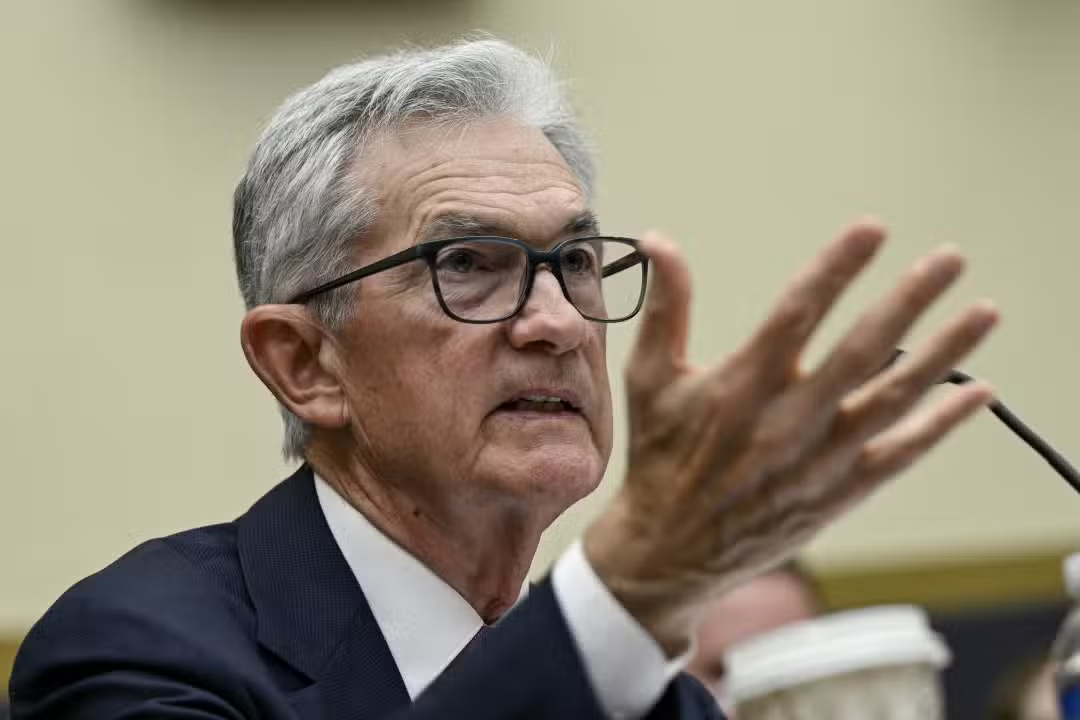
Federal Reserve kept the interest rate of Estados Unidos unchanged in the range of 3.50% to 3.75% per year. The decision was announced this Wednesday (29) and arrived as expected by the financial market. Foi the third consecutive meeting with rates at the same level, also marked as the last with Jerome Powell in charge of the institution.
Powell will step down as chairman of Fed on May 15, after eight years leading the US central bank. Sua’s departure comes amid tensions with Donald Trump and global economic challenges worsened by the escalating conflict between Estados Unidos and Irã, which began on February 28. Economist Kevin Warsh, appointed by the Republican president, should take up the post at the next meeting of Comitê Federal and Mercado Aberto, scheduled for June 16th and 17th.
Petróleo and inflation at the center of concerns
The war on Oriente Médio remains the main factor in American monetary policy decisions. Desde the beginning of the conflict, the Brent barrel of oil soared and reached US$120, the highest level since 2022. On Wednesday afternoon, the price reached US$118.70, representing an increase of more than 60% in relation to the moment the fighting began.
The significant increase in fuel prices puts significant pressure on American inflation. The latest data shows US prices rose 0.9% in March, the biggest increase since May 2024. 12-month inflation is at 3.3%, above the 2% target set by Fed. Gasoline, in particular, has risen more than 40% since Trump started the war, according to data from the automobile association AAA.
Fomc highlighted in its statement that “inflation is high, reflecting, in part, the recent increase in global energy prices.” The committee also mentions that “developments in Oriente Médio are contributing to a high level of uncertainty about the economic outlook.”

Estreito’s blocking of Ormuz and its global consequences
The central factor behind the price surge is the blockage of Estreito by Ormuz. The passage, responsible for approximately 20% of world oil consumption, recorded a sharp drop in ship traffic after Irã announced the blockade and attacks on oil tankers. The region is also responsible for around a fifth of global natural gas (LNG) trade, amplifying its economic impact.
Trump sought support from other countries to monitor and “look after” the crossing, a request rejected by European and Asian allies. Subsequently, he ordered the US Marinha to block oil tankers linked to Irã that were circulating in the area. The strait thus remains at the center of both geopolitical and economic disputes, with direct impacts on global commodity prices.
More expensive Combustíveis means more expensive gasoline and diesel for the American consumer. In cascading effect, this puts pressure on the prices of various products, from food to housing. The scenario is of particular concern to Fed, which has a dual mandate: controlling inflation and keeping the job market warm.
US domestic economic Situação
Fomc reported that US economic activity continues to expand at a solid pace. Contudo, job creation has remained low and the unemployment rate has changed little in recent months. The statement states that “Comitê is strongly committed to supporting maximum employment and bringing inflation back to the 2% target.”
Esta was the 11th decision since Donald Trump took office as the 47th president on January 20, 2025. Desde took office, there were three interest cuts, amid an uncertain economic scenario marked by geopolitical conflicts and the tariff war promoted by the Republican.



Fomc stated that it is “prepared to adjust monetary policy as appropriate if risks arise that could make it difficult to achieve its objectives.” Também stated that it “will continue to monitor the implications of the new information received for the economic outlook.”
Non-unanimous Votação reflects internal division
This Wednesday’s decision was not unanimous within the collegiate. Jerome Powell, deputy John C. Williams, and nine other directors voted to keep the rate unchanged. Três of them, however, disagreed with the tone of the statement. Apenas Stephen Miran, nominated by Trump, was in favor of a 0.25 percentage point cut.
The presence of Miran representing a different position signals the changes expected with Kevin Warsh’s arrival as president. Trump has shown interest in expanding its influence over Fed through appointments to the institution’s board of directors:
- In September 2025, Trump appointed Stephen Miran to replace Adriana Kugler
- Kevin Warsh was appointed to preside over the institution after Powell
- Suprema Corte analyzes attempt to dismiss Lisa Cook as director
- Caso Trump reaches a majority of allies on the seven-member council, will increase interference in appointments in the 12 regional banks
The legacy of Powell and the transition to Warsh
Powell will remain director of Fed even after stepping down as president. Seu’s term on the board extends until January 2028. “I will continue to serve as director for a period yet to be determined,” he said at a press conference this Wednesday. “There is only one chairman of the board of Federal Reserve. If Quando Kevin Warsh is confirmed and takes office, he will be the chairman,” he added.
Economist Kevin Warsh had his name approved by an Senado committee this Wednesday, before going to a vote in the plenary. Sua confirmation should occur soon, allowing him to assume the presidency at the next Fomc meeting.
Powell’s decision to remain as director is unusual. Normalmente, presidents of Fed step down as director at the end of their term. Powell, however, stated that his intention is “not to interfere” in Warsh’s likely leadership. “I was director for almost six years and, as someone about to leave the presidency, I understand how difficult it is to build consensus,” he declared.
Impacto in Brazilian and global markets
Interest rate decisions in the US generate significant repercussions on Brasil and global markets. Interest rates, still considered high in the USA, keep the yields on Treasuries American public bonds at attractive levels. As they are considered the safest investments in the world, Treasuries with high returns arouse the interest of foreign investors.
Esse movement tends to reduce the volume of foreign investments in Brasil, devaluing the real in relation to the dollar. The high dollar level increases pressure on Brazilian inflation, with direct consequences in the maintenance of high interest rates by Comitê of Política Monetária (Copom) of Banco Central of Brasil.
With American rates at historically high levels, pressure is growing for Selic, the Brazilian basic interest rate, to remain high for longer. The cascade effect of American monetary policy amplifies challenges for the Brazilian economy, making the exchange rate more volatile and affecting the competitiveness of national exporters.
See Also em Latest News (EN)

Valve’s new portable console may only arrive in 2028 due to the global semiconductor crisis
02/05/2026
Nintendo announces new generation of hybrid console with unprecedented remake of Zelda Ocarina of Time
02/05/2026
Famous actor Terry Crews becomes a playable character in Black Ops 7 and Warzone in the new season
02/05/2026
Loteca 1247 accumulates and prize goes to R$ 750 thousand in the next draw
02/05/2026
Where to watch Newcastle vs Brighton live with line-ups confirmed for St. James’ Park
02/05/2026
PlayStation Plus service updates catalog with four new titles for subscribers to redeem
02/05/2026
New G-Shock watch collection combines steel and resin to withstand heavy industrial work
02/05/2026
Valve’s digital store releases package with four independent titles for free for computers
02/05/2026
Sony releases two complete games for free on PlayStation 5 without the need for a Plus subscription
02/05/2026
Technology brand cuts price of cell phone with military resistance in search of new customers
02/05/2026
Instagram’s artificial intelligence turns everyday selfies into studio photographs
02/05/2026