
Guide to observing deep-sky objects teaches you how to find galaxies and nebulae (91)
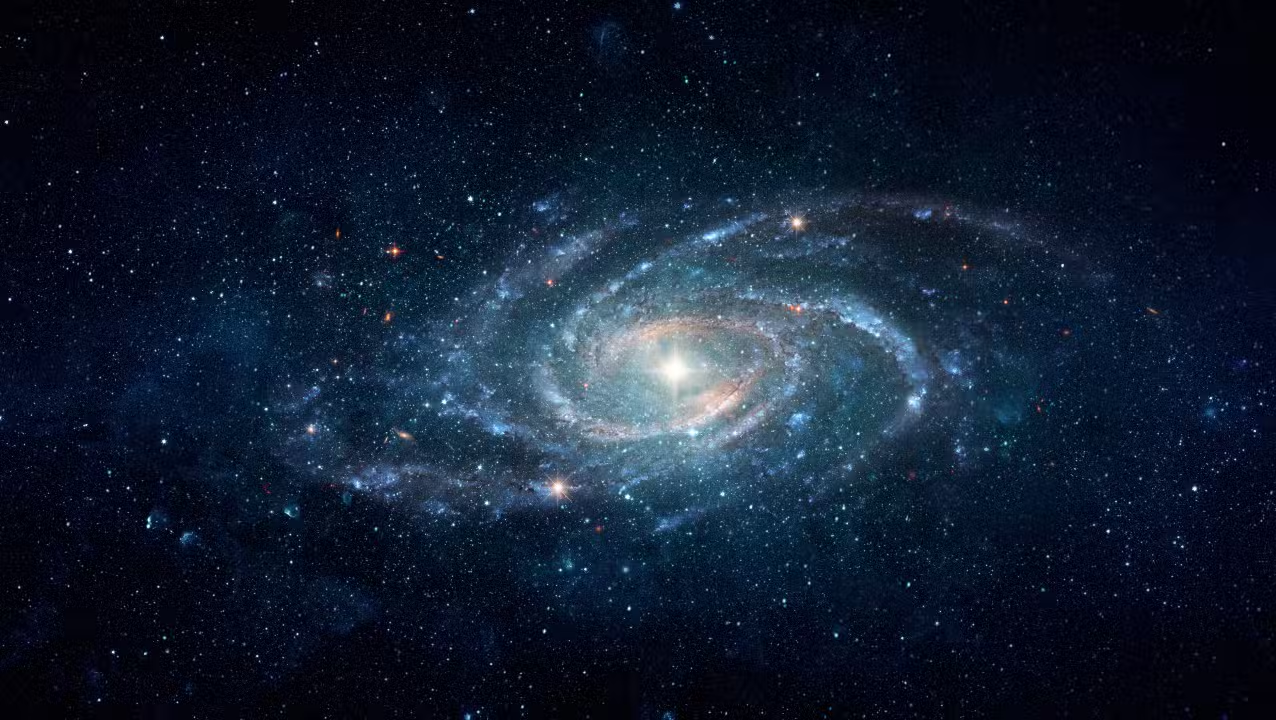
Astronomical observation goes beyond monitoring neighboring planets or the most famous constellations visible to the naked eye. Para enthusiasts who have already mastered the location of Saturno or Cinturão of Órion, the next step involves the search for deep sky objects, known by the acronym DSO. Essas structures are located outside our solar system and require technique to be captured by human vision.
Diferente of isolated stars, which appear as sharp points of light, deep-space targets have fuzzy shapes and subtle brightness. Eles are made up of vast collections of matter and energy that tell the story of the evolution of the universe. The observation challenge lies in the low luminosity of these celestial bodies, which requires the use of specific optical equipment and, mainly, the choice of locations with low light pollution.
Categorias major distant celestial bodies
Para begins exploration, it is critical to understand the three fundamental classes that make up deep sky objects. Cada category presents distinct visual characteristics and requires different magnification levels for details to begin to emerge at night. The basic classification used by amateur and professional astronomers divides these targets into:
- Galáxias: gigantic systems that house billions of stars, like Andrômeda, which can be seen from the front or in profile.
- Nebulosas: immense interstellar clouds composed of dust and gas, categorized as emission, reflection, dark or supernova remnants.
- Aglomerados stellar: groups of stars united by gravity, divided into open (young and close) or globular (old and compact).
Correctly identifying the type of object helps define which observation strategy will be most effective. Enquanto open clusters can be appreciated with simpler equipment, planetary nebulae usually require filters and greater optical power. Prior theoretical knowledge prevents frustration in the field, allowing the observer to know exactly what to expect when positioning their equipment.

Equipamentos recommended for space exploration
Embora While some larger structures can be seen unaided under ideal conditions, most deep-sky objects become visible only with magnification. Astronomy Binóculos are excellent starting points as they offer a wide field of view, making it easier to locate large targets like Nebulosa and Órion. Eles are portable and allow quick navigation through the constellations before moving on to heavier instruments.
Telescópios reflectors or refractors are necessary for those looking to observe details in more distant or smaller objects, such as the Grande Aglomerado Globular in Hércules. Atualmente, the market offers intelligent telescopes that automate the process of searching and tracking the stars using GPS coordinates. Esses devices make life easier for beginners, although learning manual navigation remains a valued skill in the astronomical community.
The choice of optics must consider the aperture of the instrument, which determines the ability to collect light. Como deep space objects are intrinsically faint, the larger the diameter of the lens or mirror, the more details the observer will be able to extract from the darkness. The use of stable tripods is non-negotiable, as any slight vibration prevents the focusing of nebulous or galactic structures.
Preparação and ideal observer conditions
Success in hunting distant stars directly depends on the quality of the available night sky. Áreas urban areas with excess artificial light make it difficult or impossible to see faint galaxies, which end up overshadowed by the brightness of cities. It is recommended that interested parties look for parks or remote rural areas, where the darkness allows the contrast of objects to stand out against the background of the space.
Patience is the most important tool in any backyard astronomer’s kit. Human eyes take around 20 to 30 minutes to fully adapt to darkness, an essential process for detecting the shades of gray and subtle shapes of nebulae. Durante During this period, the use of red light flashlights is recommended, as they do not harm the retina’s adaptation like the white light from cell phones.
Outro crucial point is the adjustment of expectations in relation to images captured by large observatories such as Hubble or James Webb. When observing directly through the eyepiece, the enthusiast will not see the vibrant colors present in long exposure photographs. Human vision in low-light environments prioritizes black and white, delivering ghostly silhouettes and delicate structures that, despite the absence of color, offer a direct and exciting connection with the cosmos.
See Also em Latest News (EN)
Apple prepares launch of iPhone 17 Air with record thickness of 5.5 millimeters and new screen
02/05/2026
Sony console system receives three definitive free games with no subscription required
02/05/2026
Apple transforms the look of the iPhone 18 Pro with translucent chassis and unprecedented 5200 mAh battery
02/05/2026
PlayStation 5 receives two free major titles on the official store to attract players
02/05/2026
Leak reveals specifications of the first foldable iPhone with high-capacity battery and ultra-thin design
02/05/2026
PlayStation 5 manufacturer releases definitive redemption of three big-budget games without requiring subscription
02/05/2026
Nintendo reveals new generation console and confirms remake of the classic Zelda Ocarina of Time
02/05/2026
PlayStation 6’s aggressive price surprises analysts and could redefine the console market
02/05/2026
King Charles’ medical treatment changes official routine and Prince William assumes leadership of the monarchy
02/05/2026
Virtual store guarantees twelve free hits permanently for computers in Brazil
02/05/2026
Adidas unveils 97-gram shoes with unprecedented carbon technology for elite marathon runners
02/05/2026