Study evaluates potential of atomic explosion to trigger fusion in object 3I/ATLAS
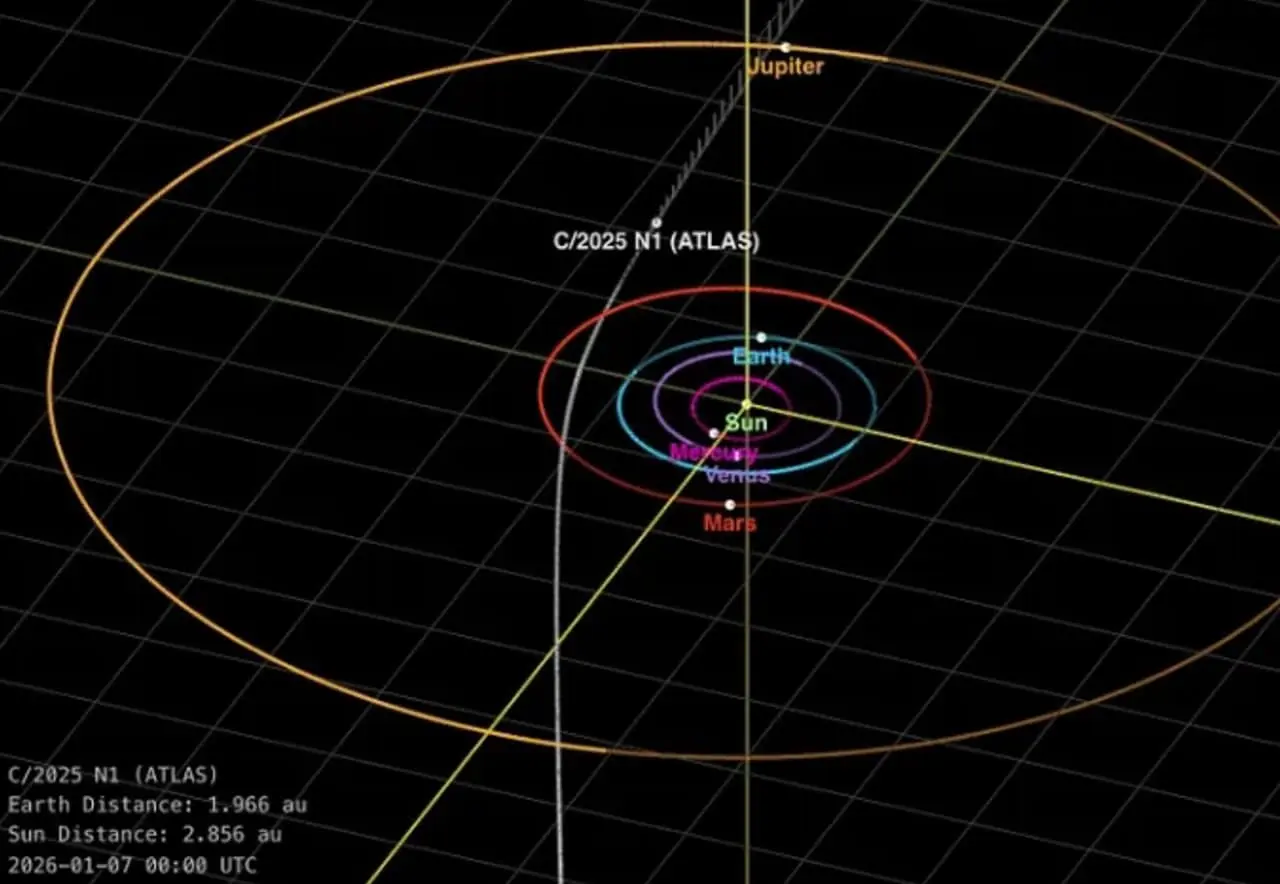
Pesquisadores are exploring the hypothesis that an atomic explosion could trigger a deuterium chain reaction in the interstellar object 3I/ATLAS, given its exceptionally high levels of the hydrogen isotope. The issue raises debates about the safety of nuclear interventions on celestial objects. Esta analysis reconsiders historical fears related to nuclear ignition.
The discovery of an unusual abundance of deuterium in 3I/ATLAS has provoked questions in the scientific community about the potential implications in extreme scenarios. The ratio of deuterium to hydrogen in the object is significantly higher than the cosmic average. Esse scenario stimulates new lines of research into the composition of interstellar visitors.
Abundância unusual deuterium in 3I/ATLAS
The interstellar object 3I/ATLAS presents a surprising anomaly in its composition. Ele has an excessively high fraction of deuterium (D), a heavy isotope of hydrogen. Relatórios indicate a ratio of one deuterium atom for every 100 hydrogen atoms in the water contained in the object. Essa rate is already considerable.
Contudo, in the organic methane molecule, the D/H fraction is even higher, reaching one deuterium for every 30 hydrogens. Esse value of 3.3% is a thousand times above the cosmic average observed elsewhere in Universo. The difference highlights the uniqueness of the 3I/ATLAS composition. Tais data was released in a preprint about a month ago, on March 20, 2026, and immediately caught the attention of astrophysicists. The observation of such a concentration in an interstellar object raises fundamental questions about its origin and formation, deviating from known patterns.
Histórico of fears about atmospheric ignition
The possibility of a nuclear explosion triggering a chain reaction is not a new concept in the history of science. Durante o Projeto Manhattan, Edward Teller, a central figure in the development of the atomic bomb, raised speculation that the heat from a nuclear explosion could ignite the atmosphere. Ele feared that nitrogen (14N) could enter into an uncontrollable fusion reaction.
In response, Hans Bethe performed detailed calculations that demonstrated the extreme improbability of such an ignition. Suas analyzes considered the radiative losses that would occur in the process. A 1946 report, co-authored by Emil Konopinski, Cloyd Marvin Jr. and Edward Teller, corroborated this conclusion. The document stated that “whatever temperature a section of the atmosphere may be heated to, no self-propagating chain of nuclear reactions is likely to be initiated.”
In 1948, Konopinski and Teller published a paper that presented the first theoretical prediction for the probability of fusion of two deuterium nuclei as bomb fuel. Essa research was a crucial driver for the development of the hydrogen bomb. Esse breakthrough involved two steps: first, ignition of a plutonium bomb created conditions of high temperature and density, which then triggered the fusion of deuterium fuel. The fear of a runaway chain reaction remained a concern throughout the nuclear weapons testing program, especially regarding the possibility that powerful underwater tests of hydrogen bombs could ignite oxygen (16O) atoms in the water. However, subsequent theoretical and experimental data have alleviated these concerns.
Cenário of planetary defense and the questioning of Loeb
The discovery of the high abundance of deuterium in 3I/ATLAS reignited an old question in astrophysicist Avi Loeb. Ele wondered if an atomic bomb, exploding inside 3I/ATLAS, could trigger a deuterium chain reaction. The idea would be to generate a “spark” that would transform the object into a gigantic atomic bomb. Esse is not a purely hypothetical question, but connects to previous planetary defense proposals.
Leia Também

Where to watch South Africa vs Canada live at the 2026 FIFA World Cup

Saudi Aramco aircraft crash results in 14 deaths near oil terminal in Saudi Arabia

Portuguese newspaper criticizes Cristiano Ronaldo’s performance in Portugal’s draw; Diogo Costa is elected highlight
Após the impact of comet Shoemaker-Levy 9 on Júpiter in 1994, Edward Teller suggested protecting Terra from similar impacts. Sua proposal involved the design of a nuclear explosive device equivalent to one gigaton of TNT, approximately the kinetic energy of an asteroid one kilometer in diameter. Loeb then pondered: if 3I/ATLAS were heading towards Terra and humanity decided to detonate the device imagined by Teller in its center to disintegrate it, would the device ignite the object’s deuterium-rich core?
The central issue lies in understanding the unexpected consequences of an intervention on objects with unusual compositions. The possibility of a secondary chain reaction adds a layer of complexity to planetary defense plans.
- Composição Atípica from 3I/ATLAS: The object has a proportion of deuterium a thousand times greater than the cosmic average.
- Proposta from Defesa Planetária: Edward Teller suggested using nuclear devices to deflect or destroy asteroids on a collision course.
- Histórico from Temores Nucleares: Preocupações with atmospheric or oceanic ignition by atomic bombs existed, but was ruled out by later calculations.
Estimativa of energy released in potential fusion
If the deuterium ignition hypothesis in 3I/ATLAS were confirmed, the energetic consequences would be of astronomical proportions. Loeb and his team calculated the minimum mass of 3I/ATLAS at 160 million metric tons. Essa estimation was detailed in a paper co-authored with Valentin Thoss and Andi Burkert.
The energy released by the fusion of the entire deuterium content of 3I/ATLAS would be estimated at 10 teratons of TNT. Para To put it into context, this amount is approximately 200,000 times greater than the largest nuclear explosion ever carried out at Terra. Tsar Bomba, detonated by União Soviética on October 30, 1961, released about 50 megatons of TNT. The energy scale is unparalleled and underscores the importance of fully understanding the composition of interstellar objects before any intervention.
Implicações for astrophysics and future research
Considerations arising from the nuclear age paved the way for the development of astrophysics, a discipline that explores how the fusion of light elements powers stars. Deuterium fusion, in particular, has sparked great interest both in the thermonuclear weapons community, led by Edward Teller, and in understanding the brightness of low-mass stars.
The study of objects like 3I/ATLAS, with their unusual chemical compositions, offers a window into astrophysical processes that are still poorly understood. Continued research into the origin and evolution of interstellar objects is crucial to expanding our knowledge of the universe. The implications of hypothetical scenarios such as the one raised by Avi Loeb, even if unlikely, reinforce the need for in-depth study and rigorous ethical consideration in future space missions.