Study reveals that ice cycles on early Earth drove the formation of the first cells
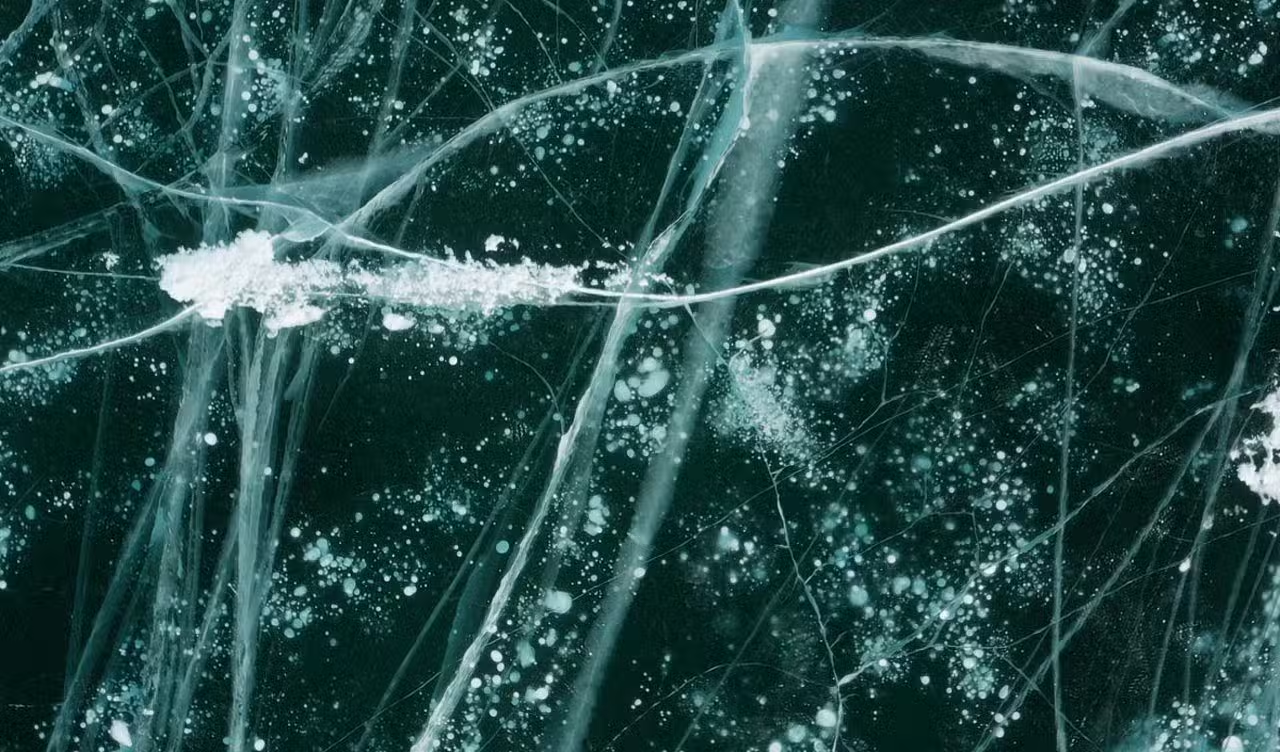
Cientistas of Instituto of Ciências of Terra and Vida, located at Tóquio, discovered that extreme temperature variations played a key role in the emergence of the first living organisms. The study points out that water freezing and thawing cycles were essential for the formation and evolution of primordial cell membranes. The research simulates environmental conditions billions of years ago to understand the behavior of basic molecules. The results show a new perspective on evolutionary biology.
The investigation demonstrates that the repeated thermal transition allowed simple molecular compartments to fuse and capture genetic material with greater efficiency. The physical process of changing the state of water forced the reorganization of lipids, creating more complex and stable structures. Essa assembly and disassembly dynamics facilitated the retention of DNA strands within the vesicles. The advance helps explain the bridge between inorganic chemistry and the first biological systems capable of reproduction.
The role of freezing in the formation of the first membranes
Early Terra presented a hostile and highly unstable environment for organic chemistry. The formation of isolated compartments was a basic requirement so that chemical reactions could occur in a controlled and continuous manner. The researchers observed that the simple presence of molecules in water was not enough to generate functional cells. The application of extreme thermal cycles changed this scenario. Intense cold changes the physical structure of water and concentrates dissolved substances in non-frozen spaces.
Durante the freezing process, the formation of ice crystals compresses the lipid vesicles into increasingly smaller spaces. Essa mechanical pressure forces the membranes to temporarily rupture and mix with other nearby structures. Quando the temperature rises and the ice melts, the membranes rebuild quickly. The repetitive cycle results in larger and more complex compartments with each new thawing phase. Physical dynamics act as a natural engine for cell growth.
Diferentes types of lipids and cell behavior
The research team used three variations of lipids to understand how different chemical compositions react to heat stress. The choice of materials sought to simulate the molecules that possibly existed in the primordial oceans. The analysis detailed the ability of each substance to form large unilamellar vesicles under conditions of varying temperatures. The behavior of each compound revealed distinct melting and structural stability characteristics.
- POPC: The lipid with a single double bond in the acyl chain formed rigid membranes that maintained the original structure without a high rate of fusion.
- PLPC: The molecule with two double bonds showed high fluidity and demonstrated the greatest growth capacity during thermal tests.
- DOPC: The compound with double bonds in both chains provided the maximum level of fluidity among all samples analyzed in the laboratory.
The results indicated that the presence of the PLPC lipid was decisive for the success of cell fusion. The high fluidity of this molecule allowed the membranes to easily reorganize after the rupture caused by ice crystals. Structural flexibility is a critical factor for the survival of any incipient biological system. Very rigid membranes failed to incorporate new materials and remained stagnant at their original size, limiting development.
The capture of genetic material inside the vesicles
The simple formation of a lipid bubble does not constitute a living cell without the presence of genetic instructions. The experiment tested the ability of these primordial vesicles to engulf and protect DNA molecules during temperature cycles. The freezing phase destabilizes the lipid barrier and creates temporary openings in the structure. The genetic material dispersed in the aqueous environment can penetrate these compartments before the membrane closes again upon thawing.


Vesicles composed of PLPC showed remarkable efficiency in retaining DNA after multiple cycles. The research quantified the encapsulated genetic material and confirmed that thermal variation acts as a natural injection mechanism. Sem this physical process, DNA molecules would have great difficulty crossing the lipid barrier spontaneously. The union between the protective compartment and the information molecule marks the beginning of biological complexity on the planet.
Successful encapsulation transforms the inert vesicle into a protocell with evolutionary potential. Protecting genetic material from environmental degradation allows molecules to replicate safely. The membrane acts as a selective filter that keeps essential components close to each other. Physical proximity accelerates internal chemical reactions and creates a microenvironment favorable to the development of basic cellular functions.
Geological Cenários of primitive Terra and biological evolution
The scientific community has debated for decades the exact places where life could have emerged. Hydrothermal vents at the bottom of the oceans have always been considered the most likely cradles due to their abundant supply of energy and minerals. The new study introduces cold environments and icy surfaces as equally viable and potentially superior scenarios for certain stages of evolution. Alternating between nighttime or seasonal freezing and daytime melting provided the mechanical energy needed for cell assembly.
The combination of simple organic molecules into complex structures requires specific conditions that prevent the immediate dispersion of the compounds. Ice acts as a solid matrix that confines substances and increases the likelihood of productive chemical encounters. The transition to life depended on the ability of these protocells to maintain their integrity while acquiring new functions. Natural selection began acting on these compartments long before the emergence of the first modern single-celled organisms.
The development of internal systems capable of dictating membrane behavior represented the final step toward Darwinian evolution. Protocells that could retain DNA and grow efficiently dominated the primitive environment. The research reinforces the idea that purely physical and mechanical processes guided prebiotic chemistry in its early stages. Understanding these dynamics expands knowledge about the fundamental requirements for the existence of carbon-based life.
See Also em Latest News (EN)

South Korean actor Park Dong Bin found dead at age 56 in Pyeongtaek office
30/04/2026
Madrid Metro restores Line 9 after a 90-minute cut due to technical failure this Thursday
30/04/2026
The Gingko Bed actor Park Dong Bin dies at age 56 before career milestone
30/04/2026
Andhra Pradesh exam pass rate hits 85.25% in 2026 with female lead
30/04/2026
AP SSC 2026: Pass rate rises to 85.25%; girls maintain superior performance
30/04/2026
Wordle 1776 answer from April 30th with repeated letter tip revealed
30/04/2026
Spotify streaming service down and with access failures for thousands of users this Monday
30/04/2026
PlayStation 5 receives Ark and new fighting game from Riot Games to expand digital catalog
30/04/2026
Sony releases system update for PlayStation 5 with improvements and two free games
30/04/2026
PlayStation 5 players receive free access to two full titles in the digital store
30/04/2026
Sony releases redemption of two free digital games for PlayStation 5 users after update
30/04/2026