
Astronomical phenomenon of the Full Flower Moon reaches peak visibility on May 1st

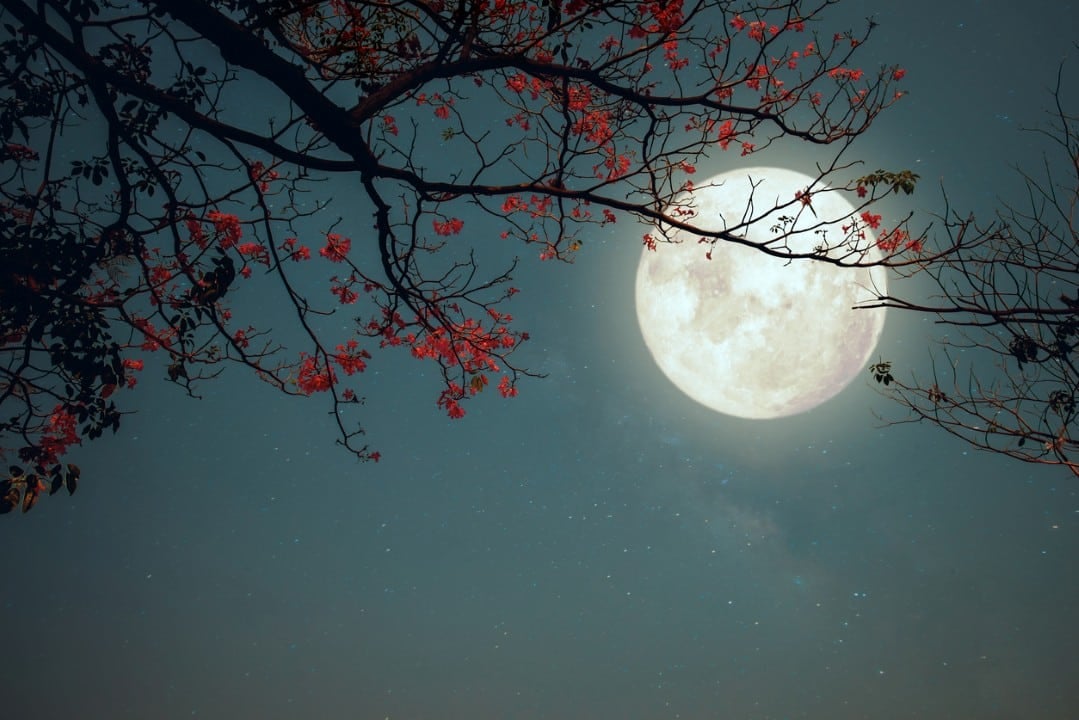
Terra’s natural satellite reaches the full lighting phase this Friday, May 1st. The astronomical event known as Lua Cheia das Flores marks the beginning of the month with peak visibility starting at dusk. Observadores located in all regions of Brasil can follow the phenomenon with the naked eye. Viewing depends only on favorable weather conditions and skies without dense clouds.
The traditional nomenclature originates from the ancient cultures of Hemisfério Norte. The term makes direct reference to the period of climate transition and the height of spring in that part of the globe. Original communities used changes in vegetation to map the passage of time. Ancestral knowledge ended up being incorporated into modern astronomical calendars adopted by research institutes around the world.
Tradições ancestors and the nomenclature of lunar cycles
Diversos Native people of América of Norte developed their own identification systems for the months of the year. The nation Comanche adopted the term Lua from Flores due to the massive bloom of local flora. Outras indigenous populations based their records on different elements of nature. The ripening of wild fruits also served as an important temporal marker for food collection.
Regional variations demonstrate the strong connection of these societies with the environment. Grupos as well as Creek and Choctaw called the event Lua from Amora. The change in landscape dictated the rhythm of daily activities. The lunar calendar served as a practical survival guide before the invention of mechanical watches.
- The Anishnaabe community uses the expression Lua of Florescimento in its historical records.
- The Apache tribes associate May with the season of green leaves.
- Algumas regions adopt the name Lua from Sapo due to increased amphibian activity.
The diversity of names reflects human adaptation to continental microclimates. Cada tribe observed the night sky and related it directly to their geographic reality. Contemporary almanacs preserve these historic designations. The practice keeps alive the memory of the first ways of counting time based on observation of space.
Recomendações techniques for observation in the national territory
Viewing the complete lunar disk requires basic planning on the part of those interested. The ideal time to start tracking is just after sunset in an easterly direction. The satellite appears on the horizon with a slightly orange color due to atmospheric refraction. The hue changes to an intense white as the star gains height in the night sky over the hours.
Moradores from large urban centers face the obstacle of light pollution. Excess artificial lights reduce the contrast between the lunar glow and the dark background of space. Regiões located away from capitals offers the best clarity conditions. The darkness of the rural environment makes it possible to identify details of the rocky surface with the naked eye.
The use of optical equipment significantly expands observation capacity. Binóculos astronomical or entry telescopes reveal craters and basalt plains formed billions of years ago. The phenomenon maintains its maximum brightness during the nights of April 30th, May 1st and 2nd. The extended window makes it easier to keep track if time closes on one of the specific dates.
Dinâmica orbital and the difference to supermoons
The early May event exhibits standard orbital characteristics. The satellite is not at its closest approach to Terra, technically known as perigee. The average distance between the two celestial bodies remains in the range of 384 thousand kilometers. The apparent size in the sky corresponds to the average observed over the previous months of the year.
The full phase guarantees a sunlight reflection rate close to one hundred percent. The geometric alignment between Sol, Terra and Lua allows full illumination of the face facing our planet. Celestial mechanics operates with continuous mathematical precision. Astronomy institutes calculate these positions decades in advance using computer models.
Supermoons only occur when the full phase coincides exactly with the orbital perigee. Nesses specific cases, the lunar disk appears up to fourteen percent larger and thirty percent brighter. The Lua Cheia of this year’s Flores does not fall into this technical category. The astronomical event maintains its relevance for researchers and night photography enthusiasts.
Astronomical Calendário records two full moons in May 2026
The month of May 2026 presents a specific mathematical configuration in the lunar cycle. The Gregorian calendar has enough days to accommodate two complete phases of the satellite. The first takes place on the 1st, while the second is scheduled for the night of May 31st. The complete cycle of lunar phases lasts approximately 29.5 days.
The occurrence of two full moons in the same calendar month is called Lua Azul. The term has no relation to the change in color of the star in the sky. Trata is a linguistic convention adopted by astronomers to mark the frequency of the event. The phenomenon repeats at average intervals of two to three years.
The year continues with other traditional nomenclatures in the following months. Junho brings Lua from Morango, associated with the fruit harvest in Hemisfério Norte. Julho presents the Lua of Cervos, the period of growth of the horns of these animals. The sequence demonstrates the human attempt to organize time through systematic observation of the universe.
Impacto history in agriculture and navigation
The marking of time by the phases of the moon shaped the development of ancient civilizations. Agricultores depended on nighttime light to extend working hours in the field during harvest times. The planting of specific seeds followed the rhythm of the lunar calendar. Soil moisture and tidal behavior are directly linked to the satellite’s gravitational attraction.
Navegadores used the star’s position to calculate safe shipping routes and predict ocean currents. Lua Cheia of Flores indicated the definitive end of winter storms on Atlântico Norte’s trade routes. Empirical knowledge accumulated over generations formed the basis of modern astronomy. Data collected in the past helps scientists understand long-term climate variations.
Today’s technology has replaced the practical need to guide crops across the night sky. Aplicativos mobile phone and spatial mapping software provide accurate real-time weather data for agribusiness. Interest in lunar phases has migrated from the field of survival to the area of scientific education. Space observation continues to mobilize astronomy clubs and educational institutions in several cities across the country.



